Category: History & Faith x Finance

True stories of historical figures whose money choices reflected Biblical stewardship

  • 6 Ways Dolly Parton Used Her Fame to Help Others

    6 Ways Dolly Parton Used Her Fame to Help Others

    A governor from one party and a governor from the other party stood on the same stage in Nashville in 2005. Dolly Parton stood between them, joked that she felt “torn between two governors,” and then got back to the actual point of the event: celebrating ten years of a program that had nothing to do with politics and everything to do with getting books into the hands of kids who needed them.

    That scene captures something Dolly understood better than most celebrities: fame is a tool, and a tool is only as good as what you build with it. Following her death on August 25, 2026, here are six verified ways she put her platform to work for people who needed it more than she did.

    1. She Scaled a Local Book Drive Into a Global Program

    The Imagination Library started small in 1995 — free books for children in Dolly’s home county, inspired by her father, who never learned to read. Because Dolly’s name carried weight, the program didn’t stay small. It expanded into the United States, Canada, the United Kingdom, Australia, and the Republic of Ireland, eventually gifting more than 270 million free books to children by 2025 — over 40 million in that year alone.

    2. She Personally Lobbied Governors to Fund It

    Dolly didn’t just start the Imagination Library and let it run — she actively used her celebrity to keep state funding behind it. In 2025, when Indiana’s governor proposed cutting the state’s funding match, Dolly and the Dollywood Foundation publicly pushed back, and the funding was preserved. She made a similar personal push in Ohio, where the governor declared an official “Dolly Parton Day” tied to the program’s growth in that state.

    3. She Gave the 100 Millionth Book to the Library of Congress

    In February 2018, Dolly personally delivered the 100 millionth Imagination Library book to the Library of Congress in Washington, D.C. It wasn’t just a nice photo — it was a deliberate use of a national spotlight to put childhood literacy on the map at the highest level of visibility available to her.

    4. She Turned Award Speeches Into Advocacy

    Dolly Parton performing joyfully on stage under warm spotlights

    When Dolly accepted the Carnegie Medal of Philanthropy in 2022 — one of the field’s highest honors — she used the moment not to talk about her career, but to talk about the Imagination Library and the simple principle behind all her giving: “I just see a need and if I can fill it, then I will.” Time and again, her acceptance speeches functioned as free advertising for causes rather than victory laps for herself.

    5. She Made Disaster Relief a Household Story

    When Dolly gave to wildfire victims in 2016 and Hurricane Helene victims in 2024, the giving itself mattered — but so did the fact that a global celebrity was doing it publicly, from her own home region. Her visibility turned regional disasters into national news, drawing additional donations and attention to East Tennessee relief efforts that a private, anonymous donor never could have generated.

    6. She Let Her Fame Point Somewhere Other Than Herself

    Perhaps the clearest evidence: when Tennessee lawmakers wanted to build her a statue, she declined, explaining that a season of division wasn’t the time to put anyone on a pedestal. “I get paid more attention than maybe some others that are doing more than me,” she once said, “[but] I hope that attention inspires more people to help others.” That’s the through-line in every item on this list — attention, spent on someone else’s behalf.

    A Platform Worth Something Beyond the Platform

    Jesus told His followers, “In the same way, let your light shine before others, that they may see your good deeds and glorify your Father in heaven” (Matthew 5:16, NIV). Dolly Parton’s fame could have stopped at entertainment. Instead, again and again, she pointed it at a need — a child without books, a family without a home, a community without a hospital — and let the light land somewhere other than herself.

    References

    • Rolling Stone Australia, “Turning Pages: Inside Dolly Parton’s Imagination Library”
    • Fox News, “Dolly Parton Urges Indiana Governor Not to Cut Funds for Her Imagination Library,” February 2025
    • Axios, “Dolly Parton Celebrates Her Imagination Library Program,” 2022
    • PBS NewsHour, “Dolly Parton’s Donation Strategy Is to Just Give From My Heart,” 2022
    • MS NOW, “Dolly Parton Was So Much More Than Her Music,” August 2026

    Scripture quotations taken from The Holy Bible, New International Version® NIV® Copyright © 1973, 1978, 1984, 2011 by Biblica, Inc.® Used by permission. All rights reserved worldwide.


    Part of Our Dolly Parton Tribute Series

    See the full Dolly Parton Tribute Series.

  • Carnegie vs. Rockefeller: How Their Rivalry Became a Race to Give It All Away

    Carnegie vs. Rockefeller: How Their Rivalry Became a Race to Give It All Away

    There’s a lot documented about the rivalry between Andrew Carnegie and John D. Rockefeller. Steel against oil. Two of the wealthiest men in American history, both accused in their own time of ruthless business tactics and monopolistic power. That part of the story has been told a thousand times.

    This isn’t that story. This is about what happened next, when the same competitive drive that built two empires turned toward giving those empires away.

    Vintage newspaper style cartoon illustration of John D Rockefeller and Andrew Carnegie facing each other, with Standard Oil derricks behind Rockefeller and steel mills behind Carnegie

    From Building Fortunes to Giving Them Away

    In 1901, Carnegie sold his steel company to J.P. Morgan for $480 million, roughly the equivalent of well over ten billion dollars today, and became, briefly, the richest man in the world. He didn’t stay that way on purpose. Over the rest of his life, Carnegie gave away more than $350 million, including some $56 million to build 2,509 public libraries around the world.

    Rockefeller, watching his rival give away a fortune, didn’t sit still. By the time he died in 1937, Rockefeller had given away more than $530 million. In 1919 alone, he made a single gift of $100 million, at the time the largest philanthropic gift in world history, split between the General Education Board and his own Rockefeller Foundation. That one gift alone equaled nearly 0.1 percent of the entire U.S. economy that year.

    Neither man was shy about the comparison. Rockefeller had openly cited Carnegie’s example as motivation for his own giving. What had once been a competition over market share in steel and oil became, in its final act, a competition over impact. And unlike almost every other rivalry in American business history, this one is remembered as a good thing, precisely because both men treated generosity as something to compete over.

    How We’re Still Feeling It Today

    This isn’t just history. The decisions these two men made with their fortunes are still shaping daily life in ways most people never connect back to them.

    Libraries

    Of Carnegie’s 2,509 libraries, around 1,679 were built in the United States, and a meaningful number are still operating as public libraries today. One of them has a story worth telling on its own.

    In 1905, an educator named Albert Meyzeek petitioned the city of Louisville, Kentucky, for a public library that African American residents could actually use, staffed by their own community, since Louisville’s library system excluded Black residents entirely at the time. The library opened that year in three rented rooms. In 1908, Carnegie’s library fund financed a permanent building at 10th and Chestnut Streets, still standing today as the Western Branch Library. Its first librarian, Thomas Fountain Blue, became the first African American in the nation to head a public library.

    Warm illustrated depiction of the historic Western Branch Library in Louisville Kentucky

    That building still serves its community more than a century later, a direct, physical result of one very wealthy man’s decision about what his fortune was for. But it almost didn’t make it that far. By 2001, the branch was facing closure, a casualty of budget cuts nearly a century after Carnegie’s money built it. That’s when Prince, the musician, made a quiet donation of $12,000 to keep it open, asking for no publicity in return. The branch survived. A library funded by one of the wealthiest men in American history was saved, decades later, by one of music’s most private acts of generosity.

    Healthcare

    Rockefeller’s giving reshaped American medicine at its foundation. His Sanitary Commission launched a campaign against hookworm disease across the American South, running public education efforts that reached more than 2 million people at over 25,000 public meetings. He funded the creation of the first schools of public health at Johns Hopkins and Harvard, and established what became Rockefeller University, one of the world’s leading centers of medical research to this day. The model of large-scale, foundation-funded medical research that Rockefeller pioneered is still how much of modern biomedical science gets funded.

    The Arts

    Carnegie’s name is still on one of the most famous concert venues in the world. Carnegie Hall, which he funded and opened in 1891 in New York City, remains one of the most prestigious performance venues on earth, still hosting concerts more than 130 years later. The Rockefeller family’s cultural footprint continued through the next generation as well, most notably in the development of Rockefeller Center and support for New York’s Museum of Modern Art, cultural landmarks that grew out of the same fortune and the same underlying instinct to put wealth toward something lasting.

    The Real Lesson in the Rivalry

    We tend to think of rivalries as something negative, two people or companies trying to tear each other down. Carnegie and Rockefeller’s story flips that. Their competition never stopped, it just changed direction, from who could out-earn the other to who could do the most good with what they’d earned. 1 Timothy 6:18 puts it simply: those who are rich in this present world are to do good, to be rich in good deeds, and to be generous and willing to share. Carnegie and Rockefeller, for all the criticism they earned building their fortunes, spent their final decades in a genuine contest to give those fortunes away. It’s one of the rare rivalries in history where everybody, including people not yet born when it started, ended up better off.

    📖 Now Available: The Full Book

    The Vanderbilts: Empire, Excess, Loss, and Redemption book cover

    If this rivalry between Gilded Age titans caught your attention, our new book traces another one of that era’s legendary families across four generations, illustrated, with practical lessons on stewardship in every chapter. Get The Vanderbilts: Empire, Excess, Loss, and Redemption as an ebook today.

    This content is for educational purposes only and is not personalized financial, legal, tax, or investment advice.

    References and Further Reading

  • 3 Incredible Stories of Generosity from Early Church History

    3 Incredible Stories of Generosity from Early Church History

    Christianity’s reputation for radical generosity didn’t start with a modern charity or a famous philanthropist. It started in the earliest decades of the church, recorded by the believers themselves and, tellingly, by outsiders who couldn’t help but notice.

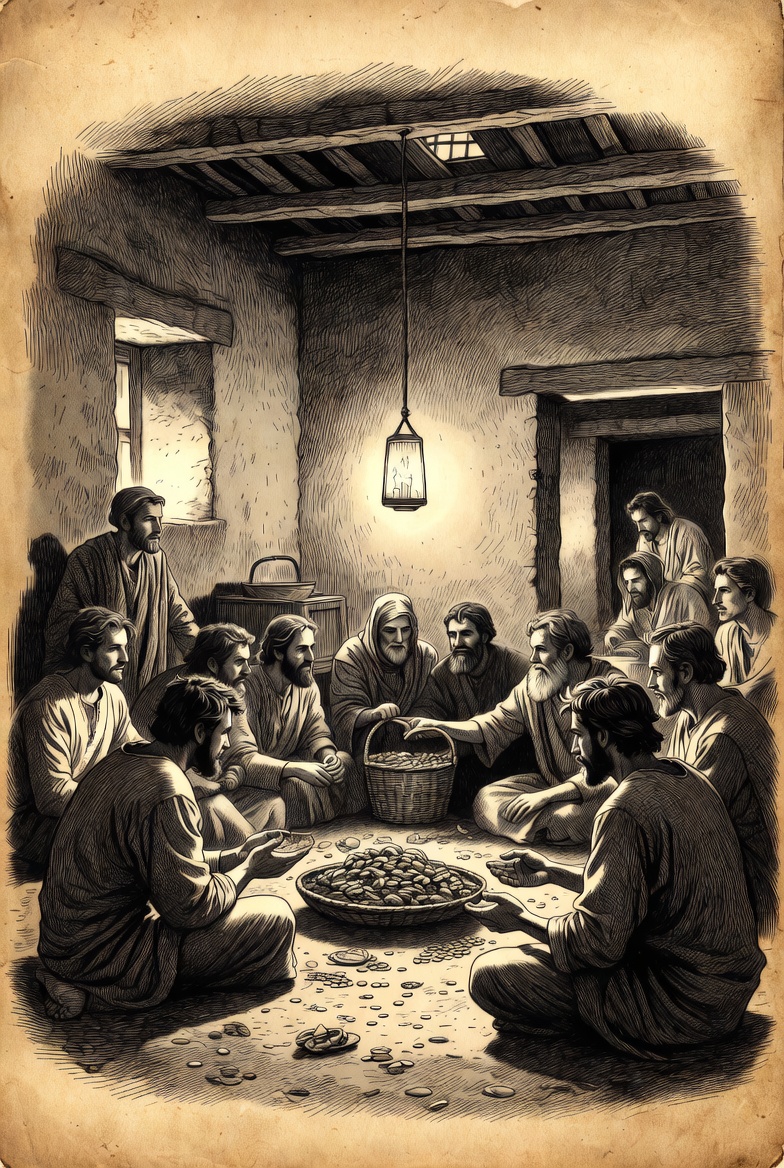
    Illustration of early believers gathered indoors in warm candlelight, sharing a meal and a common collection

    1. Barnabas Sells His Field

    Acts 4:32-37 describes the Jerusalem church in its earliest days: believers so united that no one claimed personal ownership of their possessions, and everything was shared so completely that there wasn’t a needy person among them. The passage singles out one man by name, Joseph, a Levite from Cyprus whom the apostles nicknamed Barnabas, “son of encouragement.” He sold a field he owned and laid the entire proceeds at the apostles’ feet, no strings attached, to be distributed to whoever needed it.

    What makes this remarkable isn’t just the size of the gift, it’s that Barnabas gave up a real, tangible asset, land, something most people in that era held onto as the foundation of family security, and did it voluntarily, as an act of trust rather than obligation.

    2. Justin Martyr’s Sunday Collection

    By the mid-second century, roughly a hundred years after Barnabas, the church had grown far beyond Jerusalem, and its giving had become organized without losing its heart. Justin Martyr, a Christian philosopher writing around 150-160 AD, described what happened during the weekly Sunday gathering: those who were prosperous and willing gave what they judged appropriate, and what was collected was placed with the leader of the congregation, who used it to care for orphans and widows.

    This is one of the earliest outside descriptions we have of organized Christian charity, written not as church marketing but as a straightforward explanation of Christian practice to a skeptical Roman audience. Care for the most vulnerable, the fatherless and the widowed, was baked into how the church operated from this remarkably early date.

    3. Tertullian’s Fund for the Persecuted

    Illustration representing early Christians providing aid to those imprisoned for their faith

    By around 197 AD, the church father Tertullian described a monthly voluntary collection, what he called a “treasure chest” that was never purchased at the price of a religion, meaning giving was never a fee for membership. What was gathered went to feed the poor and bury them, to support orphaned children and the elderly, and, strikingly, to care for those who had been shipwrecked or imprisoned simply for their faith. In a time when helping a prisoner of the Roman state could bring real danger to the giver, Christians were funding aid for exactly those people.

    Why This Still Matters

    None of these stories come from Christians bragging about their own generosity. Two of the three come from Christian writers explaining their faith to a watching, often hostile, outside world, and the generosity was simply part of the explanation. The pattern across all three, personal sacrifice, organized care for the vulnerable, and giving that carried real risk, set a standard the church has been measuring itself against ever since. 2 Corinthians 9:7 sums up the spirit behind all of it: God loves a cheerful giver, not one who gives reluctantly or under compulsion. The early church seems to have taken that seriously, at real cost to themselves.

    This content is for educational purposes only and is not personalized financial, legal, or tax advice.

    References and Further Reading