Tag: astor

  • John Jacob Astor and the Titanic: What Really Happened That Night

    John Jacob Astor and the Titanic: What Really Happened That Night

    John Jacob Astor IV was the wealthiest passenger aboard the RMS Titanic, part of a family that had spent four generations building one of the largest fortunes in American history. When the ship began to sink on the night of April 14, 1912, none of that money could buy him a place in a lifeboat.

    The Scandal That Sent Them to Europe

    Astor, 47, had divorced his first wife in 1909 and then married Madeleine Force, just 18 years old, in 1911. The 29-year age gap, combined with his recent divorce, scandalized New York society badly enough that the newlyweds left the country entirely, spending an extended honeymoon touring Egypt and Europe partly just to escape the gossip.

    A well-dressed older gentleman and a young woman standing together at a ship railing, Mediterranean ruins in the distance

    The Pregnancy That Brought Them Home

    While traveling, Madeleine became pregnant. Wanting their child born in the United States, the couple booked passage home, choosing the most talked-about ship afloat: the RMS Titanic, on its maiden voyage. They boarded at Cherbourg, France, on April 10, 1912, occupying one of the ship’s most opulent suites, which Astor had decorated himself in gold and pink.

    The Night the Ship Struck Ice

    When the Titanic hit an iceberg just before midnight on April 14, Astor initially wasn’t concerned. He reportedly joked that the ship’s solid decks were safer than a small lifeboat. That confidence didn’t last. By 1:45 AM, with the situation clearly serious, he woke Madeleine, told her to dress in her warmest clothes, and put all of the couple’s jewelry on her before walking her out to the deck.

    “I’ll See You in the Morning”

    Astor helped Madeleine into lifeboat 4, then asked the ship’s second officer if he might be allowed to join her, given her pregnancy. He was told no. At that point in the evacuation, only women were being permitted into the boats, regardless of a husband’s wealth or status. Astor accepted the answer immediately, without argument. He asked only which lifeboat number it was, so that he might find her again if he survived. His reported final words to Madeleine were simple:

    “The sea is calm. You’ll be alright. You’re in good hands. I’ll see you in the morning.”


    His reported final words to Madeleine

    A man in evening dress helping a woman in a fur coat down into a crowded lifeboat at night, the ship's lights blazing behind them

    Witnesses later reported seeing him searching for Madeleine’s small pet dog after her boat had already been lowered, and afterward calmly smoking in the first-class lounge as the situation worsened. He did not survive.

    What Was Found

    Astor’s body was recovered eight days later by the cable ship Mackay-Bennett, one of the relatively few Titanic victims ever found. He was identified by the initials “J.J.A.” sewn into his collar, along with a gold watch, diamond cufflinks, a three-stone diamond ring, and roughly $2,500 in cash still on him. He was buried at Trinity Church Cemetery in Manhattan.

    A folded coat and small personal effects, a pocket watch and ring, resting on a draped table aboard a ship at calm dawn

    The Son He Never Met

    Madeleine survived the sinking. Four months later, she gave birth to a son, John Jacob Astor VI, who would be known for the rest of his life as “the Titanic Baby.” He never had the chance to meet his father.

    What This Actually Teaches


    James 4:13-14 offers a warning that feels almost written for this exact story: “Now listen, you who say, ‘Today or tomorrow we will go to this or that city, spend a year there, carry on business and make money.’ Why, you do not even know what will happen tomorrow. What is your life? You are a mist that appears for a little while and then vanishes.” (NIV) Astor was, by any measure of his era, one of the most powerful and secure men alive. None of it changed the outcome that night, and none of it exempted him from the same rule every other passenger on that ship faced. What did remain fully in his control, right to the very end, was how he faced it: calmly, without demanding an exception his money couldn’t have bought him anyway, making sure his wife was safe before quietly accepting that he would not be.

    This story is part of a larger series on the Astor family and the fortune John Jacob Astor built generations earlier. This piece stands complete on its own, but if you’d like the fuller story, you can start from the beginning here.

    This content is for educational purposes only and is not personalized financial, legal, or tax advice. Scripture quotations taken from The Holy Bible, New International Version® NIV® Copyright © 1973, 1978, 1984, 2011 by Biblica, Inc.® Used by permission. All rights reserved worldwide.

    References and Further Reading


    Part of Our Astors Series

    The Titanic sailing calmly across still water under a brilliant starfield, her lights reflected perfectly in the dark sea
  • The Waldorf-Astoria: The Family Feud That Built a Hotel, and the Rule That Finally Broke

    The Waldorf-Astoria: The Family Feud That Built a Hotel, and the Rule That Finally Broke

    William Waldorf Astor had spent years feeling erased by his own aunt, Caroline, who insisted on being called simply “Mrs. Astor” as if his branch of the family didn’t exist. In 1893, he decided to answer that insult in the most expensive way imaginable.

    A Hotel Built Purely Out of Spite

    William tore down his own mansion, which sat directly beside Caroline’s, and built a massive hotel in its place, deliberately positioned to block the light into her home. He named it the Waldorf, after Walldorf, Germany, the small town the family’s founder had emigrated from generations earlier. It was a genuine, expensive act of spite, dressed up as a business venture.

    The new Waldorf hotel under construction, its scaffolding and towering facade casting a long shadow over the older mansion beside it

    The Cousin Who Answered Back

    Caroline’s son, John Jacob Astor IV, wasn’t about to let the insult stand. Four years later, in 1897, he built his own hotel directly next door, the Astoria, and made a point of building it taller than his cousin’s. For a moment, it looked like the family feud had simply produced two competing, spiteful buildings standing side by side.

    Two grand, ornate hotel facades standing side by side at dusk, one visibly taller, a narrow gap of shadow between them

    An Unlikely Peace

    Then something genuinely unexpected happened: the cousins made peace. Rather than let the two hotels stand as permanent monuments to a family grudge, they connected the two buildings with a shared corridor, still famous today as Peacock Alley, and combined them into a single operation: the Waldorf-Astoria. What began as two acts of spite became, instead, one of the most celebrated hotels in the world.

    Peacock Alley, a long marble corridor beneath crystal chandeliers, elegantly dressed guests strolling its length

    What This Actually Teaches

    Ecclesiastes 4:9-10 says, “Two are better than one, because they have a good return for their labor: if either of them falls down, one can help the other up.” (NIV) It would have been easy, and understandable, for this feud to simply calcify into permanent estrangement, two branches of one family, standing next to each other forever, refusing to speak. Instead, whatever the two men’s actual motivations, real business sense or genuine reconciliation, they chose partnership over permanent division, and built something neither of their spiteful individual hotels could have been alone.

    Tragedy, Just Fifteen Years Later

    The peace between the cousins held. But in 1912, just fifteen years after the Astoria opened, John Jacob Astor IV died aboard the Titanic, on his way home from Europe with his young, pregnant second wife. It’s a story with real, specific detail worth telling fully on its own, including what happened to his wife and the son born four months later who never met him, and we’ve done exactly that in a separate piece you can read here.

    Why the Century-Old Rule Finally Broke

    Astor IV’s son, Vincent, inherited a large share of the family fortune after the Titanic. He died suddenly in 1959, of a heart attack, with no children of his own. This mattered enormously, because the rule the founder had built generations earlier required half of every generation’s fortune to skip down to grandchildren. Vincent had none. There was nobody for the money to skip to.

    So Vincent left his fortune to his wife instead, a woman named Brooke. That one decision, forced by circumstance rather than rebellion, is what actually ended a rule that had held for well over a hundred years. Nobody broke it on purpose. The family simply ran out of the next generation the rule depended on.

    The Astor Name Today

    Brooke Astor went on to become one of the most respected philanthropists in modern New York history, giving enormously to institutions including the New York Public Library, itself a descendant of the very Astor Library the founder established generations earlier, a real, quiet full-circle moment in the family’s story. Her own later years brought a genuinely difficult chapter worth telling separately another time. Today, the Astor fortune no longer exists as a single family enterprise the way it once did. What remains is the name itself, still attached to buildings and institutions, and a hotel that recently completed a $2 billion renovation, now run by Hilton on a 100-year agreement. A fortune that outlasted the Vanderbilts by generations, but that didn’t outlast forever either.

    While the Astors and Vanderbilts spent these decades building competing social empires in New York, two other names were quietly building something else entirely, one in steel, and one in oil. Their stories are next.

    This content is for educational purposes only and is not personalized financial, legal, or tax advice.

    References and Further Reading

  • Caroline Astor and “The 400”: The Woman Who Ruled New York, and the Partner Who Betrayed Her

    Caroline Astor and “The 400”: The Woman Who Ruled New York, and the Partner Who Betrayed Her

    Caroline Schermerhorn married William Backhouse Astor Jr. in 1853, joining one of the wealthiest families in America. There was just one problem. Her husband wasn’t especially interested in the family business. While his own brother worked to grow the fortune their grandfather had built, William much preferred yachting and horse racing, leaving Caroline with a title, a fortune, and very little else to actually occupy her days.

    The Partner Nobody Expected

    So Caroline built something else instead. Her partner in it wasn’t her husband. It was a man named Ward McAllister, a Southern lawyer with a taste for high society but no real fortune of his own to speak of. McAllister became Caroline’s constant companion, escort, and behind-the-scenes strategist, and together they built something that had never quite existed in America before: a formal, ranked social order, with Caroline Astor sitting at the very top of it.

    “The 400”

    McAllister is credited with coining the phrase that made the whole system famous: “the 400,” supposedly the exact number of people in New York who actually mattered. The often-repeated explanation is that this was simply how many guests could fit in Mrs. Astor’s ballroom. The truth is a little murkier than that tidy story, McAllister may have simply thrown the number out to a reporter one day, and the ballroom explanation came together afterward as a convenient justification. Either way, the effect was the same: an entire city’s social hierarchy, formalized around one woman’s guest list.

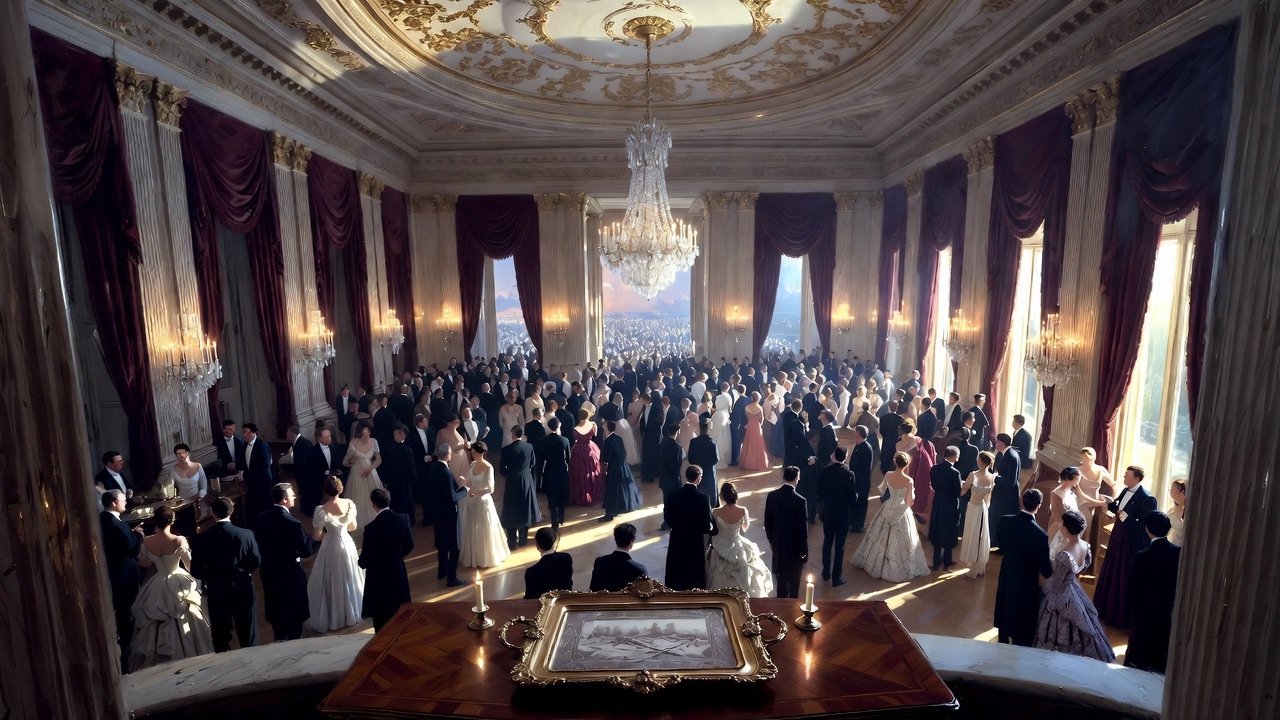
    A grand Gilded Age ballroom filled to capacity with formally dressed guests, an engraved guest list on a table in the foreground

    The Night the Vanderbilts Broke Through

    For years, Caroline refused to acknowledge the Vanderbilt family at all, dismissing them as vulgar new money despite their enormous fortune. That changed in 1883, when Alva Vanderbilt threw a costume ball so extravagant, and so widely covered in the press, that Caroline found herself facing real social pressure of her own for the first time. According to the well-documented account (readers of our Vanderbilt series may already know this story), Caroline was essentially forced to pay a formal visit to Alva just to secure an invitation to the ball for her own daughter, a quiet, symbolic admission that the Vanderbilts had finally arrived. The gatekeeper had been outmaneuvered by the very family she’d spent years locking out.

    The Betrayal

    For decades, McAllister was Caroline’s closest partner in all of this. Then, in 1890, he published a memoir called Society As I Have Found It, and made a mistake he never recovered from: he told the truth. The book laid out, in plain language, that “the 400” wasn’t some natural, meritocratic order at all. It was a list, curated deliberately by McAllister and Caroline together, with real, often petty criteria for who got in and who didn’t.

    A man in formal dress standing outside the closed gates of a grand mansion at dusk, looking back at a party he is no longer welcome to join

    High society treated the book as an unforgivable betrayal. Caroline, who had relied on McAllister for over twenty years, simply cut him off completely. He spent his final years increasingly mocked in the press, sometimes drawn in cartoons as an absurd, self-important figure. He died in 1895, cast out of the very world he’d spent his life helping build, and largely by the hand of the one person he’d built it with.

    What This Actually Teaches

    James 4:6 says plainly that “God opposes the proud but shows favor to the humble.” (NIV) It’s worth noticing what actually collapsed McAllister’s world in the end. It wasn’t a lack of cleverness, he’d built an entire social order out of nothing but ambition and charm. It was pride, on both sides. His, in believing he could reveal the game and still be welcome at the table. Hers, in a system built entirely around exclusion rather than genuine relationship. A social order built on who’s kept out rarely survives contact with the truth about how it was built.

    One more thread was already quietly forming by this point, worth watching. Caroline’s own nephew, William Waldorf Astor, harbored a real, growing resentment: his branch of the family, descended from the older brother, felt increasingly erased every time Caroline was simply referred to as “Mrs. Astor,” as if no other Mrs. Astor existed or mattered. That resentment wouldn’t stay quiet for long.

    This content is for educational purposes only and is not personalized financial, legal, or tax advice. Scripture quotations taken from The Holy Bible, New International Version® NIV® Copyright © 1973, 1978, 1984, 2011 by Biblica, Inc.® Used by permission. All rights reserved worldwide.

    References and Further Reading

  • John Jacob Astor: The Founder Who Built a Fortune That Outlasted Everyone Else’s

    John Jacob Astor: The Founder Who Built a Fortune That Outlasted Everyone Else’s

    In 1783, a young man arrived in New York with almost nothing to his name. He’d been born Johann Jakob Astor, the son of a butcher in the small German town of Walldorf, and he came to America with little more than a few flutes he hoped to sell. By the time he died sixty-five years later, John Jacob Astor was the richest man in the United States, and the rule he built into his will would go on to protect his family’s fortune longer than almost any other in American history.

    From Flutes to a Fur Empire

    Astor’s first real business wasn’t glamorous: buying furs from trappers and Native traders, then selling them at a markup. But he was relentless and shrewd, and by 1808 he’d founded the American Fur Company, aggressively building toward a genuine monopoly on the fur trade across huge stretches of the American frontier. It’s worth being honest about the less admirable part of how that fortune grew, too: starting around 1800, Astor also exported opium into China, one of several American and British merchants doing the same. China’s own government had banned opium imports since 1729, so this trade was, by China’s law, smuggling, carried out through small boats that met his ships offshore to avoid the ports. It was not, however, illegal or scandalous by the standards of Astor’s own country at the time; Western merchants conducted the trade fairly openly, and it didn’t damage a single reputation back home, including his. That doesn’t erase the real harm it caused. It just means Astor wasn’t crossing a line his own contemporaries recognized as wrong; he was participating in something the West hadn’t yet reckoned with, decades before it exploded into the Opium Wars.

    John Jacob Astor looking over land that would become New York City, from open farmland to the modern Manhattan skyline

    The Real Genius: Knowing Where a City Was Headed

    Astor’s most important decision wasn’t in furs at all. As New York City’s population began to explode in the early 1800s, he started quietly buying up undeveloped land and vacant lots on the edges of the city, land nobody else wanted yet because it wasn’t worth much yet. He was betting, correctly, that the city would keep growing north, and that the empty fields he was buying cheaply would eventually sit in the middle of some of the most valuable real estate on earth. He was right. By the time he died in 1848, his estate was worth an estimated $20 million, an almost unimaginable sum for the era, built substantially on land he’d bought decades earlier for a fraction of what it eventually became worth.

    The Rule That Protected the Fortune

    Most wealthy men of Astor’s era left their fortune to their children outright, and hoped for the best. Astor did something different. He built a rule into his will: half of what he had would go directly to his grandchildren, not his own children, and he required his children to follow the same rule with their own money when their turn came. It’s a strategy known today as a generation-skipping structure, and the idea behind it is simple but powerful: no single generation, however careless or generous, could ever spend the whole fortune, because half of it was always protected, already promised to the generation after them before they ever got the chance to touch it.

    Astor also made a second, less structural but equally deliberate choice about who within his own generation would actually be trusted with the bulk of it. His eldest son, also named John Jacob, was widely regarded by the family as unable to manage a fortune of this size. Rather than defaulting to birth order, Astor directed the majority of his estate to his second son, William, who had already spent years proving himself inside the family business. We’ll dig into exactly how that decision played out, and what William did with it, in its own dedicated piece.

    That rule held for well over a hundred years, generation after generation, longer than almost any comparable fortune of the era managed to stay intact. We’ll come back to exactly how, and why, it finally ended, much later than you might expect, and for a reason that had nothing to do with anyone breaking the rule on purpose.

    Not far away, at roughly the same time Astor was building his real estate empire, a young man was doing pretty well for himself running a small ferry boat around New York harbor. His name was Cornelius.

    What This Actually Teaches

    Jeremiah 17:11 offers a real warning worth sitting with here: “Like a partridge that hatches eggs it did not lay is the man who gains riches by unjust means; when his life is half gone, they will desert him, and in the end he will prove to be a fool.” (NIV) Astor’s story doesn’t fit that warning neatly, and that’s exactly what makes it worth thinking through honestly. Real vision and real discipline built the bulk of his fortune, buying land nobody else understood the value of yet, then protecting it with a structure smarter than almost anyone else built at the time. Part of it also came from a trade that caused real, lasting harm, even though it wasn’t considered wrong by the people around him at the time. That’s worth sitting with rather than resolving too quickly: a clean conscience in your own era doesn’t always mean a clean legacy, and wisdom by the standards of one’s own time isn’t the same as wisdom by God’s.

    The rule he left behind, though, is worth its own honest credit. Astor didn’t just build wealth. He built a structure designed to outlast his own choices, and even the choices of his children. That’s a different kind of stewardship than simply being rich, planning specifically for people who hadn’t been born yet.

    This content is for educational purposes only and is not personalized financial, legal, or tax advice. Scripture quotations taken from The Holy Bible, New International Version® NIV® Copyright © 1973, 1978, 1984, 2011 by Biblica, Inc.® Used by permission. All rights reserved worldwide.

    References and Further Reading


    Part of Our Astors Series

    Astor Series Spinoffs

    • Is HBO’s The Gilded Age Based on a True Story? Caroline Astor’s Real History — Coming Nov 5
    • How the Astors Chose Their Heir: Skipping the Firstborn for the Son Who Could Grow the Money — Coming Nov 12
    • The Rule That Finally Broke: How the Astor Trust Structure Actually Ended — Coming Nov 19
    • Peacock Alley: How a Family Feud Accidentally Invented Modern Luxury Hospitality — Coming Nov 26
    • The Scandal That Put Them on the Titanic — Coming Dec 3

    📖 Enjoy stories like this? Check out The Vanderbilts: Empire, Excess, Loss, and Redemption — available now →