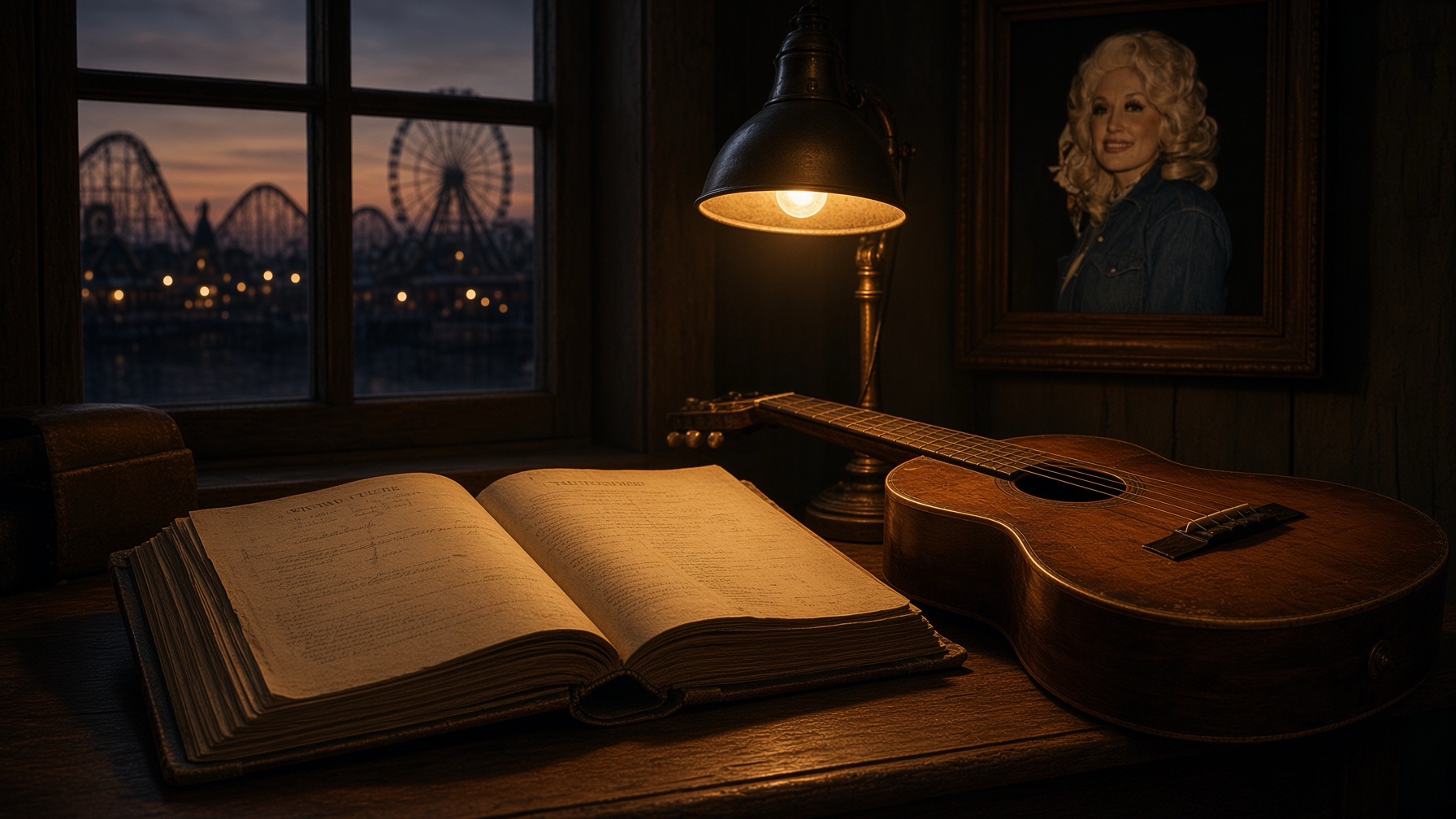
In 1986, a struggling amusement park called Silver Dollar City sat in the hills of Pigeon Forge, Tennessee. It wasn’t drawing crowds, and it wasn’t drawing money. A country singer who’d grown up nearby, in a one-room cabin with eleven siblings, decided to invest in it — not just her money, but her name. Forty years later, that decision was still generating tens of millions of dollars a year.
Dolly Parton, who died August 25, 2026 at age 80, built a fortune estimated between $450 million and $650 million — without ever chasing billionaire status, and without a Wall Street background of any kind. Here are seven reasons the woman behind “9 to 5” turned out to be one of the sharpest business minds in entertainment.
1. She Refused Elvis Presley’s People — and Kept Her Copyright
In the mid-1970s, Dolly got the call every songwriter dreams of: Elvis Presley wanted to record her song “I Will Always Love You.” Everything was arranged — until the night before the session, when Presley’s manager, Colonel Tom Parker, called with a condition. Presley’s organization didn’t record songs without owning at least half the publishing rights.
Dolly said no. “This is the most important copyright in my whole publishing company, and I can’t do that,” she told Parker. The session was cancelled, and she later admitted she cried all night over turning down the King of Rock and Roll. But she walked away owning 100 percent of a song that hadn’t even become famous yet.
2. She Let That One Decision Multiply for Fifty Years
In 1992, Whitney Houston recorded “I Will Always Love You” for The Bodyguard, and the song became one of the best-selling singles in music history. Because Dolly had refused to give up any of the publishing years earlier, every bit of that windfall came back to her — estimates of her earnings from Houston’s version alone run close to $10 million, and the song has kept generating royalties ever since.
That single decision is a big part of why Dolly’s broader songwriting catalog — more than 3,000 songs — has been valued at upwards of $120 million, with her overall music royalties estimated to bring in somewhere between $6 million and $8 million a year, even decades after most of the songs were written. She didn’t just get paid once for her talent. She built a royalty machine that kept paying her for the rest of her life.
3. She Turned the Windfall Into Real Estate — “The House That Whitney Built”
What Dolly did with the Whitney Houston royalties says as much about her financial instincts as the decision to protect them in the first place. She used a portion of that money to buy a commercial office complex in a historically Black neighborhood off 16th Avenue in Nashville. “I bought a property down in what was the Black area of town, and it was mostly just Black families and people that lived around there,” she explained on Watch What Happens Live in 2021. “This is the house that Whitney built.”
It’s a striking chain of financial decisions: a song became a copyright, the copyright became royalties, and the royalties became a physical, income-producing asset in a community she chose deliberately. Song, to royalty stream, to real estate — that’s not luck. That’s a plan.

4. She Bet On Herself and Built Dollywood
In 1986, Dolly partnered with Herschend Family Entertainment and put her name and money behind the struggling Silver Dollar City park, transforming it into Dollywood. Her 50 percent stake in the park has been estimated by Forbes at roughly $165 million on its own — and that’s before counting the millions in annual revenue the park generates (estimates range from $180 million to $580 million a year) and the thousands of local jobs it supports.
This wasn’t a hands-off investment. Dolly poured her name, her reputation, and repeated personal appearances into the park for four straight decades. It’s a reminder that some of the best investments aren’t the ones you write a check for and walk away from — they’re the ones you stay close enough to actually steward.
5. She Built an Entire Ecosystem Around Her Name
Dollywood was the anchor, but Dolly never stopped there. Her business holdings grew to include the Dolly Parton’s Stampede and Pirates Voyage dinner attractions, a signature fragrance line, cookbooks and bakeware, cosmetics, a wine label, home decor, clothing, and licensing deals across dozens of categories. Rather than depending on music royalties or theme-park revenue alone, she diversified deliberately, spreading her income across businesses that had almost nothing to do with singing.
That instinct traces back further than people realize — in 1980, she negotiated a then-unheard-of $500,000 advance for her 9 to 5 and Odd Jobs album, at a time when few artists, and especially few women in country music, were pushing for that kind of deal. Diversification wasn’t a late-career pivot for Dolly. It was a pattern from the start.
6. She Reportedly Lived on $5,000 a Month — By Choice
Here’s the detail that might be the most surprising: despite a business empire estimated to bring in hundreds of thousands of dollars a month, multiple financial profiles report that Dolly kept her own personal spending remarkably modest — reportedly living on around $5,000 a month, a tiny fraction of what her businesses generated. “I never wanted to be poor again,” she once said of the frugality that carried over from her childhood in that one-room cabin.
That gap between what she made and what she spent is, in plain terms, the entire engine of wealth-building: a strong income, paired with restrained personal spending, rather than letting lifestyle expand to swallow every dollar that came in. It’s a far less flashy secret than owning Dollywood or writing hit songs — but financially, it may have mattered just as much.
7. She Gave Away a Fortune While Still Building One
Dolly Parton was never a billionaire, and by every account, she wasn’t trying to be. A significant share of what her businesses generated was redirected into philanthropy — the Imagination Library, disaster relief, medical research, and her home county’s schools and hospital — even while those same businesses kept growing. Proverbs 3:9-10 says, “Honor the Lord with your wealth, with the firstfruits of all your crops; then your barns will be filled to overflowing” (NIV). Whether or not Dolly framed her decisions in exactly those terms, the pattern of her life — own what you create, turn income into lasting assets, live below your means, and give generously from what’s built — reflects a stewardship instinct more than a purely accumulative one.
References
- American Songwriter, “The Story Behind Why Dolly Parton Refused to Let Elvis Presley Record ‘I Will Always Love You,’” 2022
- Celebrity Net Worth, “Elvis Presley Wanted to Record ‘I Will Always Love You.’ Dolly Parton Said No,” August 2026
- Yahoo Entertainment / Andy Cohen’s Watch What Happens Live, “Dolly Parton Used Royalties From Whitney Houston Song to Support a Black Neighborhood,” July 2021
- Newser / Washington Post, “Dolly Parton: ‘This Is the House That Whitney Built,’” August 2021
- Finance Monthly, “Dolly Parton’s Net Worth 2025: A Fortune Built From ‘9 to 5,’” 2026
- Networth Hub, “How Dolly Parton’s Net Worth Reached $600M,” June 2026
- Inc., “Dolly Parton Built a $650 Million Empire by Ignoring the Goal Entrepreneurs Chase,” July 2026
- Investormint, “Dolly Parton Net Worth 2026: Music, Dollywood & More,” 2026
Scripture quotations taken from The Holy Bible, New International Version® NIV® Copyright © 1973, 1978, 1984, 2011 by Biblica, Inc.® Used by permission. All rights reserved worldwide. This post is for educational and informational purposes only and does not constitute personalized financial, investment, tax, or legal advice. Please consult a licensed professional regarding your own financial situation.

