
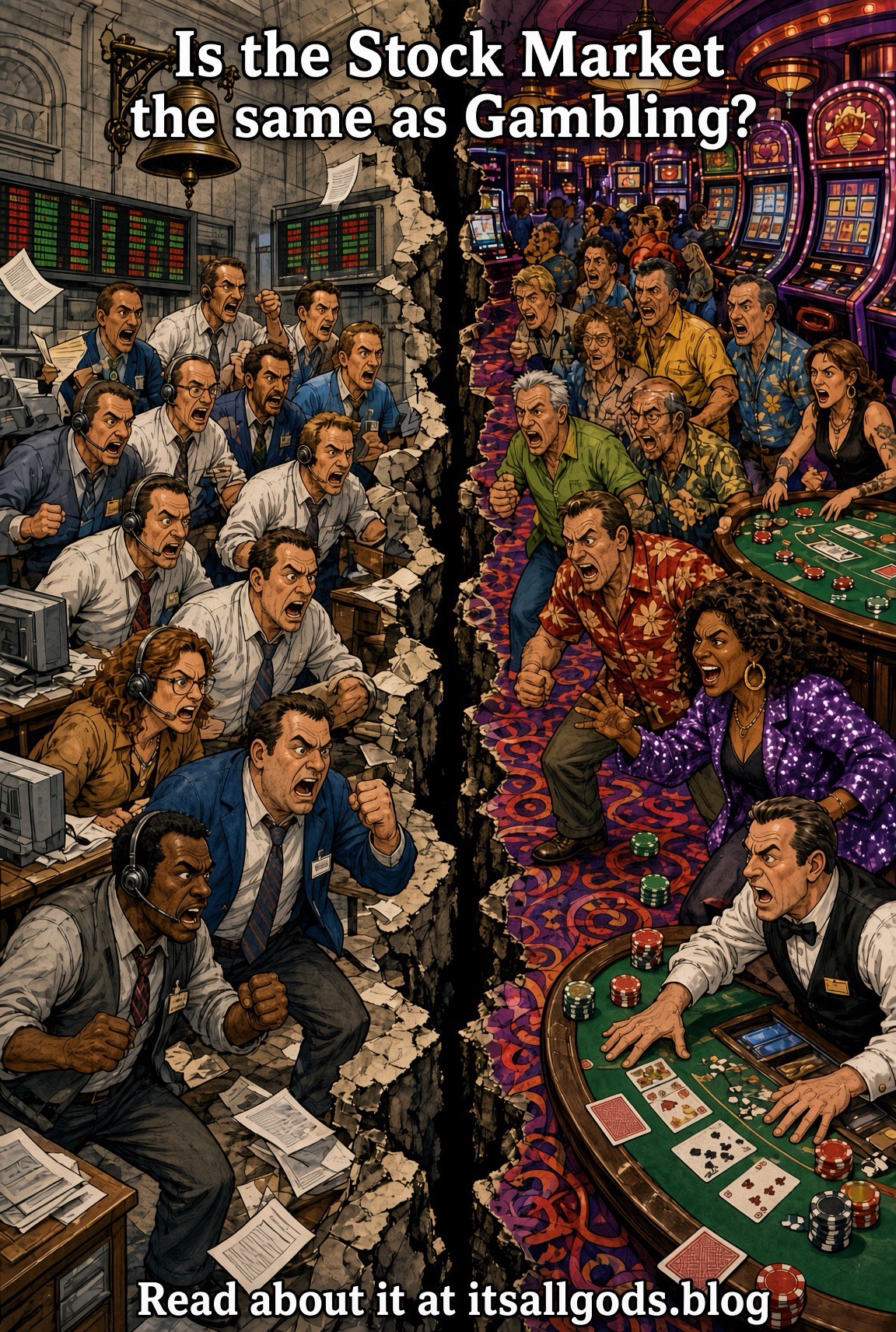
No, investing in the stock market is not gambling, and the difference isn’t just semantic. Gambling creates risk that didn’t need to exist, purely for entertainment. Investing takes on calculated risk in exchange for a share in something real: the ongoing growth of actual businesses. Understanding that difference changes how the whole question should be approached.
What Makes Gambling, Gambling
A casino game has a built-in house edge. The odds are structured so that, over enough time, the house wins and the player loses, by design. Nothing productive is being built. No value is being created. The money simply moves from one party to another based on chance.
The stock market works differently. When you buy a share of a company, you’re buying a small ownership stake in a real, functioning business, one that makes products, employs people, and, if it’s run well, grows in value over time. Historically, the S&P 500 has averaged roughly a 10% annual return since its inception. That’s not a coin flip. It’s the aggregate outcome of real companies producing real goods and services over time.
The Question Almost Nobody Asks: Is “Safe” Actually Safe?
Here’s the part of this conversation that gets skipped most often. As of August 2026, the national average savings account pays just 0.63% APY, according to Bankrate. Inflation, meanwhile, sat at roughly 3.4-3.5% as of mid-2026. That gap matters enormously: money sitting in a typical savings account isn’t neutral or risk-free, it’s quietly losing purchasing power every single year, even while the account balance itself never goes down.
Put concretely: $10,000 sitting in a national-average savings account for a year earns about $63 in interest, while inflation alone erodes roughly $340-350 worth of that money’s purchasing power over the same period. The number in the account grew. What that number can actually buy shrank. That’s a real, measurable risk, it’s just a quieter, less visible one than a stock price dropping on a screen.
A Tool, Not a Verdict
The honest answer is that the stock market is a tool, and like most tools, it can be used wisely or recklessly. Day-trading with money you can’t afford to lose, chasing hot tips, or treating individual stock picks like a lottery ticket does start to resemble gambling in practice, even though it’s technically “investing.” Broad, diversified, long-term investing, the kind most people actually mean when they talk about retirement accounts and index funds, operates on an entirely different principle: patient ownership in real productive assets, not a bet on a single unpredictable outcome.
What Scripture Actually Points Toward
Jesus told a parable about exactly this kind of stewardship in Matthew 25:14-30, the parable of the talents. A master entrusts his servants with resources before a journey. Two of them put the money to work and it grows. The third, out of fear, buries his portion in the ground to keep it perfectly safe, and he’s the one rebuked on the master’s return, not for losing money, but for refusing to put what he’d been given to productive use at all. “You wicked, lazy servant!” the master says in verse 26. “You should have put my money on deposit with the bankers, so that when I returned I would have received it back with interest.” (NIV) The parable doesn’t celebrate the safest possible choice. It celebrates faithful, productive stewardship, and treats excessive caution, not risk itself, as the actual failure.
Where This Leaves You
Investing in the stock market, done broadly and with a long time horizon, isn’t gambling. It’s participation in real economic growth, the same kind of productive stewardship the parable of the talents commends. Like any tool, it can be misused, and caution about how you invest is genuinely wise. But caution about whether to invest at all, once you understand what the alternative actually costs, deserves the same scrutiny.
This content is for educational purposes only and is not personalized financial or investment advice. Consider speaking with a licensed financial professional before making investment decisions. Scripture quotations taken from The Holy Bible, New International Version® NIV® Copyright © 1973, 1978, 1984, 2011 by Biblica, Inc.® Used by permission. All rights reserved worldwide.
Leave a Reply