Tag: biblical finance

  • 3 Incredible Stories of Generosity from Early Church History

    3 Incredible Stories of Generosity from Early Church History

    Christianity’s reputation for radical generosity didn’t start with a modern charity or a famous philanthropist. It started in the earliest decades of the church, recorded by the believers themselves and, tellingly, by outsiders who couldn’t help but notice.

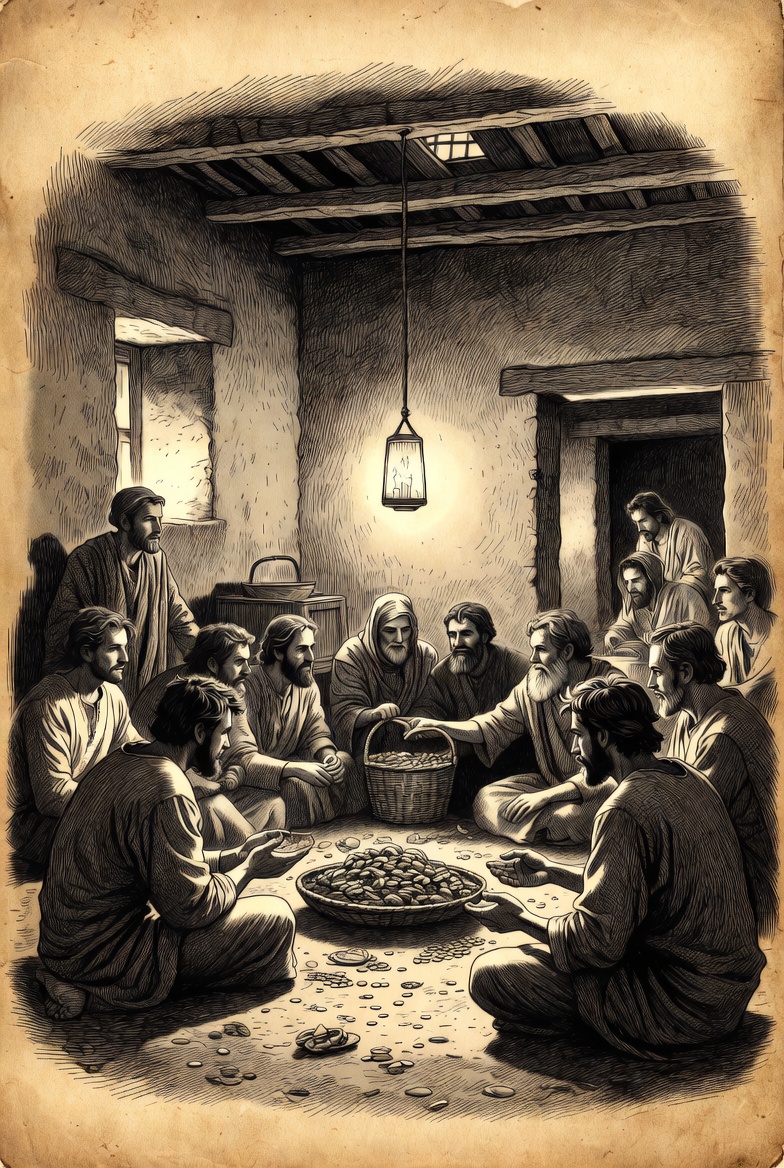
    Illustration of early believers gathered indoors in warm candlelight, sharing a meal and a common collection

    1. Barnabas Sells His Field

    Acts 4:32-37 describes the Jerusalem church in its earliest days: believers so united that no one claimed personal ownership of their possessions, and everything was shared so completely that there wasn’t a needy person among them. The passage singles out one man by name, Joseph, a Levite from Cyprus whom the apostles nicknamed Barnabas, “son of encouragement.” He sold a field he owned and laid the entire proceeds at the apostles’ feet, no strings attached, to be distributed to whoever needed it.

    What makes this remarkable isn’t just the size of the gift, it’s that Barnabas gave up a real, tangible asset, land, something most people in that era held onto as the foundation of family security, and did it voluntarily, as an act of trust rather than obligation.

    2. Justin Martyr’s Sunday Collection

    By the mid-second century, roughly a hundred years after Barnabas, the church had grown far beyond Jerusalem, and its giving had become organized without losing its heart. Justin Martyr, a Christian philosopher writing around 150-160 AD, described what happened during the weekly Sunday gathering: those who were prosperous and willing gave what they judged appropriate, and what was collected was placed with the leader of the congregation, who used it to care for orphans and widows.

    This is one of the earliest outside descriptions we have of organized Christian charity, written not as church marketing but as a straightforward explanation of Christian practice to a skeptical Roman audience. Care for the most vulnerable, the fatherless and the widowed, was baked into how the church operated from this remarkably early date.

    3. Tertullian’s Fund for the Persecuted

    Illustration representing early Christians providing aid to those imprisoned for their faith

    By around 197 AD, the church father Tertullian described a monthly voluntary collection, what he called a “treasure chest” that was never purchased at the price of a religion, meaning giving was never a fee for membership. What was gathered went to feed the poor and bury them, to support orphaned children and the elderly, and, strikingly, to care for those who had been shipwrecked or imprisoned simply for their faith. In a time when helping a prisoner of the Roman state could bring real danger to the giver, Christians were funding aid for exactly those people.

    Why This Still Matters

    None of these stories come from Christians bragging about their own generosity. Two of the three come from Christian writers explaining their faith to a watching, often hostile, outside world, and the generosity was simply part of the explanation. The pattern across all three, personal sacrifice, organized care for the vulnerable, and giving that carried real risk, set a standard the church has been measuring itself against ever since. 2 Corinthians 9:7 sums up the spirit behind all of it: God loves a cheerful giver, not one who gives reluctantly or under compulsion. The early church seems to have taken that seriously, at real cost to themselves.

    This content is for educational purposes only and is not personalized financial, legal, or tax advice.

    References and Further Reading

  • 5 Reasons You Should Consider Term Life Insurance

    5 Reasons You Should Consider Term Life Insurance

    Nobody likes thinking about their own funeral. It’s uncomfortable, it feels far off, and it’s easy to keep putting off. But here’s the thing: the discomfort of thinking about it for five minutes today is nothing compared to the very real financial strain it leaves behind for the people you love if you don’t.

    Illustration depicting the financial weight of funeral costs on a family, with bills stacked on a table

    Term life insurance is one of the simplest, most affordable tools available for protecting your family from that strain. Here’s why it’s worth a real look.

    1. Funeral and Final Expenses Add Up Fast

    The average funeral in the United States costs several thousand dollars, and that’s before medical bills, outstanding debt, or a mortgage payment that doesn’t pause just because someone passed away. Without a plan in place, those costs land directly on whoever is left behind, often at the worst possible moment, emotionally and financially.

    2. It Replaces Income Your Family Depends On

    If your income helps pay the mortgage, the groceries, the daycare bill, that income doesn’t just pause if something happens to you. Term life insurance is designed to replace a chunk of that lost income for a set number of years, giving your family breathing room instead of a financial cliff.

    3. It’s Far More Affordable Than People Assume

    This is the part that surprises most people. For a healthy adult in their 20s or 30s, a solid term life policy can cost roughly what you’d spend on a couple of cups of coffee each day. Not a couple hundred dollars a month. A couple of cups of coffee.

    Illustration comparing the cost of a few cups of coffee to the cost of term life insurance protecting a family

    That’s the trade most people don’t realize they’re already positioned to make. A small, easy-to-miss daily cost, swapped for real protection for the people who depend on you.

    4. It’s Temporary and Straightforward, Not a Lifelong Commitment

    Unlike whole life or permanent insurance, which is more complex and more expensive, term life insurance covers you for a defined period, usually 10, 20, or 30 years. You pick a term that lines up with the years your family actually needs the protection most, like while you’re paying off a mortgage or raising kids. No lifelong contract, no complicated investment component to untangle. Just straightforward coverage for the years that matter most.

    5. It’s a Concrete Way to Provide for Your Family

    1 Timothy 5:8 says that anyone who doesn’t provide for their own household has denied the faith. That’s strong language, and it’s not about guilt. It’s about the seriousness of the responsibility. Providing for the people who depend on you isn’t limited to what happens while you’re here. Term life insurance is one practical, affordable way to make sure that responsibility doesn’t end the moment you’re gone.

    Where to Go From Here

    Every family’s situation looks different, how much coverage makes sense depends on your income, your debts, and how many years you want that protection to last. The point of this article isn’t to tell you exactly what to buy. It’s to make the case that this is worth five minutes of real thought, not another year of putting it off.

    This content is for educational purposes only and is not personalized financial, legal, tax, or insurance advice. Coverage needs and costs vary by individual; consider speaking with a licensed insurance professional to find what’s right for your situation.

  • What Is an Index Fund? A Beginner’s Guide to Investing With Confidence

    What Is an Index Fund? A Beginner’s Guide to Investing With Confidence

    Imagine one jar. Inside it, instead of coins, are tiny slices of thousands of different companies, the coffee shop chain, the phone maker, the grocery store, the bank down the street. You do not own the whole coffee shop. You own a sliver of it. And a sliver of a thousand others, all in the same jar.

    That jar is basically what an index fund is.

    Illustration of a jar labeled Index Fund filling with icons of many small companies, captioned One Basket Many Companies

    What an Index Fund Actually Is

    An index fund is a type of investment that pools your money together with thousands of other investors, then spreads that money across a huge basket of companies, sometimes 500 of them, sometimes thousands. Instead of you trying to guess which one company will do well, you own a small piece of all of them at once.

    The most common one you will hear about tracks something called the S&P 500, the 500 largest publicly traded companies in America. When you buy a share of an S&P 500 index fund, you instantly own a tiny piece of all 500 of those companies. Apple, Coca-Cola, Walmart, your bank, your phone carrier, a little piece of each, all at once, all in one purchase.

    Why That Matters More Than It Sounds

    Picture a man standing in the middle of a city, and every building around him, the bank, the grocery store, the office towers, is his. Not because he built each one himself, but because he owns a small piece of every business inside them.

    Comic book style illustration of a confident man standing before a glowing city skyline, representing owning pieces of many companies through an index fund

    That is the picture worth holding onto. Most people who try to pick just one or two individual companies to invest in are making a bet, a guess about which business will win. Most guesses are wrong more often than they are right, even for professionals who do this for a living. An index fund sidesteps the guessing game entirely. You are not betting on one company. You are betting on the whole economy moving forward over time, which, historically, it has.

    Why So Many Beginners Start Here

    • Instant diversification. One purchase, hundreds or thousands of companies. If one business struggles, it barely moves the needle on your whole investment.
    • Low cost. Because nobody is actively picking and choosing stocks, index funds typically charge much lower fees than funds run by a manager trying to beat the market.
    • A strong long-term track record. Over long stretches of time, decades, not months, broad index funds have historically grown steadily, even with plenty of bumps along the way.
    • Simplicity. You do not need to read quarterly earnings reports or watch the news every day. You buy, and you leave it alone.

    What Index Funds Are Not

    They are not a get-rich-quick scheme. Nobody doubles their money in a month with an index fund, and anyone promising that is not talking about index funds. They also still go up and down, sometimes sharply, especially in the short term. The value is not in avoiding risk altogether, it is in spreading that risk across so many companies that no single failure sinks you, and in giving your money time to grow rather than trying to time the market perfectly.

    A Word on Patience

    There is something worth noticing here that goes beyond the mechanics. Scripture does not glamorize the person chasing a windfall. Proverbs 13:11 puts it plainly: wealth gained hastily will dwindle, but whoever gathers little by little will increase it. An index fund is, in a sense, the financial embodiment of that verse. Slow. Steady. Unremarkable in any given week. And that is exactly the point.

    Getting Started

    Most people buy index funds through a retirement account, like a 401(k) through work, or an IRA you open yourself, or a regular brokerage account. You do not need thousands of dollars to start, many brokerages let you begin with whatever you can set aside, even a small amount each month. The goal is not to get in perfectly. It is to get in, and stay in, for a long time.

    The Investing Fundamentals Series

    This content is for educational purposes only and is not personalized financial, legal, tax, or investment advice. Consider talking with a licensed financial professional before making investment decisions.

  • Welcome to It’s All God’s

    Every dollar you’ve ever earned passed through your hands — but it never actually belonged to you.

    That’s not a guilt trip. It’s the whole point of this blog.

    It’s All God’s exists to help everyday Christians manage money faithfully — not through prosperity-gospel promises or Wall Street jargon, but through Scripture, history, and plain honesty about what stewardship actually looks like.

    What you’ll find here

    • History & Faith x Finance — true stories of historical figures whose money choices reflected Biblical stewardship
    • Financial History — money, markets, and economic history explained simply
    • Tithing — foundational teaching on what tithing is, and the honest debates around it
    • Generosity — extreme and everyday generosity stories, Biblical giving principles
    • Money Management — budgeting, debt, saving, investing, and everyday financial discipline

    No shame if you’re starting from zero. No assumption that wealth equals faithfulness. Just a clear-eyed look at handling what was never really ours to begin with.

    Glad you’re here.

    This content is for educational purposes only and isn’t personalized financial, legal, tax, or investment advice.