
Tag: ethics

  • Biblically Responsible Investing: Should Christians Avoid “Sin Stocks”?

    Biblically Responsible Investing: Should Christians Avoid “Sin Stocks”?

    There’s no direct command in Scripture about which specific companies a Christian can or can’t hold shares in, and this is a genuine area where thoughtful believers disagree. Biblically Responsible Investing (BRI) is the term for intentionally screening investments to avoid companies profiting from industries like alcohol, tobacco, gambling, or pornography. It’s a more specific question than the broader one we’ve already covered: is investing in the stock market itself gambling?

    The Case for Screening These Investments Out

    Some Christians reason that owning stock, even a small fraction of a share, makes you a genuine part-owner of that company’s profits, and by extension, its business. If a company profits specifically from something Scripture treats as harmful, some believers feel investing in it, however indirectly, quietly puts you in partnership with that harm.

    The Case for Not Worrying About It

    Others point out that broad index funds, the kind most people actually invest in for retirement, inevitably include hundreds of companies across every industry, and meticulously screening each one is impractical for most ordinary investors. This view holds that owning a tiny fractional share in a diversified fund is different in kind from actively working for or promoting a harmful industry, and that the more important question is how you personally earn and spend money, not which index a retirement account happens to include.

    A Real, Practical Option

    For those who do want to screen their investments, BRI-specific funds now exist that explicitly exclude these industries while still offering broad diversification, giving believers who feel strongly about this a real, practical middle path rather than a choice between full screening effort and no consideration at all.

    What Actually Matters

    Romans 14 addresses exactly this kind of disputable matter directly: “Whoever regards one day as special does so to the Lord… So then, each of us will give an account of ourselves to God. Therefore let us stop passing judgment on one another.” (NIV, adapted context) Investment screening is precisely the kind of conviction Scripture treats as a matter of personal conscience, not universal command. What matters most is investing thoughtfully and prayerfully according to your own conviction, without assuming everyone who invests differently is being less faithful.

    This content is for educational purposes only and is not personalized financial or investment advice. Consider speaking with a licensed financial professional before making investment decisions. Scripture quotations taken from The Holy Bible, New International Version® NIV® Copyright © 1973, 1978, 1984, 2011 by Biblica, Inc.® Used by permission. All rights reserved worldwide.


    References and Further Reading

  • Is It a Sin to Gamble? A Biblical Look

    Is It a Sin to Gamble? A Biblical Look

    Gambling isn’t named directly anywhere in Scripture, since the modern casino and lottery industry didn’t exist in the ancient world. But several principles Scripture does address speak directly to what gambling actually involves, and most point in a cautionary direction. This is worth reading alongside a related question we’ve tackled separately: is investing in the stock market itself a form of gambling?

    Getting Rich Quick, Directly Addressed

    Proverbs 13:11 says, “Dishonest money dwindles away, but whoever gathers money little by little makes it grow.” (NIV) Gambling is built entirely around the opposite instinct: a large, quick, chance-based outcome rather than steady, deliberate stewardship. Proverbs 28:20 adds a further warning: “One eager to get rich will not go unpunished.” (NIV) These aren’t verses about gambling by name, but they describe precisely the mindset gambling is designed to activate.

    The Math Behind It

    Every form of gambling, by design, has a built-in house edge, meaning the system is structured so that, over time, the house wins and the player loses. This is a meaningful distinction from investing, where risk is taken in exchange for a share in real, productive economic activity. Gambling creates no value, it simply moves money from many losers to a few winners, with the house guaranteed a cut regardless of outcome.

    A Real Tax on the Poor

    Here’s where the honest math gets genuinely hard to look at. State lotteries specifically have earned a real, well-documented nickname: “a tax on the poor.” It’s not a rhetorical exaggeration. An Economist analysis of public lottery records found that adults in the poorest 1% of U.S. zip codes spend an average of nearly 5% of their income, roughly $600 a year, on lottery tickets alone. Adults in the wealthiest 1% of zip codes spend just 0.15% of their income, about $150 a year, on the same tickets. That’s a 33-times difference in the share of income spent on the exact same product. A separate Bankrate study found a similar pattern: the lowest-income households spend an average of $412 a year on lottery tickets, nearly four times the $105 spent by the highest earners, despite the highest earners making more than eight times as much money.

    Research published by the National Bureau of Economic Research adds a further, sobering detail: lottery spending doesn’t come from disposable income sitting on the side. It measurably crowds out other household spending, with the reduction proportionally larger among low-income households specifically, meaning the money is coming directly out of budgets that had less room to give in the first place.

    What That Same Money Could Have Become

    Take that $600-a-year figure and run it the other direction. If, instead of lottery tickets, that same $600 a year had gone into a simple S&P 500 index fund earning the market’s long-term historical average of roughly 10% annually:

    10 Years20 Years30 Years
    Total contributed$6,000$12,000$18,000
    Value if invested instead$9,562$34,365$98,696

    That same modest, ordinary amount of money, the kind that can genuinely feel insignificant one ticket at a time, becomes nearly $100,000 over 30 years simply by changing where it goes. Even using the more conservative Bankrate figure of $412 a year, the same 30-year period turns roughly $12,360 in contributions into approximately $67,772. Neither of these numbers requires a windfall, a lucky number, or a jackpot. They require nothing more than consistency and time, the two things a lottery ticket is specifically designed to make feel unnecessary.

    Stewardship, Not Just Legality

    Something being legal has never been the same question as something being wise stewardship. 1 Corinthians 10:23 offers a useful lens: “‘I have the right to do anything,’ you say, but not everything is beneficial.” (NIV) Whether or not gambling is a sin in every individual instance, the honest math and the underlying heart posture it tends to encourage, chasing a windfall rather than diligent, faithful stewardship, are both worth taking seriously. The numbers above make that math concrete rather than abstract, especially for households with the least room to absorb the loss.

    Where This Leaves You

    Scripture doesn’t hand down a verse-by-verse verdict on gambling specifically. But the principles it does offer, patient stewardship over quick riches, honest value creation over house-edge extraction, and wisdom over mere legality, point in a clear, cautionary direction. The real-world data on who actually funds state lotteries, and what that same money could have become instead, only sharpens that direction further.

    This content is for educational purposes only and is not personalized financial advice. Past market performance does not guarantee future results. If gambling has become a struggle you can’t control on your own, the National Problem Gambling Helpline (1-800-522-4700) offers free, confidential support. Scripture quotations taken from The Holy Bible, New International Version® NIV® Copyright © 1973, 1978, 1984, 2011 by Biblica, Inc.® Used by permission. All rights reserved worldwide.
    References and Further Reading

  • Is It Biblical to Negotiate Medical Debt or Settle for Less Than You Owe?

    Is It Biblical to Negotiate Medical Debt or Settle for Less Than You Owe?

    Negotiating a medical bill down, or settling it for less than the original amount, is not the same as refusing to pay a debt. Scripture takes honoring debt seriously, but it also has real precedent for structured relief when a debt becomes genuinely unbearable. This is exactly the kind of unexpected expense an emergency fund is meant to absorb, though many people are facing this reality without one already in place.

    A Real, Growing Problem

    According to Kaiser Family Foundation (KFF) national surveys, about 41% of U.S. adults currently carry some form of medical or dental debt, whether it’s on a credit card, in a payment plan, owed directly to family, or headed to collections. It’s a uniquely difficult category of debt: it’s rarely voluntary, it’s often incurred during a genuine emergency, and the initial billed amount frequently has little relationship to what insurers or the hospital itself would actually accept. Hospitals routinely negotiate their own rates with insurance companies, which means the sticker price handed to an uninsured or underinsured patient is often not a fixed, non-negotiable number at all.

    The Biblical Precedent for Debt Relief

    Scripture doesn’t treat debt relief as a foreign concept. Deuteronomy 15:1-2 establishes the Sabbatical year: “At the end of every seven years you must cancel debts… every creditor shall cancel any loan they have made to a fellow Israelite.” (NIV) This wasn’t a suggestion for the exceptionally generous, it was a structured, expected part of how the community managed debt. God built a rhythm of relief directly into the economic life of his people, not as an exception to good stewardship, but as part of it.

    Negotiating in Good Faith vs. Avoiding a Debt

    There’s a meaningful difference between the two postures worth being honest about. Negotiating in good faith means being transparent about your actual financial situation, communicating directly rather than going silent, and following through on whatever payment plan or settlement is agreed to. Avoiding a debt means ignoring it, hoping it disappears, or being dishonest about your ability to pay. The first is a reasonable, even wise, response to a genuinely difficult situation. The second is the kind of behavior Scripture consistently warns against.

    Mercy Runs Both Directions

    It’s worth noting that hospitals and billing departments are not automatically the villain in this picture either. Many have real financial assistance programs, charity care policies required of nonprofit hospitals, and structured negotiation processes built specifically for situations like this, and using them isn’t manipulation, it’s using the system as it was actually designed to work. Recent regulatory changes have also removed many smaller medical collection accounts from credit reports entirely, a meaningful, if partial, acknowledgment that this category of debt deserves different treatment than ordinary consumer debt. Mercy in this scenario isn’t just something the debtor hopes to receive. It’s often something already built into the system, waiting for someone to simply ask.

    Where This Leaves Us

    If you’re facing medical debt that feels impossible, negotiating it honestly, requesting an itemized bill, asking about financial assistance programs, or proposing a realistic payment plan, is not a failure of faith or integrity. It’s stewardship under real, often unchosen, financial pressure. The dishonoring path isn’t asking for help. It’s silence, avoidance, or dishonesty about what you can actually pay. Bringing the difficulty into the light, rather than hiding from it, is itself an act of the same integrity Scripture asks of every debt, however it eventually gets resolved.

    This content is for educational purposes only and is not personalized financial, legal, or medical billing advice. Consider speaking with a hospital financial counselor or a nonprofit credit counseling service about your specific situation. Scripture quotations taken from The Holy Bible, New International Version® NIV® Copyright © 1973, 1978, 1984, 2011 by Biblica, Inc.® Used by permission. All rights reserved worldwide.

    References and Further Reading

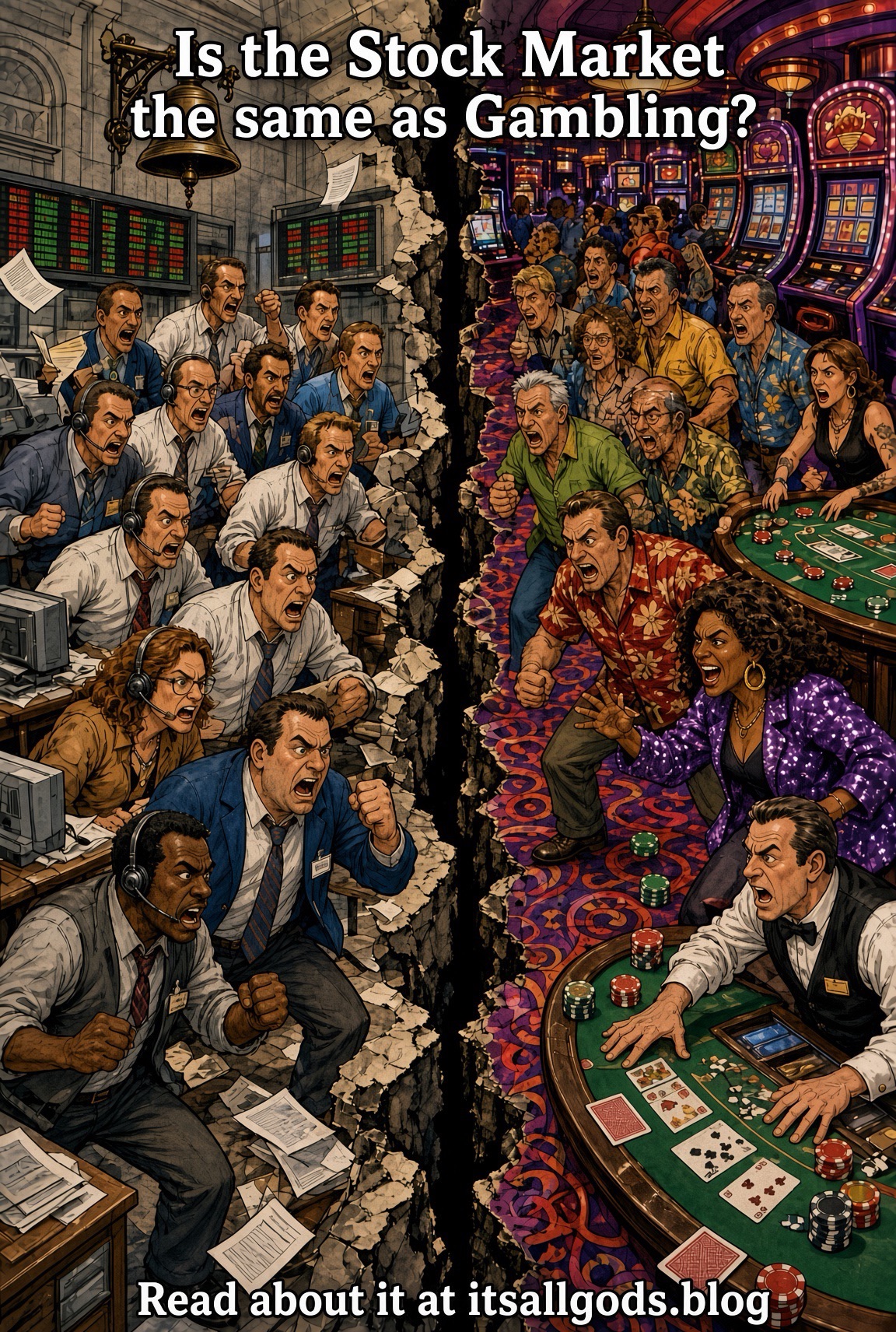
  • Is Investing in the Stock Market Gambling? A Biblical Look

    Is Investing in the Stock Market Gambling? A Biblical Look

    No, investing in the stock market is not gambling, and the difference isn’t just semantic. Gambling creates risk that didn’t need to exist, purely for entertainment. Investing takes on calculated risk in exchange for a share in something real: the ongoing growth of actual businesses. Understanding that difference changes how the whole question should be approached.

    What Makes Gambling, Gambling

    A casino game has a built-in house edge. The odds are structured so that, over enough time, the house wins and the player loses, by design. Nothing productive is being built. No value is being created. The money simply moves from one party to another based on chance.

    The stock market works differently. When you buy a share of a company, you’re buying a small ownership stake in a real, functioning business, one that makes products, employs people, and, if it’s run well, grows in value over time. Historically, the S&P 500 has averaged roughly a 10% annual return since its inception. That’s not a coin flip. It’s the aggregate outcome of real companies producing real goods and services over time.

    The Question Almost Nobody Asks: Is “Safe” Actually Safe?

    Here’s the part of this conversation that gets skipped most often. As of August 2026, the national average savings account pays just 0.63% APY, according to Bankrate. Inflation, meanwhile, sat at roughly 3.4-3.5% as of mid-2026. That gap matters enormously: money sitting in a typical savings account isn’t neutral or risk-free, it’s quietly losing purchasing power every single year, even while the account balance itself never goes down.

    Put concretely: $10,000 sitting in a national-average savings account for a year earns about $63 in interest, while inflation alone erodes roughly $340-350 worth of that money’s purchasing power over the same period. The number in the account grew. What that number can actually buy shrank. That’s a real, measurable risk, it’s just a quieter, less visible one than a stock price dropping on a screen.

    A Tool, Not a Verdict

    The honest answer is that the stock market is a tool, and like most tools, it can be used wisely or recklessly. Day-trading with money you can’t afford to lose, chasing hot tips, or treating individual stock picks like a lottery ticket does start to resemble gambling in practice, even though it’s technically “investing.” Broad, diversified, long-term investing, the kind most people actually mean when they talk about retirement accounts and index funds, operates on an entirely different principle: patient ownership in real productive assets, not a bet on a single unpredictable outcome.

    What Scripture Actually Points Toward

    Jesus told a parable about exactly this kind of stewardship in Matthew 25:14-30, the parable of the talents. A master entrusts his servants with resources before a journey. Two of them put the money to work and it grows. The third, out of fear, buries his portion in the ground to keep it perfectly safe, and he’s the one rebuked on the master’s return, not for losing money, but for refusing to put what he’d been given to productive use at all. “You wicked, lazy servant!” the master says in verse 26. “You should have put my money on deposit with the bankers, so that when I returned I would have received it back with interest.” (NIV) The parable doesn’t celebrate the safest possible choice. It celebrates faithful, productive stewardship, and treats excessive caution, not risk itself, as the actual failure.

    Where This Leaves You

    Investing in the stock market, done broadly and with a long time horizon, isn’t gambling. It’s participation in real economic growth, the same kind of productive stewardship the parable of the talents commends. Like any tool, it can be misused, and caution about how you invest is genuinely wise. But caution about whether to invest at all, once you understand what the alternative actually costs, deserves the same scrutiny.

    This content is for educational purposes only and is not personalized financial or investment advice. Consider speaking with a licensed financial professional before making investment decisions. Scripture quotations taken from The Holy Bible, New International Version® NIV® Copyright © 1973, 1978, 1984, 2011 by Biblica, Inc.® Used by permission. All rights reserved worldwide.

    References and Further Reading