
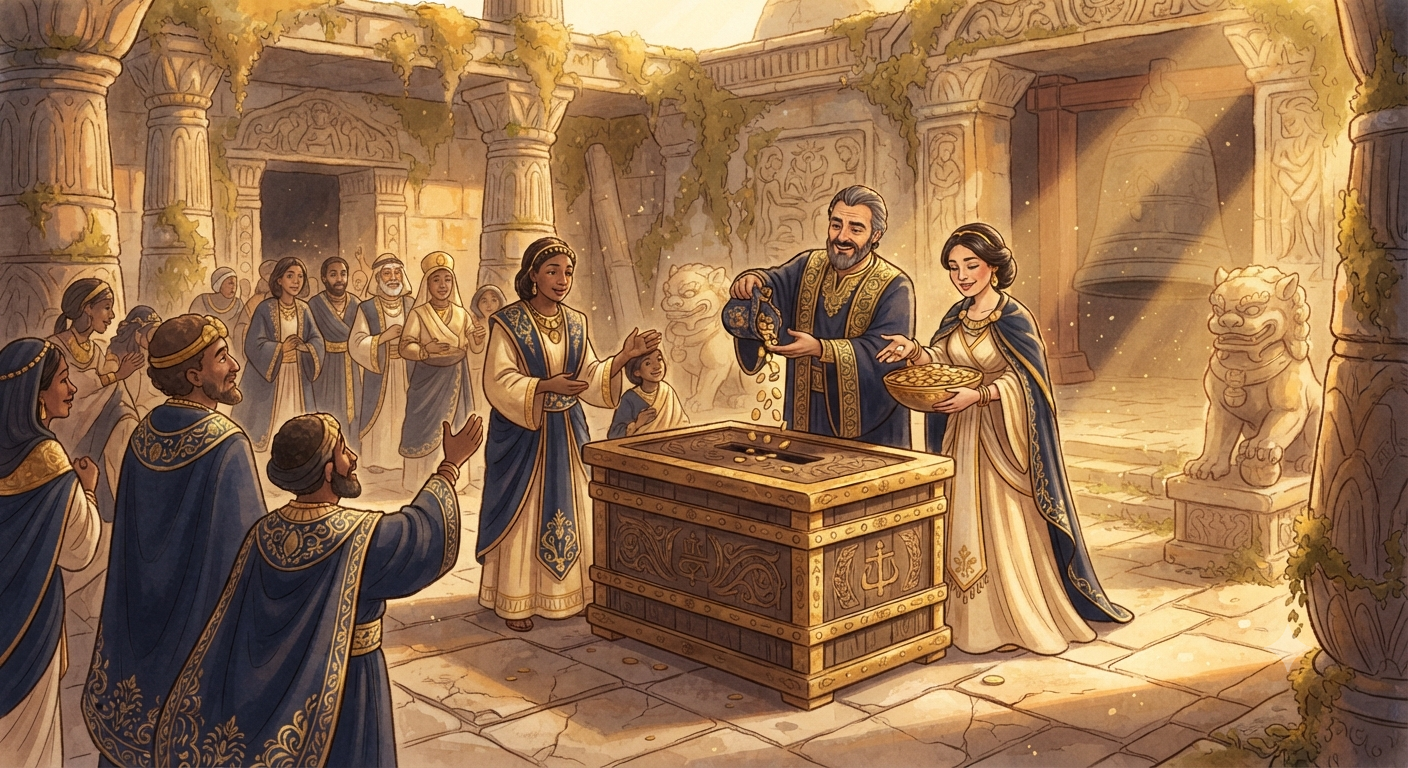
Picture the scene: a busy temple courtyard, wealthy men in fine robes stepping forward one by one to drop large sums into the temple treasury, the clink of coins loud enough to turn heads. Then a poor widow steps up, and quietly drops in two small coins worth barely a fraction of a cent combined. Jesus, watching the whole thing, tells his disciples something that would have stopped them cold: she gave more than all the rest.

The Scene, in Detail
The story appears in both Mark 12:41-44 and Luke 21:1-4. Jesus was sitting near the temple treasury, watching people put in their gifts, a public act in that era, since the treasury consisted of trumpet-shaped receptacles where coins were audibly dropped in. Many rich people, Mark tells us, put in large sums. Then one poor widow came and put in two small copper coins, worth together about a penny.
Jesus called his disciples over specifically to make a point of it. “Truly I tell you,” he said, “this poor widow has put in more than all the others. They gave out of their abundance, but she, out of her poverty, put in everything she had, all she had to live on.” (NIV)
What the Greek Reveals
Two small details from the original language add real weight to this story. The coins she gave were called lepta (λεπτά), the smallest, lowest-value coin in circulation at the time, literally meaning “thin” or “small.” It was about as low as currency got.
And the phrase “all she had to live on” translates the Greek word bios (βίος), which doesn’t simply mean money or savings. It means life itself, the same root behind our word “biology.” Mark isn’t just saying she gave her spare cash. The word choice says she gave her livelihood.
Why This Isn’t About the Amount
The math, on its face, doesn’t work in any normal accounting sense. Two small coins are not more than the large sums the wealthy donors gave, not by any measure of pure quantity. Jesus isn’t making a math argument. He’s redefining what generosity actually measures.
The wealthy donors gave out of their abundance, meaning what they gave cost them nothing they’d actually feel. Their lifestyle didn’t change. Their security wasn’t touched. The widow gave everything she had left to live on, an act that put her next meal in question. Jesus measures the gift not by its size but by what it actually cost the giver.
A Detail Easy to Miss

It’s worth noticing that Jesus doesn’t tell the widow to stop, doesn’t intervene to suggest she’s being reckless with her last money, and doesn’t hold her up as someone who made a poor financial decision. He holds her up as the standard. This sits alongside other places in the Gospels where Jesus shows real concern for the poor and vulnerable, which makes his silence here notable. He doesn’t correct her. He commends her.
That doesn’t mean this passage is a command for everyone to give away their entire livelihood. It’s describing what he saw in one specific act of worship, not laying out a universal financial strategy. But it does mean the passage can’t be softened into merely being about the size of a check.
What This Actually Asks of Us
If Jesus measures giving by cost rather than size, the practical question for anyone today isn’t how does my gift compare to what other people give. It’s did this actually require something from me. A wealthy person giving a large sum that doesn’t change their lifestyle at all isn’t automatically living out this passage just because the number looks generous. Someone giving a smaller amount that genuinely costs them something might be living it out more fully than they realize.
This isn’t a passage designed to make anyone feel guilty about their income level or their capacity to give. It’s a reframe: the size of the number was never the point God was measuring. The heart behind it was.
This content is for educational purposes only and is not personalized financial or tax advice. Scripture quotations taken from The Holy Bible, New International Version® NIV® Copyright © 1973, 1978, 1984, 2011 by Biblica, Inc.® Used by permission. All rights reserved worldwide.
Leave a Reply