
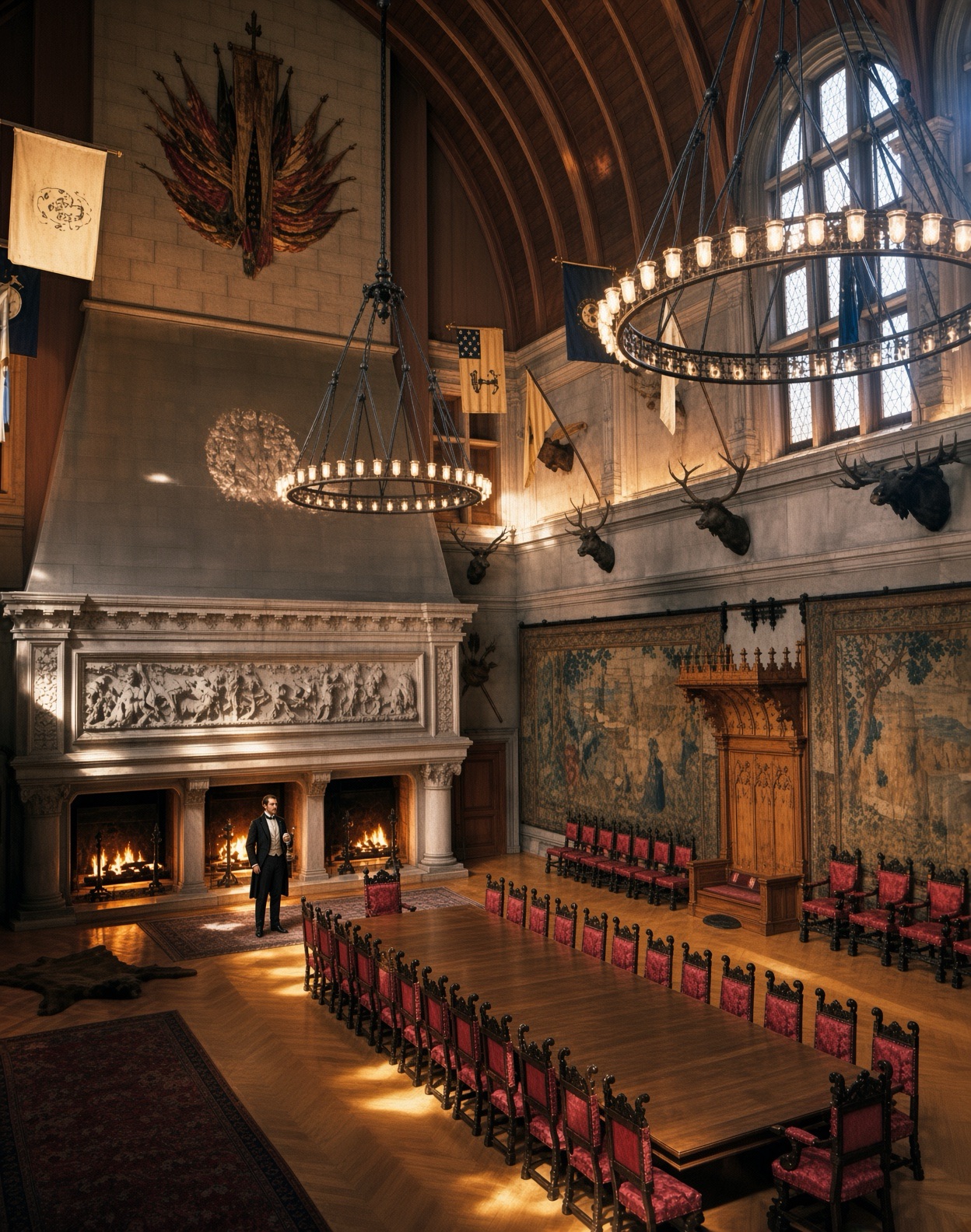
Commodore Cornelius Vanderbilt built one of the largest fortunes in American history through unglamorous, disciplined work: ferries, then railroads, decade after decade. His grandson George Washington Vanderbilt II took a very different approach with his share of that fortune. He built a house. Specifically, the largest privately owned house ever built in America, and it very nearly ruined the family that built it.
This is the fourth and final piece in our Vanderbilt series. It follows the Commodore’s rise, his son’s successful stewardship of that fortune, and how later generations ran through it, before landing here: the one branch of the family that turned near-ruin into a lasting business.
Who Owns the Biltmore Estate Today?
Short answer: The Vanderbilt family still owns it. Biltmore belongs to George Vanderbilt’s descendants through The Biltmore Company, a family-owned business controlled by the family of his grandson, William A.V. Cecil. William’s son, Bill Cecil Jr., is president and CEO. The house has been open to the public since 1930, and it is still the largest privately owned home in the United States.

An Almost Unimaginable Gamble
George Washington Vanderbilt II was the youngest son of William Henry Vanderbilt, the Commodore’s son who appeared in our earlier piece navigating the rise of a young John D. Rockefeller. Drawn to the mountain scenery around Asheville, North Carolina, George began construction on his own estate there in 1889. By the time it was completed in 1895, Biltmore House was a 250-room French Renaissance chateau spanning nearly 179,000 square feet, complete with gardens designed by Frederick Law Olmsted, the same landscape architect behind New York’s Central Park. It remains the largest privately owned house in the United States to this day.
It was also, in plain financial terms, an enormous gamble. Maintaining a house of that scale required a small army of staff and continuous upkeep, and George Vanderbilt did not have a Standard Oil or a railroad network generating fresh income behind it, just the finite fortune he’d inherited. When George died suddenly in 1914 at age 51, his widow Edith found herself managing an estate the family could no longer easily afford. She sold 87,000 acres of the surrounding land to the U.S. Forest Service, land that today forms part of Pisgah National Forest, simply to keep the core estate financially viable.
Opened to the Public, Still Not Profitable

George and Edith’s only child, Cornelia Vanderbilt, married John Francis Amherst Cecil in 1924, and the couple had two sons at Biltmore: George Henry Vanderbilt Cecil in 1925, and William Amherst Vanderbilt Cecil in 1928. In 1930, at the urging of the city of Asheville and hoping to generate desperately needed revenue during the Great Depression, the family opened Biltmore House to public tours for the first time.
It didn’t work, at least not for a long time. By 1960, the house was losing roughly $250,000 a year, a shortfall the family covered by subsidizing it with income from the estate’s dairy farm. Three decades after opening to tourists, America’s largest private home was still, financially, a losing proposition, a banquet hall built for fifty, and often, quiet as the one pictured above.
The Grandson Who Came Back
William A.V. Cecil, George Vanderbilt’s grandson, had built his own career far from Asheville, graduating Harvard in 1952 and working in finance at Chase Manhattan Bank in New York. In 1960, he left that career and returned to try to save his family’s home.
What he brought back with him was a banker’s instinct for marketing, not just nostalgia. In one notable campaign, he ran an eight-page advertisement in local newspapers and offered a free turn-of-the-century recipe from the Biltmore kitchens. It became popular enough that he started charging a quarter for it, with self-addressed envelopes flooding in. It was a small, almost quaint idea, and it was part of a broader, sustained effort to turn a crumbling mansion into something people would actually pay to experience.
It took eight years. In 1968, Biltmore recorded its first-ever profit: $16.24. Not a typo, and not a large number, but a genuine turning point after decades in the red.
From Barely Breaking Even to a Diversified Business
In the late 1970s, William and his brother George H.V. Cecil divided their inheritance along interest lines. William kept the house, gardens, and forests, the historic heart of the estate. George took the dairy farm and surrounding land, at the time the more profitable half, and built it into Biltmore Farms, a real estate development company that continues to shape the Asheville area today.
William kept building on his half. He added a vineyard and winery in 1985, expanded into restaurants, and eventually added hotel properties that now generate the bulk of the estate’s income. What began as a single, wildly expensive house had become a genuinely diversified hospitality business.
Where It Stands Today

In 1995, on the estate’s 100th anniversary, William handed control to his son, Bill Cecil Jr., who remains president and CEO today, a fourth-generation descendant of George Vanderbilt running the family business his great-grandfather nearly lost. Biltmore now draws an estimated 1.4 million visitors a year, employs more than 2,400 people, and generates roughly $50 million in annual revenue, the majority of which is reinvested directly into maintaining the property. Buncombe County tax records place the estate’s market value at approximately $374 million. Fourth and fifth generation members of the Vanderbilt family remain involved in day-to-day operations to this day.
What This Story Actually Shows
It would be easy to tell this story as a cautionary tale about extravagance, and the first half of it certainly is one. But the second half is something more interesting: real redemption, built not through a lucky break but through one family member’s decades of unglamorous, disciplined work, marketing ingenuity, and patience, the same qualities that built the original Vanderbilt fortune three generations earlier. Proverbs 24:3-4 says by wisdom a house is built, and through understanding it is established, through knowledge its rooms are filled with rare and beautiful treasures. George Vanderbilt supplied the house. It took his grandson’s wisdom, decades later, to actually establish it.
Frequently Asked Questions About the Biltmore Estate
Do the Vanderbilts still own the Biltmore?
Yes. Biltmore is still owned by George Vanderbilt’s descendants through The Biltmore Company, which is family owned and operated.
Who runs the Biltmore Estate now?
Bill Cecil Jr., George Vanderbilt’s great-grandson, is president and CEO of The Biltmore Company. He took over in 1995. His father, William A.V. Cecil, chaired the company’s board until his death in 2017 at age 89.
Who originally owned the Biltmore Estate?
George Washington Vanderbilt II, the grandson of Commodore Cornelius Vanderbilt. He built Biltmore House near Asheville, North Carolina, between 1889 and 1895.
How did the Vanderbilts make their money?
Through Cornelius “Commodore” Vanderbilt, who built his fortune in steamboats and then railroads. George inherited his share of it. Read the full story in Commodore Vanderbilt: From Ferry Boy to Railroad Titan.
When did Biltmore open to the public?
In March 1930. George’s daughter, Cornelia, and her husband, John Cecil, opened it at the request of the City of Asheville, which hoped tourism would help the area during the Great Depression.
How big is the Biltmore Estate?
The house has 250 rooms and about 179,000 square feet of floor space, including 35 bedrooms and 43 bathrooms. The estate covers about 8,000 acres today. See how the rest of the family fortune fared in How the Vanderbilt Fortune Actually Disappeared.
📖 Want the full story? Get The Vanderbilts: Empire, Excess, Loss, and Redemption — the complete ebook.
The Full Vanderbilt Series
- Commodore Vanderbilt: From Ferry Boy to Railroad Titan
- The Forgotten Vanderbilt: Did He Save the Fortune, or Destroy It?
- How the Vanderbilt Fortune Actually Disappeared
- The Biltmore Estate: How a Vanderbilt Gamble Became a Family Empire (this article)
This content is for educational purposes only and is not personalized financial, legal, or tax advice. All facts in this article are drawn from publicly available sources cited below; no claims are made beyond what those sources document.
References and Further Reading
- Biltmore: Key Figures
- Biltmore: The Vanderbilt Family
- Biltmore: Estate Timeline
- Family Business Magazine: The Biltmore Company
- Our State: How William Cecil Made Biltmore Asheville’s Biggest Tourist Attraction
- Wikipedia: George H. V. Cecil
- Wikipedia: Biltmore Estate
- Wikipedia: The Biltmore Company
- 11Alive: Owner of Biltmore Estate Dies at the Age of 89
Leave a Reply