Tag: history

  • The Waldorf-Astoria: The Family Feud That Built a Hotel, and the Rule That Finally Broke

    The Waldorf-Astoria: The Family Feud That Built a Hotel, and the Rule That Finally Broke

    William Waldorf Astor had spent years feeling erased by his own aunt, Caroline, who insisted on being called simply “Mrs. Astor” as if his branch of the family didn’t exist. In 1893, he decided to answer that insult in the most expensive way imaginable.

    A Hotel Built Purely Out of Spite

    William tore down his own mansion, which sat directly beside Caroline’s, and built a massive hotel in its place, deliberately positioned to block the light into her home. He named it the Waldorf, after Walldorf, Germany, the small town the family’s founder had emigrated from generations earlier. It was a genuine, expensive act of spite, dressed up as a business venture.

    The new Waldorf hotel under construction, its scaffolding and towering facade casting a long shadow over the older mansion beside it

    The Cousin Who Answered Back

    Caroline’s son, John Jacob Astor IV, wasn’t about to let the insult stand. Four years later, in 1897, he built his own hotel directly next door, the Astoria, and made a point of building it taller than his cousin’s. For a moment, it looked like the family feud had simply produced two competing, spiteful buildings standing side by side.

    Two grand, ornate hotel facades standing side by side at dusk, one visibly taller, a narrow gap of shadow between them

    An Unlikely Peace

    Then something genuinely unexpected happened: the cousins made peace. Rather than let the two hotels stand as permanent monuments to a family grudge, they connected the two buildings with a shared corridor, still famous today as Peacock Alley, and combined them into a single operation: the Waldorf-Astoria. What began as two acts of spite became, instead, one of the most celebrated hotels in the world.

    Peacock Alley, a long marble corridor beneath crystal chandeliers, elegantly dressed guests strolling its length

    What This Actually Teaches

    Ecclesiastes 4:9-10 says, “Two are better than one, because they have a good return for their labor: if either of them falls down, one can help the other up.” (NIV) It would have been easy, and understandable, for this feud to simply calcify into permanent estrangement, two branches of one family, standing next to each other forever, refusing to speak. Instead, whatever the two men’s actual motivations, real business sense or genuine reconciliation, they chose partnership over permanent division, and built something neither of their spiteful individual hotels could have been alone.

    Tragedy, Just Fifteen Years Later

    The peace between the cousins held. But in 1912, just fifteen years after the Astoria opened, John Jacob Astor IV died aboard the Titanic, on his way home from Europe with his young, pregnant second wife. It’s a story with real, specific detail worth telling fully on its own, including what happened to his wife and the son born four months later who never met him, and we’ve done exactly that in a separate piece you can read here.

    Why the Century-Old Rule Finally Broke

    Astor IV’s son, Vincent, inherited a large share of the family fortune after the Titanic. He died suddenly in 1959, of a heart attack, with no children of his own. This mattered enormously, because the rule the founder had built generations earlier required half of every generation’s fortune to skip down to grandchildren. Vincent had none. There was nobody for the money to skip to.

    So Vincent left his fortune to his wife instead, a woman named Brooke. That one decision, forced by circumstance rather than rebellion, is what actually ended a rule that had held for well over a hundred years. Nobody broke it on purpose. The family simply ran out of the next generation the rule depended on.

    The Astor Name Today

    Brooke Astor went on to become one of the most respected philanthropists in modern New York history, giving enormously to institutions including the New York Public Library, itself a descendant of the very Astor Library the founder established generations earlier, a real, quiet full-circle moment in the family’s story. Her own later years brought a genuinely difficult chapter worth telling separately another time. Today, the Astor fortune no longer exists as a single family enterprise the way it once did. What remains is the name itself, still attached to buildings and institutions, and a hotel that recently completed a $2 billion renovation, now run by Hilton on a 100-year agreement. A fortune that outlasted the Vanderbilts by generations, but that didn’t outlast forever either.

    While the Astors and Vanderbilts spent these decades building competing social empires in New York, two other names were quietly building something else entirely, one in steel, and one in oil. Their stories are next.

    This content is for educational purposes only and is not personalized financial, legal, or tax advice.

    References and Further Reading


    Part of Our Astors Series

    • John Jacob Astor: The Founder Who Built a Fortune That Outlasted Everyone Else’s — coming soon
    • Caroline Astor and “The 400”: The Woman Who Ruled New York, and the Partner Who Betrayed Her — coming soon
    • The Waldorf-Astoria: The Family Feud That Built a Hotel, and the Rule That Finally Broke (this article)
    • John Jacob Astor and the Titanic: What Really Happened That Night — coming soon
  • Caroline Astor and “The 400”: The Woman Who Ruled New York, and the Partner Who Betrayed Her

    Caroline Astor and “The 400”: The Woman Who Ruled New York, and the Partner Who Betrayed Her

    Caroline Schermerhorn married William Backhouse Astor Jr. in 1853, joining one of the wealthiest families in America. There was just one problem. Her husband wasn’t especially interested in the family business. While his own brother worked to grow the fortune their grandfather had built, William much preferred yachting and horse racing, leaving Caroline with a title, a fortune, and very little else to actually occupy her days.

    The Partner Nobody Expected

    So Caroline built something else instead. Her partner in it wasn’t her husband. It was a man named Ward McAllister, a Southern lawyer with a taste for high society but no real fortune of his own to speak of. McAllister became Caroline’s constant companion, escort, and behind-the-scenes strategist, and together they built something that had never quite existed in America before: a formal, ranked social order, with Caroline Astor sitting at the very top of it.

    “The 400”

    McAllister is credited with coining the phrase that made the whole system famous: “the 400,” supposedly the exact number of people in New York who actually mattered. The often-repeated explanation is that this was simply how many guests could fit in Mrs. Astor’s ballroom. The truth is a little murkier than that tidy story, McAllister may have simply thrown the number out to a reporter one day, and the ballroom explanation came together afterward as a convenient justification. Either way, the effect was the same: an entire city’s social hierarchy, formalized around one woman’s guest list.

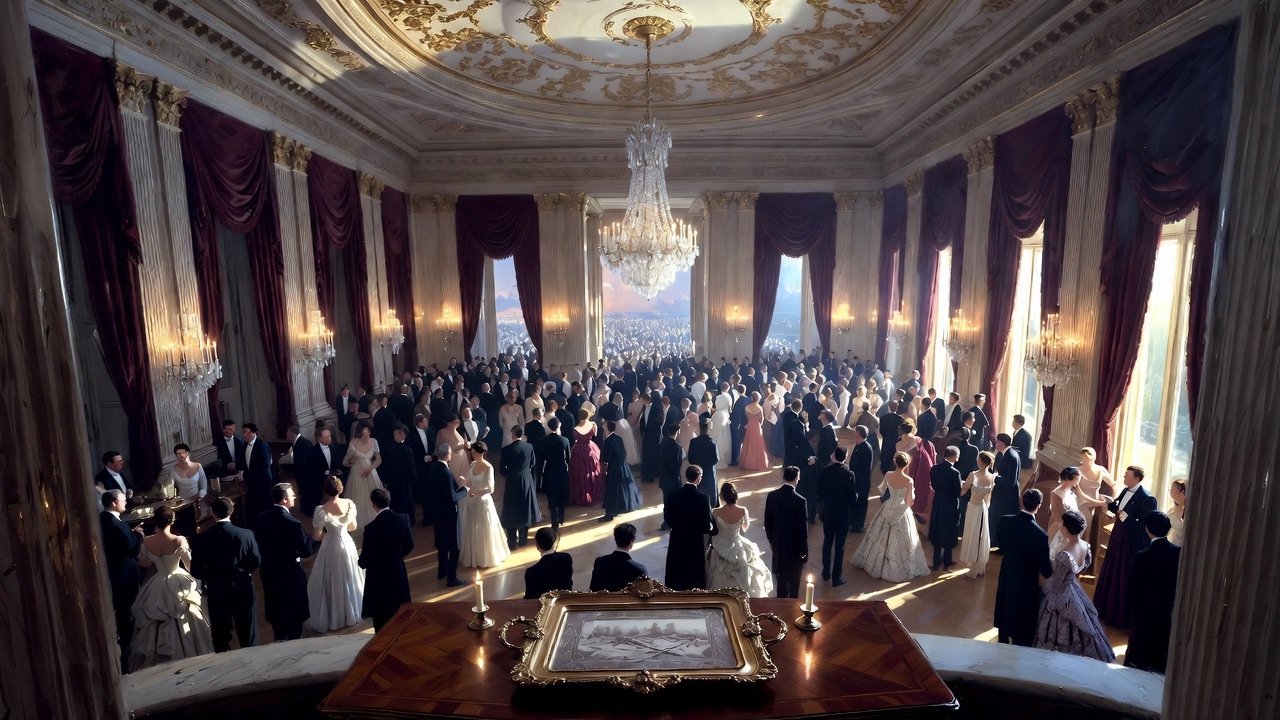
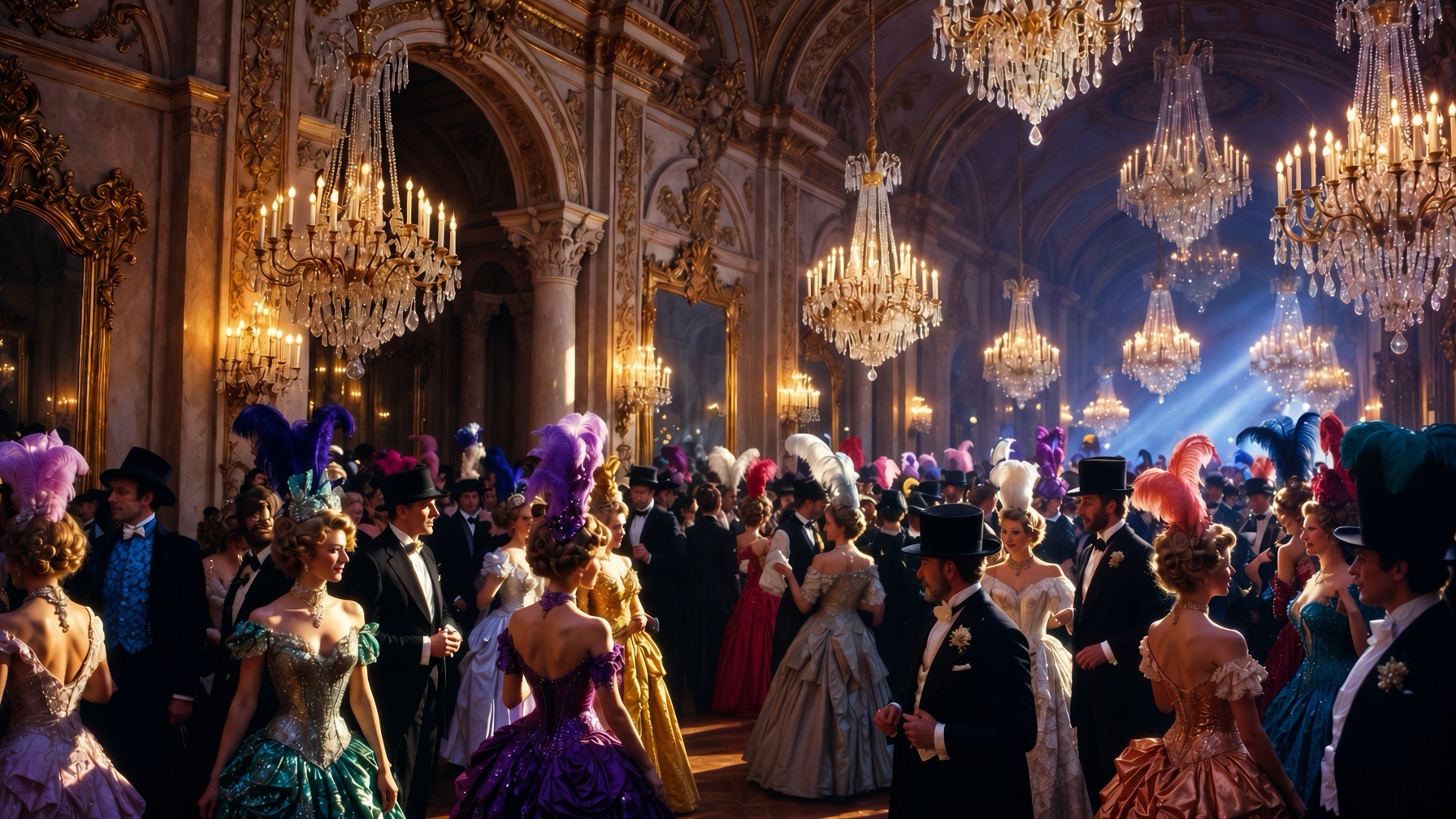
    A grand Gilded Age ballroom filled to capacity with formally dressed guests, an engraved guest list on a table in the foreground

    The Night the Vanderbilts Broke Through

    For years, Caroline refused to acknowledge the Vanderbilt family at all, dismissing them as vulgar new money despite their enormous fortune. That changed in 1883, when Alva Vanderbilt threw a costume ball so extravagant, and so widely covered in the press, that Caroline found herself facing real social pressure of her own for the first time. According to the well-documented account (readers of our Vanderbilt series may already know this story), Caroline was essentially forced to pay a formal visit to Alva just to secure an invitation to the ball for her own daughter, a quiet, symbolic admission that the Vanderbilts had finally arrived. The gatekeeper had been outmaneuvered by the very family she’d spent years locking out.

    The Betrayal

    For decades, McAllister was Caroline’s closest partner in all of this. Then, in 1890, he published a memoir called Society As I Have Found It, and made a mistake he never recovered from: he told the truth. The book laid out, in plain language, that “the 400” wasn’t some natural, meritocratic order at all. It was a list, curated deliberately by McAllister and Caroline together, with real, often petty criteria for who got in and who didn’t.

    A man in formal dress standing outside the closed gates of a grand mansion at dusk, looking back at a party he is no longer welcome to join

    High society treated the book as an unforgivable betrayal. Caroline, who had relied on McAllister for over twenty years, simply cut him off completely. He spent his final years increasingly mocked in the press, sometimes drawn in cartoons as an absurd, self-important figure. He died in 1895, cast out of the very world he’d spent his life helping build, and largely by the hand of the one person he’d built it with.

    What This Actually Teaches

    James 4:6 says plainly that “God opposes the proud but shows favor to the humble.” (NIV) It’s worth noticing what actually collapsed McAllister’s world in the end. It wasn’t a lack of cleverness, he’d built an entire social order out of nothing but ambition and charm. It was pride, on both sides. His, in believing he could reveal the game and still be welcome at the table. Hers, in a system built entirely around exclusion rather than genuine relationship. A social order built on who’s kept out rarely survives contact with the truth about how it was built.

    One more thread was already quietly forming by this point, worth watching. Caroline’s own nephew, William Waldorf Astor, harbored a real, growing resentment: his branch of the family, descended from the older brother, felt increasingly erased every time Caroline was simply referred to as “Mrs. Astor,” as if no other Mrs. Astor existed or mattered. That resentment wouldn’t stay quiet for long.

    This content is for educational purposes only and is not personalized financial, legal, or tax advice. Scripture quotations taken from The Holy Bible, New International Version® NIV® Copyright © 1973, 1978, 1984, 2011 by Biblica, Inc.® Used by permission. All rights reserved worldwide.

    References and Further Reading


    Part of Our Astors Series

    • John Jacob Astor: The Founder Who Built a Fortune That Outlasted Everyone Else’s — coming soon
    • Caroline Astor and “The 400”: The Woman Who Ruled New York, and the Partner Who Betrayed Her (this article)
    • The Waldorf-Astoria: The Family Feud That Built a Hotel, and the Rule That Finally Broke — coming soon
    • John Jacob Astor and the Titanic: What Really Happened That Night — coming soon
  • John Jacob Astor: The Founder Who Built a Fortune That Outlasted Everyone Else’s

    John Jacob Astor: The Founder Who Built a Fortune That Outlasted Everyone Else’s

    In 1783, a young man arrived in New York with almost nothing to his name. He’d been born Johann Jakob Astor, the son of a butcher in the small German town of Walldorf, and he came to America with little more than a few flutes he hoped to sell. By the time he died sixty-five years later, John Jacob Astor was the richest man in the United States, and the rule he built into his will would go on to protect his family’s fortune longer than almost any other in American history.

    From Flutes to a Fur Empire

    Astor’s first real business wasn’t glamorous: buying furs from trappers and Native traders, then selling them at a markup. But he was relentless and shrewd, and by 1808 he’d founded the American Fur Company, aggressively building toward a genuine monopoly on the fur trade across huge stretches of the American frontier. It’s worth being honest about the less admirable part of how that fortune grew, too: starting around 1800, Astor also exported opium into China, one of several American and British merchants doing the same. China’s own government had banned opium imports since 1729, so this trade was, by China’s law, smuggling, carried out through small boats that met his ships offshore to avoid the ports. It was not, however, illegal or scandalous by the standards of Astor’s own country at the time; Western merchants conducted the trade fairly openly, and it didn’t damage a single reputation back home, including his. That doesn’t erase the real harm it caused. It just means Astor wasn’t crossing a line his own contemporaries recognized as wrong; he was participating in something the West hadn’t yet reckoned with, decades before it exploded into the Opium Wars.

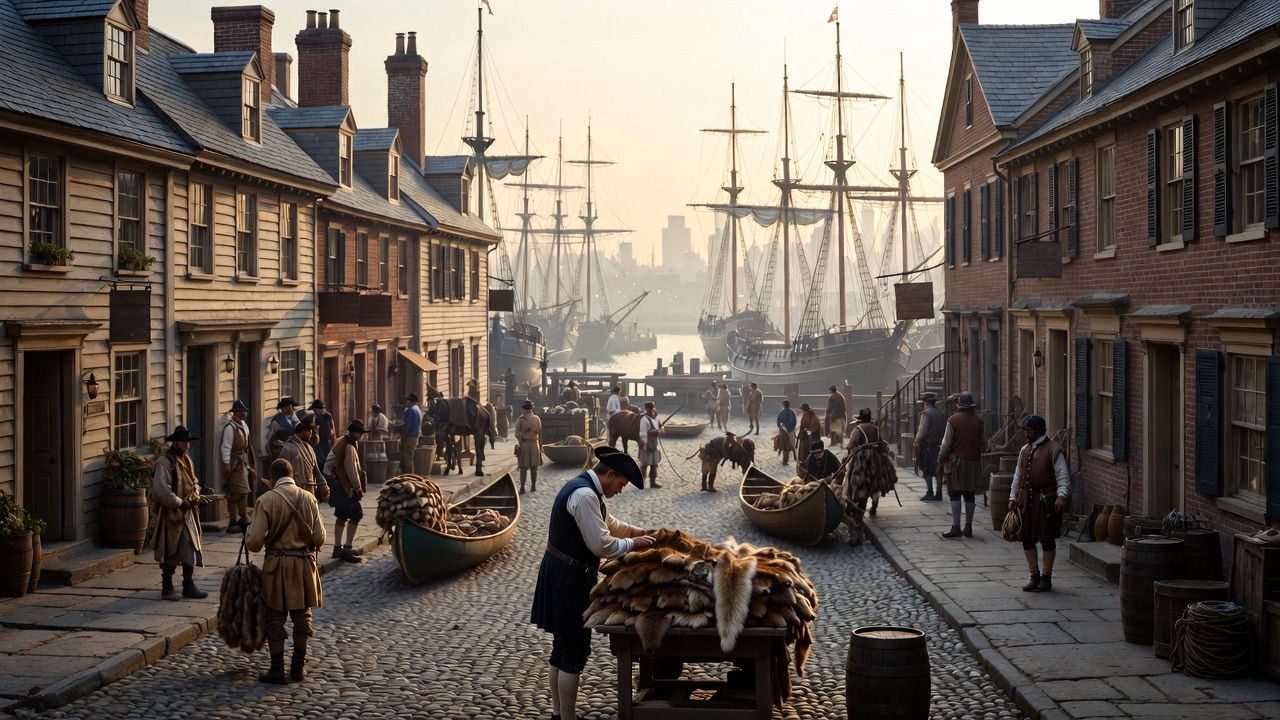
    John Jacob Astor looking over land that would become New York City, from open farmland to the modern Manhattan skyline

    The Real Genius: Knowing Where a City Was Headed

    Astor’s most important decision wasn’t in furs at all. As New York City’s population began to explode in the early 1800s, he started quietly buying up undeveloped land and vacant lots on the edges of the city, land nobody else wanted yet because it wasn’t worth much yet. He was betting, correctly, that the city would keep growing north, and that the empty fields he was buying cheaply would eventually sit in the middle of some of the most valuable real estate on earth. He was right. By the time he died in 1848, his estate was worth an estimated $20 million, an almost unimaginable sum for the era, built substantially on land he’d bought decades earlier for a fraction of what it eventually became worth.

    The Rule That Protected the Fortune

    Most wealthy men of Astor’s era left their fortune to their children outright, and hoped for the best. Astor did something different. He built a rule into his will: half of what he had would go directly to his grandchildren, not his own children, and he required his children to follow the same rule with their own money when their turn came. It’s a strategy known today as a generation-skipping structure, and the idea behind it is simple but powerful: no single generation, however careless or generous, could ever spend the whole fortune, because half of it was always protected, already promised to the generation after them before they ever got the chance to touch it.

    Astor also made a second, less structural but equally deliberate choice about who within his own generation would actually be trusted with the bulk of it. His eldest son, also named John Jacob, was widely regarded by the family as unable to manage a fortune of this size. Rather than defaulting to birth order, Astor directed the majority of his estate to his second son, William, who had already spent years proving himself inside the family business. We’ll dig into exactly how that decision played out, and what William did with it, in its own dedicated piece.

    That rule held for well over a hundred years, generation after generation, longer than almost any comparable fortune of the era managed to stay intact. We’ll come back to exactly how, and why, it finally ended, much later than you might expect, and for a reason that had nothing to do with anyone breaking the rule on purpose.

    Not far away, at roughly the same time Astor was building his real estate empire, a young man was doing pretty well for himself running a small ferry boat around New York harbor. His name was Cornelius.

    What This Actually Teaches

    Jeremiah 17:11 offers a real warning worth sitting with here: “Like a partridge that hatches eggs it did not lay is the man who gains riches by unjust means; when his life is half gone, they will desert him, and in the end he will prove to be a fool.” (NIV) Astor’s story doesn’t fit that warning neatly, and that’s exactly what makes it worth thinking through honestly. Real vision and real discipline built the bulk of his fortune, buying land nobody else understood the value of yet, then protecting it with a structure smarter than almost anyone else built at the time. Part of it also came from a trade that caused real, lasting harm, even though it wasn’t considered wrong by the people around him at the time. That’s worth sitting with rather than resolving too quickly: a clean conscience in your own era doesn’t always mean a clean legacy, and wisdom by the standards of one’s own time isn’t the same as wisdom by God’s.

    The rule he left behind, though, is worth its own honest credit. Astor didn’t just build wealth. He built a structure designed to outlast his own choices, and even the choices of his children. That’s a different kind of stewardship than simply being rich, planning specifically for people who hadn’t been born yet.

    This content is for educational purposes only and is not personalized financial, legal, or tax advice. Scripture quotations taken from The Holy Bible, New International Version® NIV® Copyright © 1973, 1978, 1984, 2011 by Biblica, Inc.® Used by permission. All rights reserved worldwide.

    References and Further Reading


    Part of Our Astors Series

    Astor Series Spinoffs

    • Is HBO’s The Gilded Age Based on a True Story? Caroline Astor’s Real History — Coming Nov 5
    • How the Astors Chose Their Heir: Skipping the Firstborn for the Son Who Could Grow the Money — Coming Nov 12
    • The Rule That Finally Broke: How the Astor Trust Structure Actually Ended — Coming Nov 19
    • Peacock Alley: How a Family Feud Accidentally Invented Modern Luxury Hospitality — Coming Nov 26
    • The Scandal That Put Them on the Titanic — Coming Dec 3

    📖 Enjoy stories like this? Check out The Vanderbilts: Empire, Excess, Loss, and Redemption — available now →

  • The Vanderbilts: How a Fortune Can Disappear While No One’s Watching

    The Vanderbilts: How a Fortune Can Disappear While No One’s Watching

    By 1973, roughly 120 descendants of Cornelius Vanderbilt gathered at the university their ancestor had endowed a century earlier. Not one of them was a millionaire. That fact gets repeated often, and it’s real, worth taking seriously rather than explaining away. But it’s also not the whole truth about what the Vanderbilts actually left behind, and both things need to be said honestly, side by side.

    A crowd of modestly dressed 1970s descendants gathered before Vanderbilt University's grand columned facade

    What’s True: One Generation Really Can Undo Everything

    The Commodore built the largest fortune in American history. William nearly doubled it. Within a few generations after that, it was functionally gone. That’s not a myth or an exaggeration, it’s a documented outcome, and it should genuinely unsettle anyone who assumes a large enough fortune is automatically safe from this. It isn’t. Scale doesn’t protect against this pattern. It just takes longer to run out.

    What’s Also True: The Legacy Isn’t Reducible to a Bank Balance

    Grand Central Terminal still operates. Vanderbilt University still exists, and still bears the name of a man who never set foot on its campus. Biltmore, the one piece of the physical estate still standing under family-adjacent management, generates over $250 million a year today. None of that shows up in a simple statement like “the money ran out.”

    The Real Warning, Which Is the Part Worth Sitting With

    Here’s what actually made the decline dangerous, and it’s not what the popular version of the story usually emphasizes. It wasn’t one catastrophic decision. It was ordinary, habitual spending that nobody treated as urgent until the math had already stopped working.

    A butler dusting a marble mantelpiece in a visibly aging mansion room with faded wallpaper and worn furniture

    Mansions kept getting maintained. Balls kept getting thrown. Lifestyles kept getting sustained, on the assumption that they always had been and therefore always would be. The danger was never a single bad call. It was the absence of anyone asking the hard question early enough for the answer to still matter.

    A Biblical Pattern With the Same Shape

    Judges 2:10 describes something structurally similar, on a much larger scale: “After that whole generation had been gathered to their ancestors, another generation grew up who knew neither the Lord nor what he had done for Israel.” (NIV) This wasn’t a generation that deliberately rejected what came before them. They simply never really knew it, the way anyone truly knows something they had to fight for themselves. The Vanderbilt heirs born into palaces never had to build one.

    Where This Leaves You

    A family, or an individual, can absolutely lose in one generation what took several to build, and pretending otherwise is its own kind of denial. But the deeper lesson isn’t really about the money at all. It’s about whether the next generation actually understands what built it, and whether anyone is willing to ask the uncomfortable question before the math makes the answer unavoidable.

    📖 Want the full story? Get The Vanderbilts: Empire, Excess, Loss, and Redemption — the complete ebook.

    This content is for educational purposes only and is not personalized financial advice. Scripture quotations taken from The Holy Bible, New International Version® NIV® Copyright © 1973, 1978, 1984, 2011 by Biblica, Inc.® Used by permission. All rights reserved worldwide.

    This post is part of our ongoing look at lessons from the Vanderbilt series. Start the full story from the beginning here.

  • The Vanderbilts: 5 Ways the Commodore’s Decision Protected the Family (Whether He Meant To or Not)

    The Vanderbilts: 5 Ways the Commodore’s Decision Protected the Family (Whether He Meant To or Not)

    Cornelius Vanderbilt built the largest fortune in American history, and when the time came to pass it on, he didn’t split it evenly among his thirteen children. Almost all of it went to one son, William, a decision that raised eyebrows even at the time. What happened next is its own remarkable story, told in full here, but the short version is this: the fortune didn’t just survive, it doubled. Looking closely at exactly what Cornelius did reveals five real, transferable principles behind that outcome, whether the Commodore was applying them on purpose or simply trusting his own instincts.

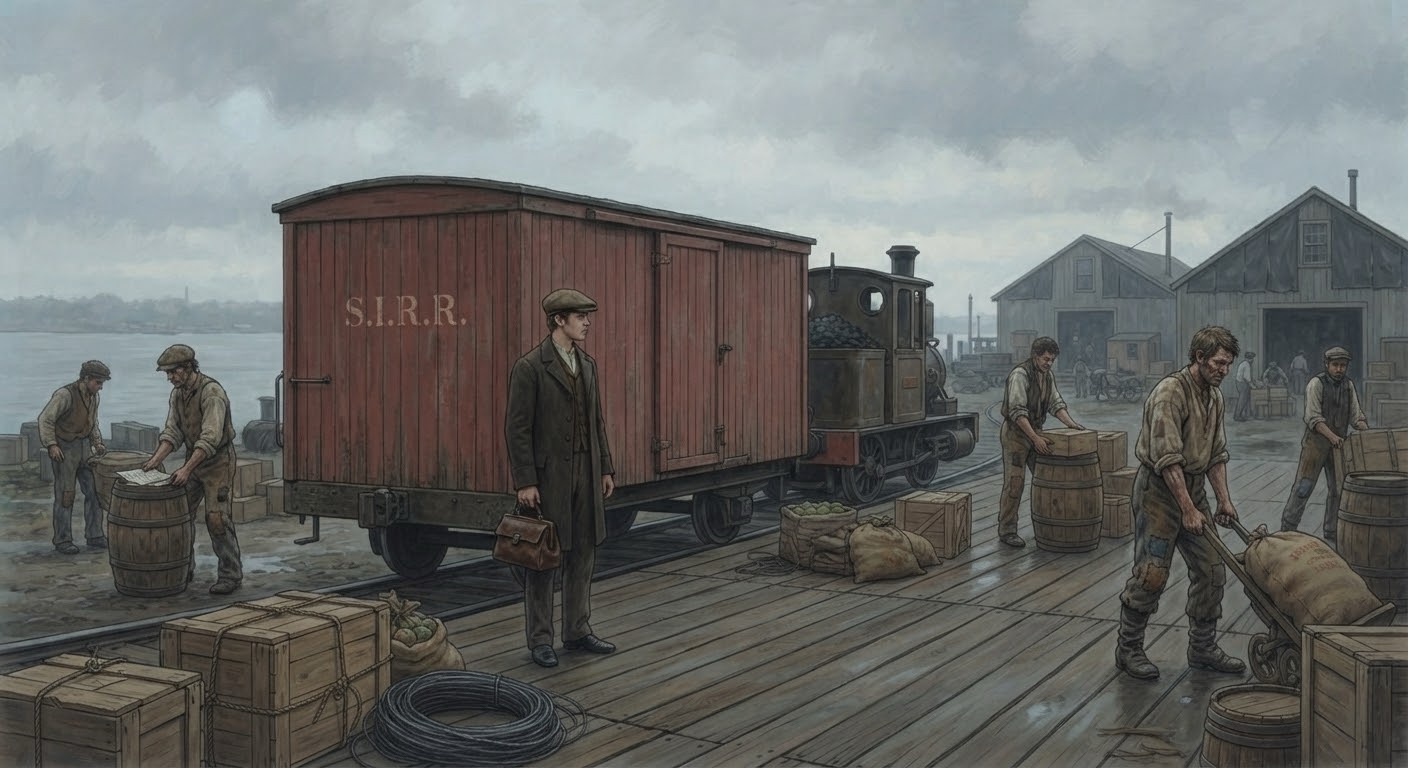
    A young William Henry Vanderbilt standing beside a modest Staten Island Railroad freight car at the docks

    1. He Tested Before He Trusted

    William wasn’t handed control of anything significant early in life. He was handed the small, failing Staten Island Railway, and only proved himself capable through that, on a scale small enough that failure wouldn’t have threatened the larger empire. Trust was earned in a controlled environment before it was extended in a consequential one.

    This is a principle worth sitting with if you’re responsible for handing off a business, a ministry, or even a family budget to someone else. Giving someone your full trust before they’ve proven themselves in something small isn’t generosity, it’s a gamble with everyone else’s future riding on it. Start people where a mistake is recoverable, and let real responsibility grow only as real, demonstrated competence grows alongside it.

    2. He Concentrated Rather Than Fragmented

    Roughly 95% of a $105 million estate went to William and his sons, an extraordinarily concentrated decision for the era. Splitting a functioning business empire evenly among many heirs often means splitting it into pieces too small for any single person to run effectively. The Commodore kept the machine whole.

    This isn’t a universal formula, and Scripture never demands it as one. But it does raise an honest question for anyone building something that actually matters: will splitting things evenly preserve what you built, or will it just guarantee that nobody involved has enough control, capital, or authority to keep it alive? Fair and equal aren’t always the same thing, and the Commodore clearly understood the difference between the two.

    3. He Passed Down Explicit Wisdom, Not Just Money

    According to family biographer Arthur T. Vanderbilt II, the Commodore’s parting words to William were blunt: any fool can make a fortune, it takes a man of brains to hold onto it. That wasn’t idle commentary. It reads like a man who understood, instinctively, that the money alone wouldn’t be enough.

    Too many families treat wealth transfer as a purely legal and financial event, wills, trusts, and account transfers, and stop there. The Commodore’s blunt warning suggests he saw the real risk more clearly than that: money without wisdom rarely survives contact with the next generation for long. A single sentence, spoken plainly at the right moment, can end up shaping a family’s future more than any legal document ever could.

    4. He Gave William Real Runway, Not a Sudden Handoff

    William’s responsibility grew steadily across roughly two decades, from the Staten Island line, to the Hudson River Railroad, to New York Central itself, well before the Commodore’s death made any of it official.

    An elderly Cornelius Vanderbilt with his hand on William Henry Vanderbilt's shoulder, both studying ledgers and maps together

    By the time William actually inherited control, he had already been functionally running the business for years. Two decades is a long runway by any standard, and it meant William wasn’t just being told he was ready, he actually was. Sudden handoffs, whether of a business, a ministry, or a family’s finances, tend to expose gaps nobody knew were there until it’s too late to fix them quietly. Gradual, visible growth in responsibility gives everyone involved, including the person receiving it, real time to see whether the trust being placed in them is actually earned.

    5. The Conflict That Followed Was Handled, Not Buried

    The concentrated inheritance triggered a real will contest from William’s siblings. Rather than let it calcify into permanent estrangement, William settled directly, paying his sisters and brother additional sums to resolve it. Conflict over money is close to inevitable in any significant inheritance. What actually matters is whether it gets addressed or left to fester.

    It would have been easy for William to treat the will as legally settled and simply ignore his siblings’ objections; he had both the money and the legal standing to do exactly that. Instead, he chose to resolve it directly and personally, which cost him more in the short term but preserved something money can’t buy back once it’s gone: an actual relationship with his own family. That choice is easy to overlook next to the bigger, flashier decisions on this list, but it may be the most instructive one here.

    What This Actually Says

    Proverbs 13:22 says, “A good man leaves an inheritance to his children’s children.” (NIV) The verse is often read as simply being about leaving money behind. The Commodore’s actual approach suggests something more specific: the inheritance that lasts isn’t just the money itself, it’s whether the next generation was actually prepared to hold onto it. It’s worth noting this was nearly the opposite philosophy of contemporaries like Andrew Carnegie and John D. Rockefeller, who built their legacies not on what they passed down, but on how much they gave away.

    Decades later, a different Gilded Age family would try something even more structural than any of this, building a rule directly into the legal terms of the will itself, rather than relying entirely on one generation’s judgment. That story is worth its own telling.

    📖 Want the full story? Get The Vanderbilts: Empire, Excess, Loss, and Redemption — the complete ebook.

    The Full Vanderbilt Series

    1. Commodore Vanderbilt: From Ferry Boy to Railroad Titan
    2. The Forgotten Vanderbilt: Did He Save the Fortune, or Destroy It?
    3. How the Vanderbilt Fortune Actually Disappeared
    4. The Biltmore Estate: How a Vanderbilt Gamble Became a Family Empire

    Plus a related lesson from their story: Lifestyle Creep: The Real Lesson Hiding in the Vanderbilt Story.

    This content is for educational purposes only and is not personalized financial, legal, or estate planning advice. Scripture quotations taken from The Holy Bible, New International Version® NIV® Copyright © 1973, 1978, 1984, 2011 by Biblica, Inc.® Used by permission. All rights reserved worldwide.

    This post is part of our ongoing look at lessons from the Vanderbilt series. Start the full story from the beginning here.

  • The Biltmore Estate: How a Vanderbilt Gamble Became a Family Empire

    The Biltmore Estate: How a Vanderbilt Gamble Became a Family Empire

    Commodore Cornelius Vanderbilt built one of the largest fortunes in American history through unglamorous, disciplined work: ferries, then railroads, decade after decade. His grandson George Washington Vanderbilt II took a very different approach with his share of that fortune. He built a house. Specifically, the largest privately owned house ever built in America, and it very nearly ruined the family that built it.

    This is the fourth and final piece in our Vanderbilt series. It follows the Commodore’s rise, his son’s successful stewardship of that fortune, and how later generations ran through it, before landing here: the one branch of the family that turned near-ruin into a lasting business.

    Who Owns the Biltmore Estate Today?

    Short answer: The Vanderbilt family still owns it. Biltmore belongs to George Vanderbilt’s descendants through The Biltmore Company, a family-owned business controlled by the family of his grandson, William A.V. Cecil. William’s son, Bill Cecil Jr., is president and CEO. The house has been open to the public since 1930, and it is still the largest privately owned home in the United States.

    Illustrated Biltmore House at dusk with empty grounds, grand and imposing but isolated

    An Almost Unimaginable Gamble

    George Washington Vanderbilt II was the youngest son of William Henry Vanderbilt, the Commodore’s son who appeared in our earlier piece navigating the rise of a young John D. Rockefeller. Drawn to the mountain scenery around Asheville, North Carolina, George began construction on his own estate there in 1889. By the time it was completed in 1895, Biltmore House was a 250-room French Renaissance chateau spanning nearly 179,000 square feet, complete with gardens designed by Frederick Law Olmsted, the same landscape architect behind New York’s Central Park. It remains the largest privately owned house in the United States to this day.

    It was also, in plain financial terms, an enormous gamble. Maintaining a house of that scale required a small army of staff and continuous upkeep, and George Vanderbilt did not have a Standard Oil or a railroad network generating fresh income behind it, just the finite fortune he’d inherited. When George died suddenly in 1914 at age 51, his widow Edith found herself managing an estate the family could no longer easily afford. She sold 87,000 acres of the surrounding land to the U.S. Forest Service, land that today forms part of Pisgah National Forest, simply to keep the core estate financially viable.

    Opened to the Public, Still Not Profitable

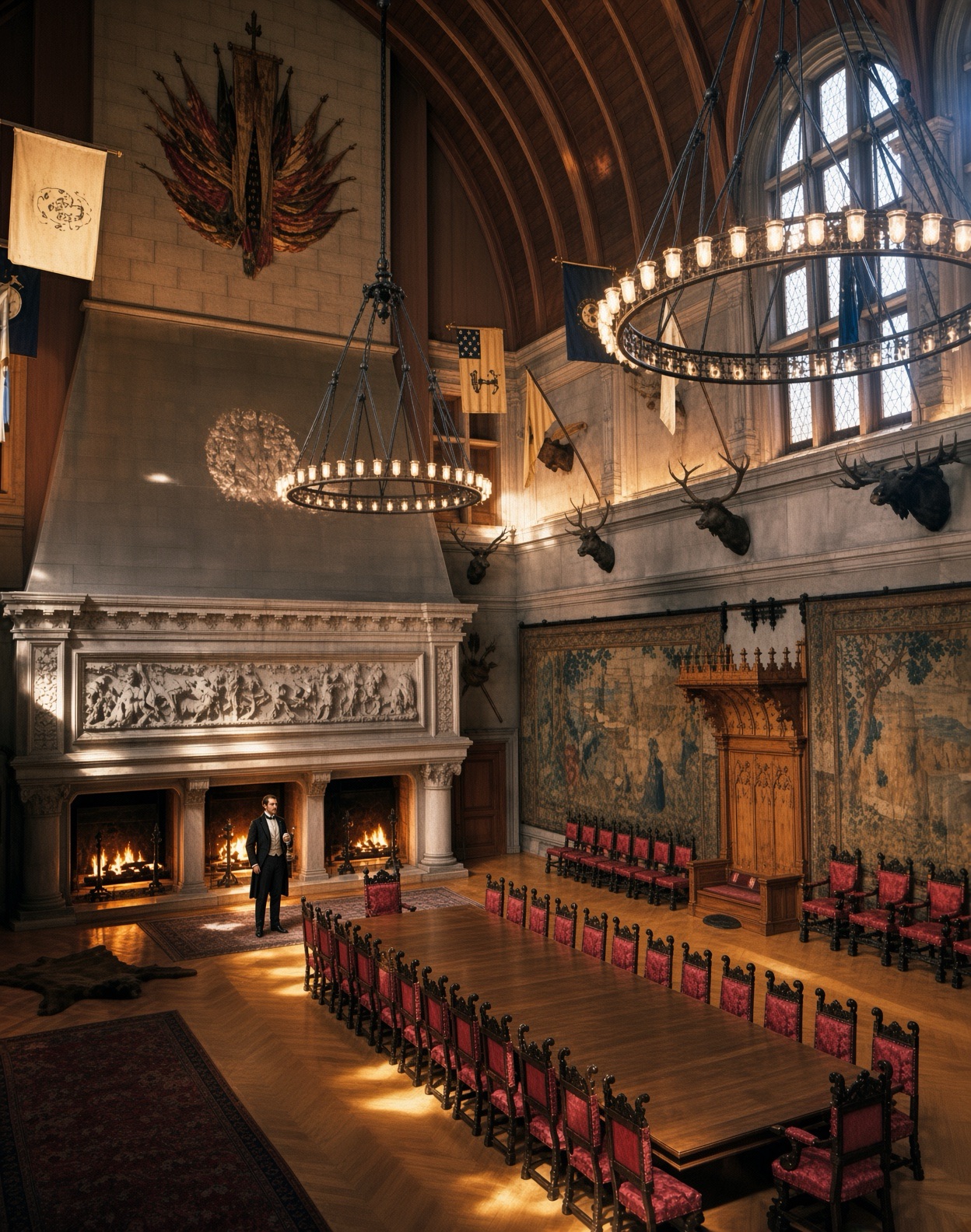
    Illustrated Gilded Age gentleman standing alone by a roaring fireplace in Biltmore's vast empty banquet hall

    George and Edith’s only child, Cornelia Vanderbilt, married John Francis Amherst Cecil in 1924, and the couple had two sons at Biltmore: George Henry Vanderbilt Cecil in 1925, and William Amherst Vanderbilt Cecil in 1928. In 1930, at the urging of the city of Asheville and hoping to generate desperately needed revenue during the Great Depression, the family opened Biltmore House to public tours for the first time.

    It didn’t work, at least not for a long time. By 1960, the house was losing roughly $250,000 a year, a shortfall the family covered by subsidizing it with income from the estate’s dairy farm. Three decades after opening to tourists, America’s largest private home was still, financially, a losing proposition, a banquet hall built for fifty, and often, quiet as the one pictured above.

    The Grandson Who Came Back

    William A.V. Cecil, George Vanderbilt’s grandson, had built his own career far from Asheville, graduating Harvard in 1952 and working in finance at Chase Manhattan Bank in New York. In 1960, he left that career and returned to try to save his family’s home.

    What he brought back with him was a banker’s instinct for marketing, not just nostalgia. In one notable campaign, he ran an eight-page advertisement in local newspapers and offered a free turn-of-the-century recipe from the Biltmore kitchens. It became popular enough that he started charging a quarter for it, with self-addressed envelopes flooding in. It was a small, almost quaint idea, and it was part of a broader, sustained effort to turn a crumbling mansion into something people would actually pay to experience.

    It took eight years. In 1968, Biltmore recorded its first-ever profit: $16.24. Not a typo, and not a large number, but a genuine turning point after decades in the red.

    From Barely Breaking Even to a Diversified Business

    In the late 1970s, William and his brother George H.V. Cecil divided their inheritance along interest lines. William kept the house, gardens, and forests, the historic heart of the estate. George took the dairy farm and surrounding land, at the time the more profitable half, and built it into Biltmore Farms, a real estate development company that continues to shape the Asheville area today.

    William kept building on his half. He added a vineyard and winery in 1985, expanded into restaurants, and eventually added hotel properties that now generate the bulk of the estate’s income. What began as a single, wildly expensive house had become a genuinely diversified hospitality business.

    Where It Stands Today

    Illustrated Biltmore House full of visitors with vineyard hills in the background, thriving and alive

    In 1995, on the estate’s 100th anniversary, William handed control to his son, Bill Cecil Jr., who remains president and CEO today, a fourth-generation descendant of George Vanderbilt running the family business his great-grandfather nearly lost. Biltmore now draws an estimated 1.4 million visitors a year, employs more than 2,400 people, and generates roughly $50 million in annual revenue, the majority of which is reinvested directly into maintaining the property. Buncombe County tax records place the estate’s market value at approximately $374 million. Fourth and fifth generation members of the Vanderbilt family remain involved in day-to-day operations to this day.

    What This Story Actually Shows

    It would be easy to tell this story as a cautionary tale about extravagance, and the first half of it certainly is one. But the second half is something more interesting: real redemption, built not through a lucky break but through one family member’s decades of unglamorous, disciplined work, marketing ingenuity, and patience, the same qualities that built the original Vanderbilt fortune three generations earlier. Proverbs 24:3-4 says by wisdom a house is built, and through understanding it is established, through knowledge its rooms are filled with rare and beautiful treasures. George Vanderbilt supplied the house. It took his grandson’s wisdom, decades later, to actually establish it.

    Frequently Asked Questions About the Biltmore Estate

    Do the Vanderbilts still own the Biltmore?

    Yes. Biltmore is still owned by George Vanderbilt’s descendants through The Biltmore Company, which is family owned and operated.

    Who runs the Biltmore Estate now?

    Bill Cecil Jr., George Vanderbilt’s great-grandson, is president and CEO of The Biltmore Company. He took over in 1995. His father, William A.V. Cecil, chaired the company’s board until his death in 2017 at age 89.

    Who originally owned the Biltmore Estate?

    George Washington Vanderbilt II, the grandson of Commodore Cornelius Vanderbilt. He built Biltmore House near Asheville, North Carolina, between 1889 and 1895.

    How did the Vanderbilts make their money?

    Through Cornelius “Commodore” Vanderbilt, who built his fortune in steamboats and then railroads. George inherited his share of it. Read the full story in Commodore Vanderbilt: From Ferry Boy to Railroad Titan.

    When did Biltmore open to the public?

    In March 1930. George’s daughter, Cornelia, and her husband, John Cecil, opened it at the request of the City of Asheville, which hoped tourism would help the area during the Great Depression.

    How big is the Biltmore Estate?

    The house has 250 rooms and about 179,000 square feet of floor space, including 35 bedrooms and 43 bathrooms. The estate covers about 8,000 acres today. See how the rest of the family fortune fared in How the Vanderbilt Fortune Actually Disappeared.

    📖 Want the full story? Get The Vanderbilts: Empire, Excess, Loss, and Redemption — the complete ebook.

    The Full Vanderbilt Series

    This content is for educational purposes only and is not personalized financial, legal, or tax advice. All facts in this article are drawn from publicly available sources cited below; no claims are made beyond what those sources document.

    References and Further Reading

  • How the Vanderbilt Fortune Actually Disappeared

    How the Vanderbilt Fortune Actually Disappeared

    When William Henry Vanderbilt died in 1885, he left behind roughly $200 million, a fortune he’d nearly doubled from what his father built. He also left behind eight children who had grown up watching that fortune double, in a family that had just built its first mansion on Fifth Avenue. This is the third piece in our Vanderbilt series, and it’s the one where the story turns.

    A House for Every Heir

    Unlike his father’s concentrated inheritance strategy, William split his fortune more evenly among his children. What followed wasn’t reckless all at once, at first it looked like ambition. His son Cornelius Vanderbilt II took over much of the railroad business alongside his brother William Kissam Vanderbilt and, for a time, kept the empire genuinely thriving. But the family’s real energy in this generation went somewhere else: building. Along Fifth Avenue, Vanderbilt mansion after Vanderbilt mansion went up, a stretch of the street so dense with the family’s palaces it became known as “Vanderbilt Row.”

    The Party That Announced a New Standard

    Illustrated lavish Gilded Age costume ball with elaborately dressed guests and crystal chandeliers

    On March 26, 1883, Alva Vanderbilt, wife of William Kissam Vanderbilt, hosted a costume ball at their newly built Fifth Avenue mansion for 1,200 guests. The New York World called it an event never equalled in the social history of the city. Police held back crowds just to watch the carriages arrive. It was, by design, a public announcement that the Vanderbilts had arrived at the very top of American society, and it set a tone the next generation would spend enormous sums trying to match or exceed.

    Newport’s “Cottages”

    Illustrated grand Newport Gilded Age summer cottage mansion overlooking the Atlantic coastline at sunset

    The competition didn’t stay in Manhattan. In Newport, Rhode Island, the family built a series of summer homes so large they were called “cottages” only ironically. Cornelius Vanderbilt II built The Breakers. William Kissam and Alva Vanderbilt built Marble House, reportedly costing around $11 million, a staggering sum for a seasonal residence used only a few weeks a year. Each new house seemed to exist partly to outdo the last one.

    The youngest of William’s sons, George Washington Vanderbilt II, would eventually take this instinct further than anyone. In the mountains of North Carolina, he built the largest private home ever constructed in America, a story significant enough that it deserves, and gets, its own telling in the final piece of this series.

    The Money Stops Growing

    Houses don’t generate income, they consume it, in staff, upkeep, and property taxes, year after year. Meanwhile, the family kept growing. Each generation split the fortune into more pieces than the one before, spread across more heirs, most of whom had been raised to spend at a Vanderbilt standard without necessarily being raised to run a railroad. According to family historian Arthur T. Vanderbilt II’s account in Fortune’s Children, Cornelius II’s descendants in particular proved far better at spending than earning, and several died relatively young, cutting short whatever chance there was to rebuild.

    The End of the Railroad Empire

    Illustrated faded Gilded Age mansion interior with furniture under dust sheets and a single shaft of light

    The business that had generated the fortune in the first place didn’t survive it either. New York Central, once one of the largest railroads in the country, declared bankruptcy in 1970. By 1947, every Vanderbilt mansion on Fifth Avenue had been demolished, their contents auctioned off to help cover debts.

    The Reunion That Said It All

    In 1973, roughly 120 descendants of Cornelius Vanderbilt gathered at Vanderbilt University, the school the Commodore himself had endowed exactly a century earlier. According to Arthur T. Vanderbilt II’s research, not one person in that room was a millionaire. A fortune that had once been larger than the entire U.S. Treasury had, across four generations, simply run out.

    What Actually Happened Here

    It wasn’t one bad decision. It was a pattern: a fortune divided more ways with each generation, poured increasingly into assets that consumed money rather than generated it, spent by heirs raised to display wealth more than to build it. Proverbs 21:20 says the wise store up choice food and oil, but fools gulp theirs down. Three generations of Vanderbilts gulped. One house, though, built by the youngest of them and seemingly headed for exactly the same fate, would eventually take a very different path. That’s where we’re headed next.

    📖 Want the full story? Get The Vanderbilts: Empire, Excess, Loss, and Redemption — the complete ebook.

    The Full Vanderbilt Series

    Or see the full series hub page for the complete story, including practical lessons drawn from it.

    This content is for educational purposes only and is not personalized financial, legal, or tax advice. All facts in this article are drawn from publicly available sources cited below; no claims are made beyond what those sources document.

    References and Further Reading

  • The Vanderbilt Family Story

    In 1810, a sixteen-year-old boy named Cornelius Vanderbilt borrowed $100 from his mother and bought a small boat to ferry passengers around New York harbor. By the time he died sixty-seven years later, he was worth more in cash than the United States Treasury itself held at the time. This is the full story of what his family did with that fortune across four generations: how it was built, how it very nearly evaporated in some of the most extravagant spending America has ever witnessed, and how one branch of the family found an unlikely second life in the very house that almost ruined them.

    Part One: The Commodore

    Cornelius Vanderbilt was born in 1794 on Staten Island to a family of modest means, and he left formal schooling behind entirely by age eleven. What he lacked in education he made up for in relentless physical work and an instinct for undercutting competitors that would define his entire career. That first ferry, purchased with his mother’s $100 loan, grew into a fleet, then into a full-scale steamboat empire spanning the eastern seaboard and, eventually, routes to California and Central America during the Gold Rush years, when tens of thousands of prospectors needed fast, reliable transit and Vanderbilt built a route through Nicaragua that undercut every competitor’s price. Ecclesiastes 9:10 says, “Whatever your hand finds to do, do it with all your might.” Vanderbilt seems to have taken that literally for the better part of six decades.

    He earned the nickname “Commodore” through sheer dominance of the shipping trade, and he earned a reputation for ruthlessness alongside it. When business rivals tried to shut him out of that Nicaragua transit route he’d built, he is famously said to have written them a one-line threat: “You have undertaken to cheat me. I won’t sue you, for the law is too slow. I’ll ruin you.” He generally did, driving rate wars so aggressive that competing shipping lines regularly paid him simply to go away and stop undercutting them, a tactic that became almost as profitable as running the ships themselves.

    By his sixties, an age when most men of his era considered themselves retired, he made an audacious pivot, selling off his shipping interests entirely and throwing his fortune into something newer and far riskier: railroads. It worked, spectacularly. He consolidated smaller, competing lines into the New York Central Railroad, one of the most powerful rail networks in the country, and in 1871 opened Grand Central Depot in Manhattan, the direct ancestor of today’s Grand Central Terminal. By the time of his death in 1877, he had amassed roughly $100 million, an almost incomprehensible sum for the era, and one that made him, by some measures, wealthier in real terms than the federal government’s own cash reserves.

    The Erie War

    Vanderbilt’s railroad ambitions produced one of the wildest corporate battles in American history: the fight for control of the Erie Railroad in 1868. Vanderbilt tried to acquire the Erie the same way he’d acquired everything else, buying up stock until he controlled it. His opponents, a trio of financiers named Daniel Drew, Jim Fisk, and Jay Gould, responded by doing something almost unthinkable: they simply printed more stock. Erie’s board controlled the company’s own printing press, and every time Vanderbilt bought up enough shares to gain control, Drew, Fisk, and Gould issued tens of thousands of new, freshly printed shares to dilute his position, flooding the market faster than Vanderbilt could buy. Vanderbilt reportedly spent more than $7 million trying to corner a stock that kept multiplying beneath him.

    When a New York judge, at Vanderbilt’s request, ordered Drew, Fisk, and Gould arrested for contempt of court over the scheme, the three men famously fled across the Hudson River to New Jersey with the company’s cash reserves stuffed into suitcases, setting up a temporary headquarters in a hotel in Jersey City, just outside the reach of New York law enforcement, where they continued running the company by proxy for months. Vanderbilt eventually cut his losses and settled, walking away from the fight with a real financial loss but an even more valuable lesson: even the shrewdest operator in America could be beaten at his own game by men willing to print their way out of a corner.

    But even at the height of his power, a much younger and far less famous man was quietly building something that would eventually test his empire in an entirely different way. John D. Rockefeller started small in the 1860s, one refinery among dozens in Cleveland, Ohio. By 1872, he had begun aggressively consolidating the oil refining business under Standard Oil, buying out 22 of Cleveland’s 26 refineries in a matter of weeks. That same year, Rockefeller and a group of refiners and railroad men formed the South Improvement Company, a scheme to secure secret rebates on oil shipments in exchange for guaranteed freight volume. The railroads at the table included Vanderbilt’s own New York Central, by then increasingly run day to day by his son, William Henry Vanderbilt, as the aging Commodore’s health declined. The scheme leaked to the press and collapsed under public backlash within weeks, but it revealed something important: the era of the unchallenged railroad titan was already ending, and a new kind of industrial power was rising fast enough to test even Vanderbilt’s empire.

    The Final Gift and a Contentious Death

    Vanderbilt’s one major act of public philanthropy came near the very end of his life. In 1873, persuaded largely by a Methodist bishop who saw an opportunity to unite a fractured post-Civil War nation through education, the Commodore gave $1 million to establish a university in Nashville, Tennessee, a place he had never visited and had no personal connection to. The school was renamed Vanderbilt University in his honor. It would remain, for the rest of his life, essentially his only large-scale charitable act, a single moment of institutional generosity from a man otherwise defined by decades of relentless, self-interested accumulation.

    When Vanderbilt died in January 1877, his death set off one of the most contentious inheritance disputes of the century, a preview of exactly the kind of family conflict that would define the generations to come, and the first real test of whether the fortune he’d spent sixty-seven years building could survive contact with his heirs.

    Part Two: The Son Who Doubled It (And the Con That Almost Caught Him)

    William Henry Vanderbilt was not, at first, anyone’s idea of a worthy heir. Known to the family as Billy, he struggled early in life and reportedly suffered a nervous breakdown as a young man. The Commodore, unimpressed, started him at 19 as a bank clerk rather than anywhere near the family business. What changed his father’s mind was a test, not a promotion: William was handed the small, failing Staten Island Railway, and he turned it around. That success earned him the presidency of the line in 1862, then steadily more responsibility over the following two decades, working his way up through the Hudson River Railroad and eventually into daily operational control of the New York Central itself, quietly running the empire for years before his father’s death made it official.

    A Bitter Will Contest

    When Cornelius Vanderbilt died in 1877, he left roughly 95% of his $105 million estate to William and William’s own sons, an extraordinarily concentrated decision for the era, when dividing an estate evenly among all children was the more typical approach. His other children, several daughters and a troubled son named Cornelius Jeremiah, who struggled with gambling debts his entire adult life, received far smaller sums. Cornelius Jeremiah, feeling cut out entirely despite bearing his father’s name, formally contested the will in court, arguing his father had been manipulated by William and was not of sound mind at the time of signing. The trial became a genuine public spectacle, dragging on for the better part of a year with testimony from mediums, family friends, and business associates all weighing in on the Commodore’s mental state in his final years. William ultimately settled with several of his siblings directly rather than risk a jury verdict, paying substantial additional sums to end the litigation and preserve both the estate and whatever remained of the family’s public image.

    According to William’s family biographer, Arthur T. Vanderbilt II, the Commodore’s parting words to him were blunt: any fool can make a fortune, it takes a man of brains to hold onto it. Proverbs 20:21 offers a matching warning from the other direction: “An inheritance claimed too soon will not be blessed at the end.” The Commodore’s insistence on testing William first, rather than simply handing him the keys decades earlier, reads like an instinctive understanding of exactly that principle, and the will contest that followed his death is a real-world illustration of what happens when that principle gets ignored by everyone else in the family.

    William more than justified the trust his father placed in him, at least financially. He aggressively expanded the family’s rail network, acquiring controlling interests in the Michigan Central, the Lake Shore and Michigan Southern, and the Canada Southern railways, among others, and pushed the family’s stake in the New York Central itself to roughly 87%. By the time poor health forced his retirement from railroad leadership in 1883, he had very nearly doubled his father’s fortune. Estimates of his estate at his death in 1885 range from $200 million to $232 million, making him, by some measures, briefly the richest man in the world.

    He was not universally beloved for it. In an 1882 newspaper interview, William was widely quoted responding to a question about an unprofitable train service he’d cancelled with the dismissive line, “The public be damned.” Whether he meant it quite as coldly as it read in print has been debated by historians ever since, but the phrase followed him for the rest of his life and became a kind of shorthand for Gilded Age indifference to public opinion, printed and reprinted in newspapers hostile to the railroad barons for decades afterward.

    Outfoxed by a President’s Son

    His business instincts were not infallible either, and one episode deserves telling in full. In 1884, William invested in Grant and Ward, a Wall Street banking firm whose partners included Ulysses S. Grant Jr., son of the former president and Civil War general. The firm’s other partner, Ferdinand Ward, nicknamed “the Young Napoleon of Finance” in the press for his seemingly magical investment returns, was in reality running what amounted to a Ponzi scheme, using new investors’ money to pay off earlier ones while quietly siphoning funds for himself. The firm’s apparent success, and the credibility lent by Grant’s own name attached to it, drew in investor after investor, including some of the most experienced financial minds in the country.

    Grant and Ward collapsed in May 1884, one of the most notorious financial scandals of the era. It didn’t just cost investors money, it completely wiped out former President Grant’s personal fortune. Grant, already dying of throat cancer, spent his final months racing to write his memoirs specifically to leave his family something to live on, a project he finished mere days before his death in 1885, and which went on to become one of the best-selling military memoirs in American history, largely because Mark Twain personally arranged its publication to help the Grant family recover financially. William Henry Vanderbilt, one of the shrewdest businessmen in the country, lost $150,000 in the same collapse, the son of a former president having personally lent his name and credibility to the very scheme that ruined him. Even a fortune built on genuine business skill offered no immunity to a well-dressed con wearing a famous name.

    William also expanded the family’s philanthropic footprint modestly beyond his father’s single gift, contributing to Columbia College’s School of Physicians and Surgeons among other causes, though giving remained a minor thread in his life compared to building the fortune itself. He built the first of what would become a long line of Vanderbilt mansions on Fifth Avenue, a limestone “triple palace” at 640 Fifth Avenue that set a new standard for the family’s public displays of wealth. And near the end of his life, he said something worth sitting with: inherited wealth, he confessed, was a real handicap to happiness, leaving him with nothing left to hope for or strive toward. He had eight children, every one of them growing up watching a fortune that had just doubled, in a family that had just built its first Fifth Avenue palace, with a father who privately wondered whether the money itself was good for anyone.

    Part Three: The Excess, By the Numbers

    What William’s children did with that fortune is where the story turns. Unlike his father’s concentrated inheritance strategy, William split his estate more evenly among his heirs, and the family’s competitive energy shifted almost entirely from railroads to real estate and social spectacle. 1 Timothy 6:9-10 warns that “those who want to get rich fall into temptation and a trap and into many foolish and harmful desires… the love of money is a root of all kinds of evil.” The next generation of Vanderbilts illustrated the warning almost too literally.

    The Ball That Bought Social Acceptance

    William Kissam Vanderbilt and his wife Alva built a 150-room limestone “chateau” at 660 Fifth Avenue, explicitly designed to force New York’s old-money establishment, who had always looked down on the Vanderbilts as vulgar new money despite their fortune, to finally accept the family socially. On March 26, 1883, Alva hosted a costume ball there for 1,200 guests, an event costing an estimated $6 million by today’s standards and one The New York World called “never equalled in the social history of the city.” Guests arrived dressed as royalty, historical figures, and mythological characters, and police held back crowds simply to watch the carriages arrive.

    The strategy worked exactly as intended: Mrs. Astor herself, the reigning gatekeeper of old New York society who had spent years refusing to acknowledge the Vanderbilts as social equals, was forced to pay a formal visit to Alva just to secure a ball invitation for her own daughter, effectively admitting the Vanderbilts into the highest tier of society at last. It is difficult to overstate how significant this was in Gilded Age New York: an entire evening of costumed spectacle had done more to legitimize the family socially than three generations of railroad and shipping wealth had managed on its own.

    Marble Cottages and Ruined Marriages

    Alva didn’t stop there. She and William Kissam went on to build Marble House in Newport, Rhode Island, a 50-room summer “cottage” that employed a staff of 36 and cost roughly $11 million to build at the time, an amount worth close to $300 million today. Cornelius Vanderbilt II built The Breakers, another Newport palace, just down the same stretch of coastline. Along Fifth Avenue itself, so many Vanderbilt mansions went up in succession that the block became known simply as “Vanderbilt Row.”

    The same ambition that built these houses shaped the family’s next generation in far more painful ways. Alva and William Kissam’s daughter, Consuelo Vanderbilt, was secretly engaged at 18 to a fellow American, Winthrop Rutherfurd, a match Alva considered beneath the family’s new social ambitions. Alva wanted a title, and she had her sights set on Charles Spencer-Churchill, the 9th Duke of Marlborough, whose family estate, Blenheim Palace in England, was in serious financial trouble and desperately needed an infusion of American money. According to multiple historical accounts, when Consuelo resisted, Alva locked her in her room, threatened to have Rutherfurd killed, and eventually claimed she was so ill with heart trouble over her daughter’s defiance that she was near death. Consuelo, only 18, gave in. She reportedly wept visibly at her own wedding in 1895, unable to hide her distress even in front of the assembled guests.

    Decades later, testifying in the couple’s eventual annulment proceedings, Alva stated it plainly under oath: “I forced my daughter to marry the Duke. I have always had absolute power over my daughter.” The marriage brought the Duke a dowry worth an estimated $2.5 million in railroad stock, enough to save Blenheim Palace from financial ruin, and it brought Consuelo eleven years of what she later described as a cold, loveless marriage before the couple separated, divorced, and eventually had the union annulled entirely, a process that required Alva’s own sworn testimony admitting the coercion in order to satisfy the Catholic Church’s grounds for annulment. Consuelo found genuine happiness only in a second marriage, years later, to a man she’d actually chosen herself.

    The Empire Runs Out

    The pattern repeated across the family for roughly two generations: each new house built partly to outdo the last one, each marriage increasingly treated as a strategic transaction, each fortune divided into more pieces than the one before, spread across heirs raised to display wealth more than to build it. The railroad empire that had generated the money in the first place didn’t survive its heirs either. New York Central, once one of the largest railroads in the country, declared bankruptcy in 1970. By 1947, every Vanderbilt mansion on Fifth Avenue had been demolished, their contents auctioned to help cover debts.

    In 1973, roughly 120 descendants of Cornelius Vanderbilt gathered at Vanderbilt University, the school the Commodore himself had endowed exactly a century earlier. According to family historian Arthur T. Vanderbilt II’s research, not one person in that room was a millionaire. A fortune once larger than the U.S. Treasury had, across four generations, simply run out, spent on houses that no longer stand, marriages contracted for status rather than affection, and a lifestyle that consumed far more than it ever generated.

    One branch of that same family tree is still publicly recognizable today. Gloria Vanderbilt, the fashion designer and “poor little rich girl” of Depression-era headlines, was the great-great-granddaughter of Cornelius Vanderbilt II, William Henry’s son, through her father Reginald Claypoole Vanderbilt. Her son, journalist Anderson Cooper, is therefore a great-great-great-grandson of the original Commodore, sitting on an entirely different branch of the family tree than the one this story turns to next, a branch that took a very different path.

    Part Four: The Biltmore Gamble

    While most of William Henry Vanderbilt’s children were competing to out-build each other in Newport and Manhattan, his youngest son took the same instinct somewhere no one else had: the mountains of North Carolina. George Washington Vanderbilt II began buying land near Asheville in 1888, eventually acquiring roughly 125,000 acres, and in 1889 broke ground on a house unlike anything else in America. He hired Frederick Law Olmsted, the same landscape architect behind New York’s Central Park, to design the grounds, a decision that shaped not just Biltmore’s gardens but eventually the entire discipline of American forestry, since Olmsted’s team pioneered scientific forest management on the estate’s surrounding acreage, techniques that spread across the country in the decades that followed.

    Building the Largest House in America

    Biltmore House took six years and the labor of more than 1,000 workers and 60 stonemasons to complete. A three-mile private railway spur was built just to haul materials to the site, along with an on-site brick kiln producing 32,000 bricks a day and a dedicated woodworking factory to supply finished materials for the interior. When it opened on Christmas Eve, 1895, the finished house held 250 rooms across nearly 179,000 square feet of floor space, 35 bedrooms, 43 bathrooms, 65 fireplaces, and three kitchens, along with an indoor swimming pool, a bowling alley, and a library holding more than 10,000 volumes, outfitted with technology most Americans had never seen in a private home: electric lighting, elevators, central heating, and indoor plumbing with hot running water. Running the house and stables required a domestic staff of roughly 80 people, a mix of local North Carolinians and specialists brought in from Europe, including an English head housekeeper and a French chef. Total construction cost was around $6 million in 1895 dollars, somewhere north of $180 million today.

    It was, in plain financial terms, an enormous gamble, and George Vanderbilt did not have a railroad network or a Standard Oil generating fresh income behind it, just the finite fortune he had inherited. When he died suddenly in 1914 at age 51, his widow Edith found herself managing an estate the family could no longer comfortably afford, eventually selling 87,000 acres of the surrounding land to the U.S. Forest Service, land that today forms part of Pisgah National Forest, simply to keep the core estate financially viable. Edith went on to become a respected civic figure in her own right, helping found what became the Asheville Chamber of Commerce and remaining active in the community for decades after her husband’s death, a very different legacy than most of her Vanderbilt in-laws pursued.

    A Secret Wartime Vault

    In 1930, hoping to generate revenue during the Great Depression, the family opened Biltmore House to public tours for the first time. It didn’t work, at least not for decades. By 1960, the house was losing roughly $250,000 a year. In between those two facts sits one of the strangest chapters in the estate’s history: in January 1942, weeks after Pearl Harbor, the National Gallery of Art in Washington, D.C. quietly evacuated 62 paintings and 17 sculptures, including works by Rembrandt, Raphael, Botticelli, and Gilbert Stuart’s famous portrait of George Washington, to Biltmore’s unfinished Music Room, fearing a Nazi air raid on the capital.

    The room was fitted with hidden steel vault doors concealed behind ordinary draperies, along with fire alarms and steel racks to hang the artwork properly. The priceless collection sat under 24-hour armed guard for nearly three years while ordinary tourists walked past the wall, never knowing that some of the most valuable paintings in the country were a few feet away. The art was quietly returned to Washington in the fall of 1944, well after the danger of invasion had passed, and the full story wasn’t publicly told for years afterward. For a house built to display one family’s wealth, it spent one of its most consequential chapters quietly protecting a piece of the nation’s cultural inheritance instead.

    Eight Years to $16.24

    The financial rescue came from a different Vanderbilt entirely. George Vanderbilt’s grandson, William A.V. Cecil, left a finance career at Chase Manhattan Bank in New York and returned to Asheville in 1960 to try to save the family home. Using a banker’s marketing instincts rather than nostalgia alone, including an eight-page newspaper advertisement and a small paid recipe card that drew a flood of mail orders from across the country, he spent eight years slowly turning the operation around, testing new ideas, cutting costs where he could, and treating the house less like a museum and more like a business that needed to earn its keep. In 1968, Biltmore recorded its first-ever profit: $16.24.

    From that almost absurdly small starting point, the estate has grown into something the original builder likely never imagined. Under Cecil’s continued leadership and later his son Bill Cecil Jr., the estate added a working winery in 1985, then hotels, restaurants, and an expanding events and licensing business that now sells Biltmore-branded furniture and home goods nationally. Today, Biltmore draws an estimated 1.4 million visitors a year, employs thousands of people, and generates annual revenue now estimated at roughly $258 million, an extraordinary turnaround for a house that was hemorrhaging money just decades ago. Buncombe County tax records place the estate’s overall value at hundreds of millions of dollars, and the Vanderbilt-Cecil family is now preparing a fifth generation of descendants, Bill Cecil Jr.’s own children, to eventually lead the business.

    What the Whole Story Actually Says

    Read start to finish, the Vanderbilt story is really two stories layered on top of each other. The first is about building: a ferry boy’s discipline compounding into the largest fortune in American history, surviving a stock-printing war with three of the shrewdest operators on Wall Street, then, remarkably, doubling again in the hands of a son nobody initially trusted, a son who survived being personally conned by a president’s own son and still nearly doubled what his father left him.

    The second story is about what happens next, when wealth meets generations that inherited the money without inheriting the discipline that built it, generations that spent fortunes on houses built purely to impress, and in Consuelo’s case, sacrificed a daughter’s own happiness for the sake of a title. Psalm 49:16-17 speaks directly into that gap: “Do not be overawed when others grow rich, when the splendor of their houses increases; for they will take nothing with them when they die, their splendor will not descend with them.” The Vanderbilts built some of the most splendid houses America has ever seen, and within a few generations, nearly all of that splendor, along with the money behind it, was gone.

    Except, remarkably, for one house. Proverbs 27:24 says plainly that “riches do not endure forever.” Biltmore very nearly proved that verse right, bleeding money for six decades after its builder’s death, even while secretly guarding some of the nation’s greatest treasures during its darkest financial years. What makes it worth telling as its own chapter is that it didn’t stay that way. It took one grandson’s willingness to leave a stable career, run the numbers honestly, and rebuild something sustainable, not from a lucky break, but from eight years of unglamorous, patient work. The same qualities that built the original fortune three generations earlier, discipline, patience, and a willingness to bet on something risky, resurfaced just in time to save the one piece of it still standing.

    This content is for educational purposes only and is not personalized financial, legal, or tax advice. All facts in this article are drawn from publicly available sources cited below; no claims are made beyond what those sources document.

    📖 Want the full story with more detail and illustrations? Get The Vanderbilts: Empire, Excess, Loss, and Redemption — the complete ebook.

    References and Further Reading

  • The Forgotten Vanderbilt: Did He Save the Fortune, or Destroy It?

    The Forgotten Vanderbilt: Did He Save the Fortune, or Destroy It?

    This is the second piece in our Vanderbilt series. Our first article ended with a young John D. Rockefeller quietly testing the limits of the Vanderbilt railroad empire in 1872, a scheme that collapsed under public backlash before it could do real damage. What that story didn’t get to: the man actually running New York Central by then wasn’t the aging Commodore. It was his son, William Henry Vanderbilt, and Rockefeller was about to become a permanent fixture in his career, sometimes as a rival, and just as often, surprisingly, as a partner.

    Illustrated portrait of William Henry Vanderbilt standing before a Chateauesque railroad terminal in Gilded Age style

    The Son Nobody Expected Much From

    Cornelius Vanderbilt did not initially see a successor in his eldest son. William, known to the family as Billy, struggled early on and reportedly suffered a nervous breakdown as a young man. The Commodore, unimpressed, started him at 19 as a bank clerk rather than anywhere near the family business.

    What changed his father’s mind was a test, not a promotion. William was put in charge of the small, failing Staten Island Railway, and he turned it around. That success earned him the presidency of the Staten Island line in 1862, then the vice presidency of the Hudson River Railroad, then of the New York Central itself by 1869. By the time the Commodore died in 1877, William had spent nearly two decades quietly proving himself before he ever controlled the whole empire.

    A Deliberate, Concentrated Inheritance

    When Cornelius Vanderbilt died, he left roughly 95% of his $105 million estate to William and William’s own sons, an extraordinarily concentrated decision at a time when dividing an estate evenly among all children was the more typical approach. His other children received far smaller sums; his daughters $200,000 each, and his troubled son Cornelius Jeremiah, considered untrustworthy with money, received $300,000. According to William’s family biographer, Arthur T. Vanderbilt II, the Commodore’s parting words to William were blunt: any fool can make a fortune, it takes a man of brains to hold onto it.

    The concentrated inheritance didn’t go unchallenged. Several of William’s siblings sued for a larger share. Rather than fight it out in public, William settled, paying each sister an additional $500,000 and reaching a similar arrangement with his brother. It resolved the dispute, and it’s worth noting as its own small lesson: even a carefully planned succession created real family conflict, and William’s response was to spend money proactively to preserve peace rather than let resentment sit unresolved.

    Doubling an Already Enormous Fortune

    What William did next answered any remaining doubts. He expanded the New York Central network aggressively, acquiring the Chicago and North Western Railway, the Nickel Plate Railroad, and the Lake Shore and Michigan Southern, among others, while the family’s stake in New York Central itself reached roughly 87%. By the time poor health forced his retirement from railroad leadership in 1883, William had very nearly doubled his father’s fortune. Estimates of his estate at his death in 1885 range from about $200 million to $232 million, making him, by some measures, the richest man in the world at the time.

    Rockefeller: Rival and, Just as Often, Ally

    Here’s where the record gets more interesting than a simple story of William getting outmaneuvered. Historical accounts, including Ida Tarbell’s contemporaneous history of Standard Oil, document that William H. Vanderbilt himself became a stockholder in Rockefeller’s Standard Oil Company by 1876. And in 1877, when the Pennsylvania Railroad’s Empire Transportation subsidiary tried to move into oil refining, directly threatening Rockefeller’s business, it was Vanderbilt’s New York Central that Rockefeller leaned on as an ally against the Pennsylvania line, not the other way around.

    The two men remained locked in genuine competition over freight rates for years. But the relationship was never simply predator and prey. William learned to be a stockholder, a competitor, and a strategic partner with the same man, sometimes all at once, which is arguably a more useful lesson than a straightforward story of getting outfoxed would have been.

    What This Succession Actually Teaches

    A few real lessons sit inside this story. First, the Commodore didn’t hand William the empire, he tested him with something small and failing first, and only trusted him with more once he’d proven himself. Luke 16:10 puts the same principle plainly: “Whoever can be trusted with very little can also be trusted with much, and whoever is dishonest with very little will also be dishonest with much.” (NIV) The Commodore seems to have understood this instinctively, decades before it would have been quoted back at him. Second, concentrating the inheritance in the most capable heir, rather than splitting it evenly, was a deliberate strategy, one that came with real relational cost that had to be managed afterward, not ignored. Third, even William wasn’t immune to being fooled: in 1884, he lost $150,000 in the collapse of Grant and Ward, a Ponzi scheme run partly by Ulysses S. Grant’s own son. Brains and experience reduce risk. They don’t eliminate it.

    The Cracks Beginning to Show

    Illustrated Gilded Age street scene of the Vanderbilt Triple Palace mansion on Fifth Avenue with horse drawn carriages

    William built the first of what would become a long line of Vanderbilt mansions on Fifth Avenue, a limestone “triple palace” at 640 Fifth Avenue that set a new standard for the family’s public displays of wealth. He also, near the end of his life, said something worth sitting with: “Inherited wealth is a real handicap to happiness. It has left me with nothing to hope for, with nothing definite to seek or strive for.”

    He had eight children. Every one of them grew up watching a fortune that had just doubled, in a family that had just built its first Fifth Avenue palace, with a father who privately wondered whether the money itself was good for anyone. That tension, a fortune still growing, a family rapidly expanding, and a lifestyle standard climbing right alongside both, is exactly where the next chapter of this story begins.

    📖 Want the full story? Get The Vanderbilts: Empire, Excess, Loss, and Redemption — the complete ebook.

    The Full Vanderbilt Series

    Or see the full series hub page for the complete story, including practical lessons drawn from it.

    This content is for educational purposes only and is not personalized financial, legal, or tax advice. All facts in this article are drawn from publicly available sources cited below; no claims are made beyond what those sources document.

    References and Further Reading

  • A Brief History of Tithing: What the Bible Actually Says

    A Brief History of Tithing: What the Bible Actually Says

    Ask ten Christians what tithing means and you’ll likely get ten different answers. Some will tell you it’s a strict 10% off the top, non-negotiable. Others will say it’s an Old Testament rule that doesn’t apply to New Testament believers at all. Both sides have real Scripture behind them. Here’s the actual history.

    Where Did Tithing Come From?

    Short answer: The first tithe in the Bible is in Genesis 14, when Abram (later Abraham) gave a tenth to Melchizedek, king of Salem and priest of God Most High. That was centuries before the Law of Moses. Later, the Law made the tithe a command for Israel: a tenth of crops and livestock to support the Levites, the temple and the poor (Leviticus 27:30-32, Numbers 18:21, Deuteronomy 14:28-29). Whether that command still binds Christians today is a real debate, and we lay out both sides below.

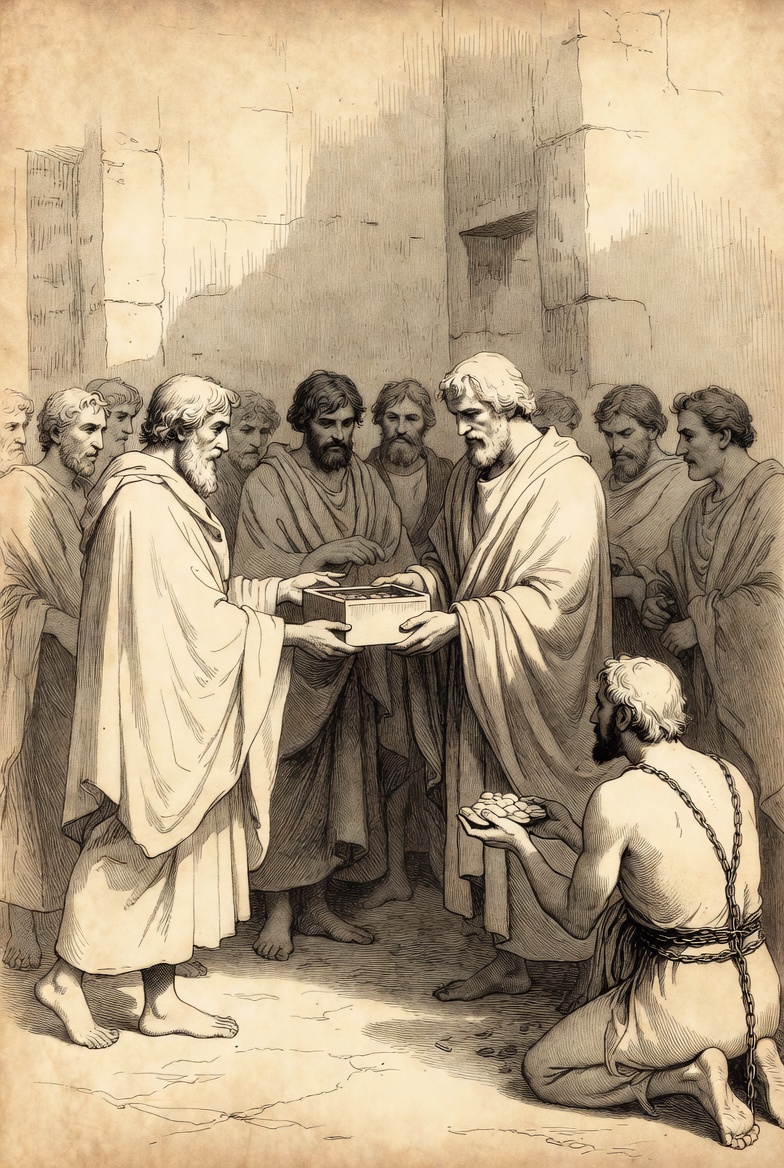
    Illustration of ancient Israelite figures in robes exchanging a tithe offering

    Where the Tithe Came From

    The tithe shows up early in the Old Testament, well before the Law of Moses. Abraham gave a tenth of the spoils of battle to Melchizedek, king of Salem and priest of God Most High, in Genesis 14. Jacob vowed a tenth of everything God gave him in Genesis 28. By the time of Moses, tithing had become codified law: Israelites were commanded to bring a tenth of their crops and livestock to support the Levites, the tribe set apart for the priesthood and temple service, since the Levites received no land inheritance of their own (Leviticus 27:30-32, Numbers 18:21).

    This wasn’t charity in the modern sense. It was closer to a national tax that funded Israel’s entire religious and social infrastructure, including provision for the poor, the foreigner, the widow, and the orphan (Deuteronomy 14:28-29).

    Did the Early Church Tithe?

    This is where it gets genuinely debated, and worth being honest about rather than picking a side and pretending it’s obvious. The New Testament never explicitly commands a 10% tithe for Christians. The early church in Acts didn’t run on a fixed percentage, it ran on radical, voluntary generosity, believers selling property and laying the proceeds at the apostles’ feet, giving as anyone had need (Acts 2:44-45, Acts 4:32-35).

    Paul’s instructions to the Corinthian church point the same direction. He tells believers to set aside a portion of their income “as he may prosper” (1 Corinthians 16:2), and later urges cheerful, willing giving rather than giving under compulsion or by a fixed rule (2 Corinthians 9:7). Some Christian scholars, including writers like Stuart Murray Williams, argue directly that the tithe was a Mosaic Law requirement never carried forward as binding on New Testament believers, replaced instead by proportional, Spirit-led generosity.

    Other traditions push back, pointing out that tithing predates the Law of Moses entirely (Abraham gave his tithe centuries before Sinai), and that Jesus himself affirmed tithing practice while criticizing those who tithed meticulously but neglected justice and mercy (Matthew 23:23), suggesting he saw it as a floor, not something to be abandoned.

    Same 10% for the Wealthy and the Poor?

    This is the practical question that matters most, and it’s worth sitting with rather than rushing past. A flat 10% is a very different sacrifice for someone earning $30,000 a year than for someone earning $3 million. Jesus made exactly this point when he watched a poor widow give two small coins at the temple, and told his disciples she had given more than all the wealthy donors combined, because she gave out of her poverty while they gave out of their abundance (Mark 12:41-44, Luke 21:1-4).

    That story doesn’t settle the tithing debate, but it does settle something else: God has never measured generosity by the size of the number. He measures it by what it actually costs the giver. Whatever position a Christian lands on regarding a fixed 10%, the widow’s example suggests the real question isn’t “did I hit the percentage,” but “did this giving actually require faith and sacrifice from me.” For a closer look at that exact debate, see our piece on whether the 10% tithe is a biblical command or a guideline.

    Where This Leaves Us

    Illustration of a family giving generously together, warm and heartfelt

    This site isn’t going to tell you which side of the tithing debate is correct, since faithful, Bible-believing Christians land in different places on this one. What we will say is this: whether you land on a strict 10%, a percentage that grows as you’re able, or Paul’s “as you have prospered” principle, the goal was never a number for its own sake. It was always a heart posture, that everything you have already belongs to God, and giving is simply putting that belief into practice. If you’re wondering why this topic doesn’t come up more often from the pulpit, we’ve written about that too: 7 reasons churches need to preach more on tithing.

    Frequently Asked Questions About the History of Tithing

    Who gave the first tithe in the Bible?

    Abram, later called Abraham. In Genesis 14:18-20 he gave Melchizedek, king of Salem and priest of God Most High, a tenth after a military victory. Hebrews 7 looks back on that same moment.

    Where is tithing first mentioned in Genesis?

    Twice. Genesis 14:20 records Abram’s tenth to Melchizedek. Genesis 28:22 records Jacob’s vow to give God a tenth of everything God gave him.

    Was tithing part of the Law of Moses?

    Yes. The Law commanded Israel to give a tenth of crops and livestock (Leviticus 27:30-32). It supported the Levites, who had no land of their own (Numbers 18:21), and helped care for foreigners, orphans and widows (Deuteronomy 14:28-29). But the practice is older than the Law, which is one reason Christians still debate whether it applies today.

    When did tithing become money?

    In ancient Israel, tithes were mostly crops and animals. Deuteronomy 14:24-26 let a family that lived too far from the place of worship sell its tithe for silver, carry the silver, and buy food there instead. Giving in coins and, later, paper money grew as economies moved from farming to wages. Many Christians today ask a related question: should you tithe on gross or net income?

    Did the early church tithe?

    The New Testament never sets a fixed percentage for Christians. The church in Acts gave freely and often far beyond 10%. See 3 incredible stories of generosity from early church history.

    This content is for educational purposes only and is not personalized financial, legal, or tax advice.

    References and Further Reading