Category: Tithing

What tithing is, its Biblical roots, and how Christians should think about giving

  • 6 Signs Your Church’s Approach to Giving May Be Unhealthy

    6 Signs Your Church’s Approach to Giving May Be Unhealthy

    Most unhealthy approaches to giving aren’t extreme or obvious. They’re common, subtle, and easy to sit through without ever naming what’s happening. Here are 6 signs worth knowing, each measured against what Scripture actually says.

    1. Giving Is Tied to a Financial Blessing Promise

    “Give, and God will make you prosper financially” goes beyond what Scripture promises. Paul’s actual standard is simpler: “Each of you should give what you have decided in your heart to give, not reluctantly or under compulsion, for God loves a cheerful giver” (2 Corinthians 9:7, NIV). Cheerful, willing giving, not a financial transaction with God, is the standard.

    2. Not Giving Is Framed as Inviting a Curse

    This pattern usually leans on Malachi 3:8-10, a passage originally addressed to Israel’s priests about a specific covenant obligation, applied instead as a general threat to any Christian who doesn’t give. It also skips over Galatians 3:13, which teaches that believers in Christ have been redeemed from a curse-based system entirely.

    3. Guilt-Trip Appeals Equate Love for God With the Amount Given

    “If you really loved God, you’d give more” is the direct opposite of “not reluctantly or under compulsion” (2 Corinthians 9:7, NIV). Love for God and generosity are connected, but generosity used as proof of love, measured by a dollar amount, turns worship into a performance.

    4. Appeals Rely on In-the-Moment Emotional Pressure

    Paul’s language is that each person gives “as he has purposed in his heart” (2 Corinthians 9:7) — decided ahead of time, prayerfully, not decided in the pressure of the moment an appeal is being made.

    5. Giving Is Expected, but Financial Reporting Is Vague or Hidden

    Paul modeled the opposite. He deliberately structured how the Jerusalem collection was handled so that no one could question the church’s integrity with the money (2 Corinthians 8:20-21). A church that asks for sacrificial giving while staying vague about where it goes isn’t following that example.

    6. Giving Level Affects Standing, Voice, or Membership

    In Acts 5:1-4, Ananias and Sapphira weren’t judged for giving less. Peter tells them directly the money was theirs to keep or give, either way, before it was ever given. The sin was the lie about what they gave, not the amount itself. Giving in the early church was consistently voluntary, never a condition of belonging.

    This content is for educational purposes and reflects general biblical principles, not a judgment of any specific church. Scripture quotations taken from The Holy Bible, New International Version® NIV® Copyright © 1973, 1978, 1984, 2011 by Biblica, Inc.® Used by permission. All rights reserved worldwide.

    References and Further Reading

  • Why Pastors Go Silent on Giving — And Why That’s Not Actually Safer

    Why Pastors Go Silent on Giving — And Why That’s Not Actually Safer

    Silence on giving feels safer than manipulation, but it isn’t actually safe. It just trades one problem for another: a congregation that’s never been taught a biblical view of money at all.

    The Reasonable Fear Behind the Silence

    Most pastors who go quiet on giving aren’t lazy or uncaring. They’ve seen the damage guilt-driven, manipulative preaching on tithing can do, and they don’t want any part of it. That’s a good instinct. But avoiding the topic entirely doesn’t protect a church from the problem, it just creates a different one: a congregation left to figure out biblical stewardship on their own, usually from culture instead of Scripture.

    Silence Has a Cost Too

    Scripture doesn’t treat teaching on money as optional or dangerous territory to avoid. Jesus talked about money constantly, more than almost any other subject. Paul spent two full chapters (2 Corinthians 8-9) carefully, directly asking the Corinthian church to give generously to a specific need. He wasn’t silent, and he wasn’t manipulative either. He modeled something in between: clear, direct teaching, held together with real transparency and respect for people’s freedom to decide.

    When pastors stay silent, churches often end up under-resourced for real ministry, and members never learn what Scripture actually teaches about generosity, stewardship, or contentment. The absence of manipulation isn’t the same thing as the presence of health.

    What This Series Explores

    The rest of this series walks through both ends of this spectrum: the signs that a church’s approach to giving has become unhealthy, the signs that it’s genuinely healthy, and practical, biblical ways pastors can challenge their people to give without falling into either silence or manipulation.

    Scripture quotations taken from The Holy Bible, New International Version® NIV® Copyright © 1973, 1978, 1984, 2011 by Biblica, Inc.® Used by permission. All rights reserved worldwide.

    References and Further Reading

  • Should You Tithe on Gross or Net Income?

    Should You Tithe on Gross or Net Income?

    There’s no verse that settles whether tithing should be calculated on gross income (before taxes and deductions) or net income (what actually lands in your bank account). Both are genuinely common, faithful practices among believers, and the honest answer is that this is a personal decision, not a biblical mandate either direction. It’s a natural follow-up to a bigger question we’ve already tackled: is the 10% tithe itself a command or a guideline?

    The Case for Gross Income

    Some Christians point to Old Testament tithing, which was calculated on the full harvest or flock, not after some portion had already been set aside for other obligations. Tithing on gross income, in this view, honors God with the “first fruits,” the full increase, before anything else touches it, including taxes.

    The Case for Net Income

    Others point out that taxes aren’t discretionary spending, they’re an obligation deducted before the money is ever truly “yours” to give from. Under this view, net income more accurately reflects actual increase, what a person genuinely has available to steward, and tithing on the full gross amount could mean giving more than 10% of real, usable income once taxes are accounted for.

    What Actually Matters More Than the Formula

    2 Corinthians 9:7 offers the principle worth anchoring to here: “Each of you should give what you have decided in your heart to give, not reluctantly or under compulsion, for God loves a cheerful giver.” (NIV) Scripture’s emphasis consistently lands on the posture behind giving, cheerful, willing, consistent, rather than a precise mathematical formula. Getting stuck on gross-versus-net can quietly become a way of turning generosity into an accounting exercise, when the actual point was never the specific number.

    Where This Leaves You

    Whichever way you calculate it, gross or net, do it consistently, prayerfully, and without treating the other choice as the wrong one for someone else. This is a genuine case where reasonable, faithful believers land in different places, and that’s alright.

    This content is for educational purposes only and is not personalized financial or tax advice. Scripture quotations taken from The Holy Bible, New International Version® NIV® Copyright © 1973, 1978, 1984, 2011 by Biblica, Inc.® Used by permission. All rights reserved worldwide.

    References and Further Reading

  • Is the 10% Tithe a Biblical Command or a Guideline?

    Is the 10% Tithe a Biblical Command or a Guideline?

    Few questions in Christian finance generate as much genuine, good-faith disagreement as this one. Some Christians treat 10% as a fixed, non-negotiable floor. Others believe it was a Mosaic Law requirement that never carried forward as binding on the church. Many evangelical and Baptist traditions still teach the fixed tithe as a standard practice today, so this remains a live question, not a settled one. Here’s the strongest version of each case, what the original languages actually say, and why the percentage debate might matter less than the question underneath it.

    What the Original Words Actually Mean

    Illustration of an ancient scroll showing the Hebrew word ma'aser and Greek word dekate side by side, both meaning a tenth

    The Hebrew word behind every Old Testament tithe reference is ma’aser (מַעֲשֵׂר), and the Greek word behind the New Testament references is dekate (δεκάτη). Both words mean exactly the same thing: a tenth. The debate was never about what the word tithe means. It’s about whether the practice it describes still applies the same way today.

    The Case for Command

    The strongest argument for treating the tithe as a standing command starts before the Law of Moses even existed. Abraham gave a tenth of the spoils of battle to Melchizedek in Genesis 14, and Jacob independently vowed a tenth of everything God gave him in Genesis 28, both centuries before Sinai. If the tithe were purely a Mosaic Law requirement, the argument goes, it wouldn’t have shown up as a voluntary act of worship before that Law existed at all.

    Malachi 3:10 is the passage most often cited: “Bring the whole tithe into the storehouse, that there may be food in my house. Test me in this,” says the Lord Almighty, “and see if I will not throw open the floodgates of heaven and pour out so much blessing that there will not be room enough to store it.” (NIV) Pastor and author Tony Evans, drawing on the Genesis 14 precedent, teaches tithing as an act of worship that predates the Law entirely, a tangible way of recognizing God as the source of everything a person has.

    The Case for Guideline

    The strongest argument on the other side starts with what the New Testament doesn’t say. Nowhere does Jesus, Paul, or any New Testament writer explicitly command a 10% tithe for Christians. Pastor John MacArthur has made this case directly and repeatedly over decades of teaching: “New Testament believers are never commanded to tithe.” His reading of 2 Corinthians 8-9, the New Testament’s longest sustained passage on giving, finds no percentage requirement anywhere in it, only the instruction to give “not reluctantly or under compulsion” (2 Corinthians 9:7, NIV).

    Pastor Francis Chan holds the same position and has taken it further in practice than most, reportedly giving away roughly 90% of his own income without ever framing it as a required percentage. His point isn’t that giving matters less without a fixed floor. It’s that generosity shouldn’t need a legal minimum to be taken seriously, a conviction two centuries of thought have echoed. John Wesley’s own instruction to his followers never mentioned a percentage at all: “Earn all you can, save all you can, give all you can.” And Charles Spurgeon, pushed on the question directly by his own congregation, put it plainly: “There are no rules laid down in the Word of God” for exactly what a Christian owes.

    Why the Percentage Debate Is a Distraction

    Illustration contrasting a calculator showing a percentage sign with an open hand releasing coins into warm golden light

    Here’s what we’d actually encourage you to take from all of this: spend less energy on the technical questions, gross or net income, before or after taxes, exactly which percentage, and more on the question underneath all of them. Every voice above, regardless of which side of the debate they land on, agrees on one thing: the goal was never a specific number. It was a posture of trust and sacrifice.

    A precisely calculated 10% given without any real sacrifice attached to it can miss the point just as easily as skipping giving altogether. Someone giving 6% because that’s genuinely stretching them may be living out the actual heart behind these passages more fully than someone technically hitting the number without feeling it at all. The debate matters for understanding Scripture accurately. It shouldn’t become the thing that determines whether or how generously someone actually gives.

    Where This Leaves Us

    We won’t tell you which side of this is correct. Faithful, Bible-believing Christians across real traditions, some teaching the fixed tithe as a continuing standard, others teaching Spirit-led proportional giving, land in genuinely different places on this question, and both positions deserve to be taken seriously rather than dismissed.

    1 Chronicles 29:14 captures something both sides actually agree on regardless of the percentage debate. King David, reflecting on the offerings gathered for the temple, prayed, “Everything comes from you, and we have given you only what comes from your hand.” (NIV) Whether you land on a strict 10%, a growing percentage, or Paul’s “as you have prospered” principle, that’s the actual foundation underneath all of it. The real question was never the percentage. It’s what your giving actually costs you.

    This content is for educational purposes only and is not personalized financial or tax advice. Scripture quotations taken from The Holy Bible, New International Version® NIV® Copyright © 1973, 1978, 1984, 2011 by Biblica, Inc.® Used by permission. All rights reserved worldwide.

    References and Further Reading

  • 7 Reasons Churches Need to Preach More on Tithing

    7 Reasons Churches Need to Preach More on Tithing

    There’s a strange gap sitting in the data on American church giving. Most churchgoers still believe tithing matters. Very few actually practice it. That gap is worth taking seriously, and it points less to a generosity problem than a teaching one.

    Illustration of a pastor preaching to an attentive congregation in a warmly lit church

    The Belief-Practice Gap, in Numbers

    According to research compiled by Fellowship Development, 77% of American Protestant churchgoers affirm that tithing is a biblical command that still applies today, down slightly from 83% in 2017. And yet only about 27% of churchgoers actually tithe at or above the traditional 10% mark. Average giving across all churchgoers sits at roughly 2.5% of net income, according to Christianity Today, actually lower than the 3.3% Christians gave during the Great Depression, a season with far less financial margin than most churchgoers have today.

    Illustration of a crowd split by a widening crack, labeled believe it and practice it, showing the gap between belief and action

    That’s not a small gap. Most people in the pews believe the teaching. Most aren’t living it out. Here are seven reasons that gap is worth churches addressing directly, not avoiding.

    1. Belief Without Practice Isn’t Discipleship

    A congregation that intellectually agrees tithing matters but doesn’t practice it hasn’t actually been discipled on the subject, it’s been informed about it. Those are different outcomes, and only one of them is the actual goal.

    2. Money Is One of the Most-Discussed Topics in Scripture

    Jesus talked about money and possessions more than almost any other single topic, more than heaven, more than prayer. A church that teaches deeply on prayer and heaven but avoids money isn’t giving a full picture of what Jesus actually emphasized.

    3. Silence Gets Filled By Something Else

    When churches don’t teach clearly on money, culture fills the gap instead, consumerism, financial anxiety, or vague guilt untethered from any actual biblical framework. Clear teaching is the alternative to that vacuum, not an intrusion into it.

    4. Generosity Is Linked to Real Wellbeing

    Research on giving and happiness, including studies published in the journal Science, has found that people who give measurably report greater happiness than those who don’t, a finding that holds across income levels. Teaching people to give isn’t just a church funding strategy, it’s pointing them toward something that appears to genuinely benefit them.

    5. Many Churchgoers Genuinely Don’t Know Where to Start

    Gross or net income, tithing while carrying debt, whether giving has to go to a local church specifically, these are common, sincere questions, and silence from the pulpit leaves people guessing rather than confidently obeying something they already believe in.

    6. Avoiding the Topic Often Comes From Fear, Not Wisdom

    Many pastors avoid teaching on money specifically to not be seen as chasing donations, an understandable instinct given how the topic has been abused elsewhere. But avoiding a true, important subject to dodge a false accusation isn’t wisdom, it’s letting fear set the curriculum.

    7. The Ministry Impact Is Real

    One estimate from Health Research Funding suggests that if every American Christian tithed at 10%, churches and ministries would have an additional $139 billion available annually. Whatever a congregation believes about the specific percentage, undertaught generosity has a real, measurable cost to the ministries and people that consistent giving could otherwise support.

    What This Isn’t Saying

    This isn’t an argument for guilt-driven fundraising appeals or manipulative giving campaigns, and it isn’t taking a side on the specific tithing debates covered elsewhere on this site. It’s simply naming what the data already shows: a wide gap between what churchgoers believe about money and what they actually do with it, and that gap closes through clear, consistent, honest teaching, not through avoidance.

    This content is for educational purposes only and is not personalized financial or tax advice.

    References and Further Reading

  • A Brief History of Tithing: What the Bible Actually Says

    A Brief History of Tithing: What the Bible Actually Says

    Ask ten Christians what tithing means and you’ll likely get ten different answers. Some will tell you it’s a strict 10% off the top, non-negotiable. Others will say it’s an Old Testament rule that doesn’t apply to New Testament believers at all. Both sides have real Scripture behind them. Here’s the actual history.

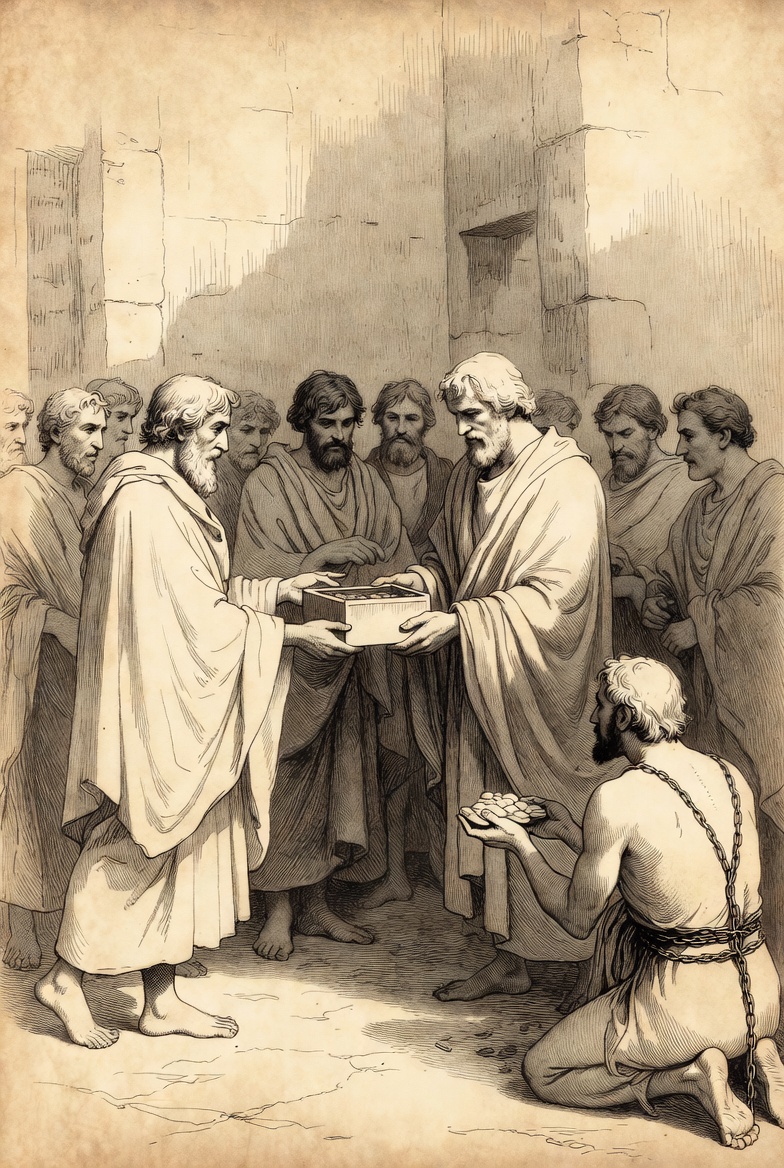
    Illustration of ancient Israelite figures in robes exchanging a tithe offering

    Where the Tithe Came From

    The tithe shows up early in the Old Testament, well before the Law of Moses. Abraham gave a tenth of the spoils of battle to Melchizedek, king of Salem and priest of God Most High, in Genesis 14. Jacob vowed a tenth of everything God gave him in Genesis 28. By the time of Moses, tithing had become codified law: Israelites were commanded to bring a tenth of their crops and livestock to support the Levites, the tribe set apart for the priesthood and temple service, since the Levites received no land inheritance of their own (Leviticus 27:30-32, Numbers 18:21).

    This wasn’t charity in the modern sense. It was closer to a national tax that funded Israel’s entire religious and social infrastructure, including provision for the poor, the foreigner, the widow, and the orphan (Deuteronomy 14:28-29).

    Did the Early Church Tithe?

    This is where it gets genuinely debated, and worth being honest about rather than picking a side and pretending it’s obvious. The New Testament never explicitly commands a 10% tithe for Christians. The early church in Acts didn’t run on a fixed percentage, it ran on radical, voluntary generosity, believers selling property and laying the proceeds at the apostles’ feet, giving as anyone had need (Acts 2:44-45, Acts 4:32-35).

    Paul’s instructions to the Corinthian church point the same direction. He tells believers to set aside a portion of their income “as he may prosper” (1 Corinthians 16:2), and later urges cheerful, willing giving rather than giving under compulsion or by a fixed rule (2 Corinthians 9:7). Some Christian scholars, including writers like Stuart Murray Williams, argue directly that the tithe was a Mosaic Law requirement never carried forward as binding on New Testament believers, replaced instead by proportional, Spirit-led generosity.

    Other traditions push back, pointing out that tithing predates the Law of Moses entirely (Abraham gave his tithe centuries before Sinai), and that Jesus himself affirmed tithing practice while criticizing those who tithed meticulously but neglected justice and mercy (Matthew 23:23), suggesting he saw it as a floor, not something to be abandoned.

    Same 10% for the Wealthy and the Poor?

    This is the practical question that matters most, and it’s worth sitting with rather than rushing past. A flat 10% is a very different sacrifice for someone earning $30,000 a year than for someone earning $3 million. Jesus made exactly this point when he watched a poor widow give two small coins at the temple, and told his disciples she had given more than all the wealthy donors combined, because she gave out of her poverty while they gave out of their abundance (Mark 12:41-44, Luke 21:1-4).

    That story doesn’t settle the tithing debate, but it does settle something else: God has never measured generosity by the size of the number. He measures it by what it actually costs the giver. Whatever position a Christian lands on regarding a fixed 10%, the widow’s example suggests the real question isn’t “did I hit the percentage,” but “did this giving actually require faith and sacrifice from me.” For a closer look at that exact debate, see our piece on whether the 10% tithe is a biblical command or a guideline.

    Where This Leaves Us

    Illustration of a family giving generously together, warm and heartfelt

    This site isn’t going to tell you which side of the tithing debate is correct, since faithful, Bible-believing Christians land in different places on this one. What we will say is this: whether you land on a strict 10%, a percentage that grows as you’re able, or Paul’s “as you have prospered” principle, the goal was never a number for its own sake. It was always a heart posture, that everything you have already belongs to God, and giving is simply putting that belief into practice. If you’re wondering why this topic doesn’t come up more often from the pulpit, we’ve written about that too: 7 reasons churches need to preach more on tithing.

    This content is for educational purposes only and is not personalized financial, legal, or tax advice.

    References and Further Reading