There’s no verse that settles whether tithing should be calculated on gross income (before taxes and deductions) or net income (what actually lands in your bank account). Both are genuinely common, faithful practices among believers, and the honest answer is that this is a personal decision, not a biblical mandate either direction. It’s a natural follow-up to a bigger question we’ve already tackled: is the 10% tithe itself a command or a guideline?
The Case for Gross Income
Some Christians point to Old Testament tithing, which was calculated on the full harvest or flock, not after some portion had already been set aside for other obligations. Tithing on gross income, in this view, honors God with the “first fruits,” the full increase, before anything else touches it, including taxes.
The Case for Net Income
Others point out that taxes aren’t discretionary spending, they’re an obligation deducted before the money is ever truly “yours” to give from. Under this view, net income more accurately reflects actual increase, what a person genuinely has available to steward, and tithing on the full gross amount could mean giving more than 10% of real, usable income once taxes are accounted for.
What Actually Matters More Than the Formula
2 Corinthians 9:7 offers the principle worth anchoring to here: “Each of you should give what you have decided in your heart to give, not reluctantly or under compulsion, for God loves a cheerful giver.” (NIV) Scripture’s emphasis consistently lands on the posture behind giving, cheerful, willing, consistent, rather than a precise mathematical formula. Getting stuck on gross-versus-net can quietly become a way of turning generosity into an accounting exercise, when the actual point was never the specific number.
Where This Leaves You
Whichever way you calculate it, gross or net, do it consistently, prayerfully, and without treating the other choice as the wrong one for someone else. This is a genuine case where reasonable, faithful believers land in different places, and that’s alright.
Cornelius Vanderbilt built the largest fortune in American history, and when the time came to pass it on, he didn’t split it evenly among his thirteen children. Almost all of it went to one son, William, a decision that raised eyebrows even at the time. What happened next is its own remarkable story, told in full here, but the short version is this: the fortune didn’t just survive, it doubled. Looking closely at exactly what Cornelius did reveals five real, transferable principles behind that outcome, whether the Commodore was applying them on purpose or simply trusting his own instincts.
1. He Tested Before He Trusted
William wasn’t handed control of anything significant early in life. He was handed the small, failing Staten Island Railway, and only proved himself capable through that, on a scale small enough that failure wouldn’t have threatened the larger empire. Trust was earned in a controlled environment before it was extended in a consequential one.
This is a principle worth sitting with if you’re responsible for handing off a business, a ministry, or even a family budget to someone else. Giving someone your full trust before they’ve proven themselves in something small isn’t generosity, it’s a gamble with everyone else’s future riding on it. Start people where a mistake is recoverable, and let real responsibility grow only as real, demonstrated competence grows alongside it.
2. He Concentrated Rather Than Fragmented
Roughly 95% of a $105 million estate went to William and his sons, an extraordinarily concentrated decision for the era. Splitting a functioning business empire evenly among many heirs often means splitting it into pieces too small for any single person to run effectively. The Commodore kept the machine whole.
This isn’t a universal formula, and Scripture never demands it as one. But it does raise an honest question for anyone building something that actually matters: will splitting things evenly preserve what you built, or will it just guarantee that nobody involved has enough control, capital, or authority to keep it alive? Fair and equal aren’t always the same thing, and the Commodore clearly understood the difference between the two.
3. He Passed Down Explicit Wisdom, Not Just Money
According to family biographer Arthur T. Vanderbilt II, the Commodore’s parting words to William were blunt: any fool can make a fortune, it takes a man of brains to hold onto it. That wasn’t idle commentary. It reads like a man who understood, instinctively, that the money alone wouldn’t be enough.
Too many families treat wealth transfer as a purely legal and financial event, wills, trusts, and account transfers, and stop there. The Commodore’s blunt warning suggests he saw the real risk more clearly than that: money without wisdom rarely survives contact with the next generation for long. A single sentence, spoken plainly at the right moment, can end up shaping a family’s future more than any legal document ever could.
4. He Gave William Real Runway, Not a Sudden Handoff
William’s responsibility grew steadily across roughly two decades, from the Staten Island line, to the Hudson River Railroad, to New York Central itself, well before the Commodore’s death made any of it official.
By the time William actually inherited control, he had already been functionally running the business for years. Two decades is a long runway by any standard, and it meant William wasn’t just being told he was ready, he actually was. Sudden handoffs, whether of a business, a ministry, or a family’s finances, tend to expose gaps nobody knew were there until it’s too late to fix them quietly. Gradual, visible growth in responsibility gives everyone involved, including the person receiving it, real time to see whether the trust being placed in them is actually earned.
5. The Conflict That Followed Was Handled, Not Buried
The concentrated inheritance triggered a real will contest from William’s siblings. Rather than let it calcify into permanent estrangement, William settled directly, paying his sisters and brother additional sums to resolve it. Conflict over money is close to inevitable in any significant inheritance. What actually matters is whether it gets addressed or left to fester.
It would have been easy for William to treat the will as legally settled and simply ignore his siblings’ objections; he had both the money and the legal standing to do exactly that. Instead, he chose to resolve it directly and personally, which cost him more in the short term but preserved something money can’t buy back once it’s gone: an actual relationship with his own family. That choice is easy to overlook next to the bigger, flashier decisions on this list, but it may be the most instructive one here.
What This Actually Says
Proverbs 13:22 says, “A good man leaves an inheritance to his children’s children.” (NIV) The verse is often read as simply being about leaving money behind. The Commodore’s actual approach suggests something more specific: the inheritance that lasts isn’t just the money itself, it’s whether the next generation was actually prepared to hold onto it. It’s worth noting this was nearly the opposite philosophy of contemporaries like Andrew Carnegie and John D. Rockefeller, who built their legacies not on what they passed down, but on how much they gave away.
Decades later, a different Gilded Age family would try something even more structural than any of this, building a rule directly into the legal terms of the will itself, rather than relying entirely on one generation’s judgment. That story is worth its own telling.
The Bible never explicitly calls debt a sin, but it consistently treats it as a serious obligation deserving real caution, not something to enter into casually or treat as a neutral financial tool. This principle applies directly to newer forms of debt too, like Buy Now, Pay Later services.
The Clearest Warning
Proverbs 22:7 states the core dynamic plainly: “The rich rule over the poor, and the borrower is slave to the lender.” (NIV) This isn’t a moral condemnation of debt as inherently sinful, it’s a clear-eyed description of what debt actually creates: real obligation, real vulnerability, and a real transfer of power to whoever is owed.
Old Testament Structure Around Debt
Scripture doesn’t treat debt as something to avoid discussing either. The Sabbatical year in Deuteronomy 15 required debts to be canceled every seven years among the Israelite community, a built-in system of relief rather than indefinite obligation. God’s law took debt seriously enough to build structured limits around it.
What This Means Practically
Romans 13:8 adds a further, often-quoted instruction: “Let no debt remain outstanding, except the continuing debt to love one another.” (NIV) Many read this as counsel toward paying off obligations diligently rather than a flat prohibition on ever borrowing, since Scripture elsewhere assumes lending and borrowing will happen. The consistent thread isn’t “debt is forbidden.” It’s “debt is serious, and should be entered into rarely, repaid faithfully, and never treated lightly.”
Where This Leaves You
Debt isn’t a sin to avoid confessing. It’s an obligation Scripture takes seriously enough to warn about repeatedly, structure limits around, and instruct believers to repay diligently. That’s a different, more nuanced picture than either “debt is always fine” or “debt is always wrong.”
This is the companion piece to our article on what actually counts as an asset. If an asset, by the practical cash-flow definition, is something that puts money in your pocket, a liability is its mirror image: something that takes money out, month after month, whether or not you’re using it.
The Traditional Definition vs. the Practical One
In traditional accounting terms, a liability is simply anything you owe, a debt, a loan balance, money legally owed to someone else. That’s accurate but incomplete for everyday decision-making. The more useful, practical definition, popularized by writers like Robert Kiyosaki, asks a different question: does this cost you money every month, regardless of whether it’s technically “debt” in the legal sense.
10 Things That Are Actually Liabilities (By the Cash-Flow Definition)
A car loan, especially on a vehicle that depreciates faster than the loan is paid down
A mortgage on a primary home, since it costs money monthly without generating income back, regardless of long-term appreciation
Credit card balances carried month to month, compounding against you instead of for you
A timeshare, which combines an upfront cost with ongoing fees and notoriously little resale value
Unused subscription services, small individually, real money in aggregate
A boat, RV, or other recreational vehicle sitting unused most of the year while still costing insurance, storage, and maintenance
Student loans for a credential that hasn’t translated into increased earning power
A home equity line of credit used for consumption rather than investment
Store credit cards with high interest rates opened for a one-time discount
“Good debt” that isn’t actually generating any return, a category people often assume is automatically safe simply because it’s labeled that way
Where the Real Confusion Lives
The most common financial blind spot isn’t obvious debt like credit cards, most people already know those are liabilities. It’s the assets that are quietly functioning as liabilities without anyone noticing. A primary home is the clearest example: it’s genuinely valuable, it may appreciate significantly over time, and it’s still, from a monthly cash-flow standpoint, a liability the entire time you own it, since it costs money every month rather than generating any.
This isn’t a case against homeownership, mortgages, or reasonable debt used deliberately. It’s a case for accuracy: knowing which of your monthly obligations are actually working against your cash flow helps you make clearer decisions about which ones to pay down first, and which ones might not be worth taking on at all.
What Scripture Says About This
Proverbs 22:7 states it plainly: “The rich rule over the poor, and the borrower is slave to the lender.” (NIV) That’s not a condemnation of every form of debt, Scripture doesn’t treat all borrowing as sin, but it is a clear-eyed warning about what debt actually does: it creates real obligation and real vulnerability, even when it’s fully legal and even when it’s labeled “good.” A liability, understood honestly, is exactly that, an ongoing claim on your future income, whether that claim comes from a predatory interest rate or a perfectly reasonable mortgage.
The Practical Takeaway
Building real financial margin usually means doing two things at once: acquiring more of the things that put money in your pocket, and being honest about which of your current obligations are quietly taking money out. Most people already have a clearer sense of their assets than their liabilities. Listing both accurately, using the same practical definition, tends to be the more uncomfortable exercise, and the more useful one.
Buy Now, Pay Later isn’t inherently sinful, but it is a form of debt, and it deserves the same honest evaluation Scripture asks us to bring to any borrowing. Here’s how to think it through. If margin is tight enough that BNPL feels necessary, it may be worth starting with building a real emergency fund instead.
What BNPL Actually Is
Buy Now, Pay Later services like Afterpay, Klarna, and Affirm let you split a purchase into several payments, often four installments over six weeks, with no interest if you pay on time. It’s marketed as smarter than a credit card: no interest, no annual fee, and it’s baked right into checkout at thousands of retailers. By 2026, roughly 96 million Americans are expected to use a BNPL service.
Is It Actually Debt?
Functionally, yes. You’re receiving something now and promising future payment for it, which is the basic definition of debt regardless of what it’s branded as. The absence of interest, when payments are made on time, is a real difference from a credit card. But according to LendingTree’s 2026 Buy Now, Pay Later Report, 47% of BNPL users say they’ve paid late on a loan in the past year, up from 41% in 2025 and 34% in 2024, a trend moving in the wrong direction, not the right one.
The Real Risk: It Doesn’t Feel Like Debt
The genuine concern with BNPL isn’t the mechanics, it’s the psychology. Splitting $200 into four $50 payments makes a purchase feel dramatically smaller than it is, which can quietly erode the kind of deliberate, planned spending Scripture consistently points toward. LendingTree’s research also found a troubling shift: a growing share of BNPL users now report using it for groceries, not just discretionary purchases, a sign the tool is increasingly covering needs rather than wants. Proverbs 21:5 says, “The plans of the diligent lead to profit as surely as haste leads to poverty.” (NIV) BNPL is engineered, by design, to reduce the friction between wanting something and buying it. That’s precisely the kind of haste this proverb warns against.
A Simple Discernment Test
Rather than a blanket rule, a more useful question is this: would you make this exact purchase today if you had to pay the full amount upfront, right now, from money already in hand? If the honest answer is no, the four-payment plan isn’t making the purchase wiser. It’s just making it easier to say yes to something you’d otherwise pause on.
Where This Leaves Us
Christians land in different places here. Some avoid BNPL entirely, treating any deferred payment as a discipline risk not worth taking. Others use it deliberately and carefully, for planned purchases they could afford outright anyway, simply to smooth out cash flow. Neither position is unbiblical on its face. What matters more than which camp you’re in is whether your use of it reflects patience and planning, or whether it’s quietly becoming a way to want things faster than your actual means allow. That’s a question worth being honest with yourself about, far more than a question of which app is on your phone.
Read the Vanderbilt story in order and a pattern becomes hard to miss: nearly every major purchase the family made after the Commodore’s death wasn’t really justified on its own terms. It was justified by comparison to whatever the last purchase had been. That pattern has a name, lifestyle creep, and it’s worth pulling out of the story and looking at directly, because it doesn’t require Gilded Age money to operate. It just requires a moving baseline.
The Escalation, Traced Directly
William Henry Vanderbilt built the first major Vanderbilt showpiece, the “Triple Palace” on Fifth Avenue, a genuine architectural statement in its own right. It didn’t stay the ceiling for long. Alva Vanderbilt built 660 Fifth Avenue specifically to outdo it, then threw a $6 million costume ball inside it specifically to force New York society to notice. Her sister-in-law didn’t stay quiet either, The Breakers went up in Newport not long after. Then Marble House. Each structure wasn’t simply “a nice house.” It was a direct answer to whichever relative had built the last one.
Why This Matters More Than the Dollar Figures
The specific numbers are almost beside the point. What matters is the mechanism: at no stage did anyone in this pattern sit down and ask “what do we actually need.” The question that actually got asked, explicitly or not, was “what did the last person have, and how do we exceed it.” That’s the entire engine of lifestyle creep, and it runs exactly the same way at any income level. A raise becomes a bigger car payment not because the bigger car was ever actually needed, but because the old car now feels like it belongs to a smaller version of your life than the one you’re currently living.
The Quiet Part Nobody Budgets For
What made this genuinely dangerous for the Vanderbilts wasn’t any single house. It was that each new baseline became permanent overhead, staff, maintenance, upkeep, that had to be sustained indefinitely, long after the excitement of building it had worn off.
Lifestyle creep rarely announces itself as a single bad decision. It shows up as a new normal that quietly requires more from every year that follows, whether or not the income behind it keeps pace.
What Actually Breaks the Pattern
1 Timothy 6:8 offers about as direct a countermeasure as Scripture has to offer: “But if we have food and clothing, we will be content with that.” (NIV) That’s not a call to poverty, it’s a description of a floor, a baseline set by actual need rather than by comparison to whoever happens to be nearby. The Vanderbilts never really had that floor. Each generation’s “enough” was defined entirely by the previous generation’s “too much,” and a family fortune large enough to survive almost any single mistake still couldn’t survive that particular pattern running unchecked for three generations straight.
No, being rich is not itself a sin. Scripture never condemns wealth in and of itself, faithful, wealthy people appear throughout the Bible without rebuke. What Scripture consistently warns against isn’t wealth, it’s what wealth can do to the heart of the person holding it. This is closely related to a question we’ve tackled from a different angle: is the prosperity gospel actually biblical?
Wealthy and Faithful, at the Same Time
Abraham, Job, and Solomon were all extraordinarily wealthy, and all three are described as faithful, not condemned for their riches. Job in particular is described as blameless and upright, and also as one of the wealthiest men in the East, the two descriptions sitting side by side without tension.
Where the Real Warning Actually Lives
1 Timothy 6:10 is often misquoted as “money is the root of all evil.” That’s not what it says. “For the love of money is a root of all kinds of evil.” (NIV) The warning targets the love of money, an attachment, a trust placed in wealth instead of God, not the possession of money itself. Jesus’s own warning about the rich young ruler in Mark 10 wasn’t a blanket statement against wealth either, it was a specific diagnosis of that one man’s specific attachment, the thing standing between him and following Christ.
The Actual Test
The real question Scripture asks isn’t “how much do you have,” it’s “what has your heart attached itself to.” A person of modest means can be just as consumed by money as a wealthy person, and a wealthy person can hold their resources with genuinely open hands. Wealth reveals character. It doesn’t determine it.
Where This Leaves You
Being rich isn’t the sin. Loving riches, trusting them instead of God, and letting them crowd out generosity and dependence on Him, is exactly what Scripture consistently warns against, regardless of the number in your bank account.
Ask most people what an asset is, and they’ll describe anything they own that’s worth money: a house, a car, jewelry, whatever’s sitting in a bank account. That definition isn’t wrong exactly, but it’s incomplete in a way that quietly steers a lot of people toward the wrong financial decisions. This is the first piece in a growing series on assets and liabilities, paired with its companion post on what actually counts as a liability.
Two Different Definitions
In traditional accounting, an asset is simply anything you own that has value, full stop. Your house counts. Your car counts. A watch, a piece of furniture, all of it.
But a second, more practical definition has become popular through personal finance writers like Robert Kiyosaki: an asset is something that puts money in your pocket. A liability is something that takes money out. This cash-flow definition is more useful for everyday decision-making, because it forces a different question than “what’s this worth,” it asks “what is this actually doing for me, month over month.”
10 Things That Are Actually Assets (By the Cash-Flow Definition)
A paid-off rental property generating monthly income
Dividend-paying investments that pay you simply for holding them
A marketable skill or certification that increases your earning power
A high-yield emergency fund, which does more than just sit there protecting you from costly debt, kept in a high-yield savings account rather than a standard checking account, it actively earns interest on money that would otherwise be doing nothing, making it a genuine cash-flow asset in its own right, not just a safety net
A business that runs without your constant presence
Royalties from creative or intellectual work
A well-maintained professional network, which has real, if harder to quantify, income-generating value
Paid-off equipment used to generate income, like a tradesperson’s tools or a photographer’s camera
Tax-advantaged investment accounts, a category worth knowing by name rather than treating as one generic bucket: a Roth IRA (contributions grow and can be withdrawn tax-free in retirement), a 529 plan (tax-advantaged savings earmarked for education), and a Health Savings Account, or HSA (one of the only accounts offering a tax break going in, tax-free growth, and tax-free withdrawals for medical expenses, arguably the single most tax-advantaged account available to most people)
Digital assets built for a business, like a large, engaged email list or social media following, which translates directly into future sales and income potential the same way a physical customer base would
The Confusion This Clears Up
Here’s where the two definitions can genuinely conflict, and it’s worth being upfront that this is a real, live debate rather than a settled question. Under the traditional accounting definition, a primary home is an asset, full stop, it has value. Under a strict monthly cash-flow definition, a home doesn’t generate income the way a rental property does, since money flows out every month rather than in. But a strong counter-case exists too: a home is typically purchased at one price and, in most markets over a long enough timeframe, sold later at a higher one, which is its own legitimate way of putting money in your pocket, just on the timeline of a sale rather than a monthly check. Reasonable people, including us, genuinely disagree on how much weight that appreciation should carry against the monthly cash-flow question. We think this deserves its own full treatment rather than a quick verdict buried in a list, so we’ll be dedicating a full series to making the case for homeownership as a genuine wealth-building asset. For now, the useful takeaway is simpler: know which definition you’re using, and don’t let a purely cash-flow framework talk you out of a decision that may be building real wealth on a different, longer timeline.
What This Actually Means for Building Wealth
This isn’t an argument against owning a home or other traditional assets, those often serve real, important purposes beyond monthly cash flow. It’s simply a case for knowing which kind of asset you’re looking at before making decisions based on the wrong definition. Someone trying to build long-term financial security benefits from deliberately acquiring cash-flow assets, things that work for them every month, alongside longer-horizon assets like a home that build value on a different timeline.
Jesus told a parable about exactly this kind of stewardship in Luke 19:12-27, the parable of the ten minas, where a nobleman entrusts money to his servants before a journey and later evaluates them based on what they did with it, not simply on what they were given. The servant who put his mina to work and multiplied it was commended. The one who did nothing but preserve it, keeping it safely wrapped in a cloth, was rebuked, not for losing money, but for failing to put what he had to productive use. The parable isn’t really about money management technique. It’s about the expectation that what we’re given should be put to work, not just held.
This content is for educational purposes only and is not personalized financial advice.
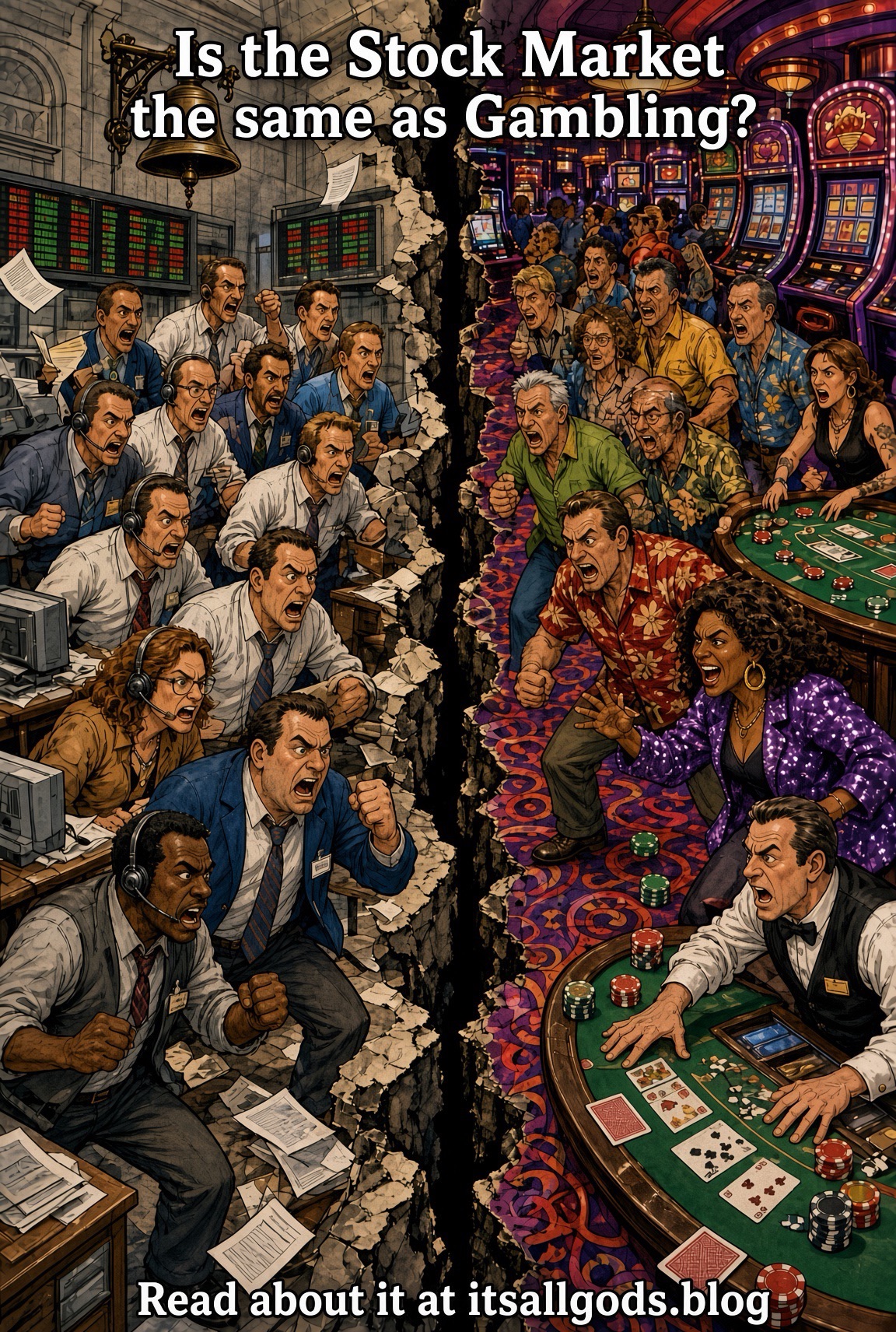
No, investing in the stock market is not gambling, and the difference isn’t just semantic. Gambling creates risk that didn’t need to exist, purely for entertainment. Investing takes on calculated risk in exchange for a share in something real: the ongoing growth of actual businesses. Understanding that difference changes how the whole question should be approached.
What Makes Gambling, Gambling
A casino game has a built-in house edge. The odds are structured so that, over enough time, the house wins and the player loses, by design. Nothing productive is being built. No value is being created. The money simply moves from one party to another based on chance.
The stock market works differently. When you buy a share of a company, you’re buying a small ownership stake in a real, functioning business, one that makes products, employs people, and, if it’s run well, grows in value over time. Historically, the S&P 500 has averaged roughly a 10% annual return since its inception. That’s not a coin flip. It’s the aggregate outcome of real companies producing real goods and services over time.
The Question Almost Nobody Asks: Is “Safe” Actually Safe?
Here’s the part of this conversation that gets skipped most often. As of August 2026, the national average savings account pays just 0.63% APY, according to Bankrate. Inflation, meanwhile, sat at roughly 3.4-3.5% as of mid-2026. That gap matters enormously: money sitting in a typical savings account isn’t neutral or risk-free, it’s quietly losing purchasing power every single year, even while the account balance itself never goes down.
Put concretely: $10,000 sitting in a national-average savings account for a year earns about $63 in interest, while inflation alone erodes roughly $340-350 worth of that money’s purchasing power over the same period. The number in the account grew. What that number can actually buy shrank. That’s a real, measurable risk, it’s just a quieter, less visible one than a stock price dropping on a screen.
A Tool, Not a Verdict
The honest answer is that the stock market is a tool, and like most tools, it can be used wisely or recklessly. Day-trading with money you can’t afford to lose, chasing hot tips, or treating individual stock picks like a lottery ticket does start to resemble gambling in practice, even though it’s technically “investing.” Broad, diversified, long-term investing, the kind most people actually mean when they talk about retirement accounts and index funds, operates on an entirely different principle: patient ownership in real productive assets, not a bet on a single unpredictable outcome.
What Scripture Actually Points Toward
Jesus told a parable about exactly this kind of stewardship in Matthew 25:14-30, the parable of the talents. A master entrusts his servants with resources before a journey. Two of them put the money to work and it grows. The third, out of fear, buries his portion in the ground to keep it perfectly safe, and he’s the one rebuked on the master’s return, not for losing money, but for refusing to put what he’d been given to productive use at all. “You wicked, lazy servant!” the master says in verse 26. “You should have put my money on deposit with the bankers, so that when I returned I would have received it back with interest.” (NIV) The parable doesn’t celebrate the safest possible choice. It celebrates faithful, productive stewardship, and treats excessive caution, not risk itself, as the actual failure.
Where This Leaves You
Investing in the stock market, done broadly and with a long time horizon, isn’t gambling. It’s participation in real economic growth, the same kind of productive stewardship the parable of the talents commends. Like any tool, it can be misused, and caution about how you invest is genuinely wise. But caution about whether to invest at all, once you understand what the alternative actually costs, deserves the same scrutiny.
In 1986, a struggling amusement park called Silver Dollar City sat in the hills of Pigeon Forge, Tennessee. It wasn’t drawing crowds, and it wasn’t drawing money. A country singer who’d grown up nearby, in a one-room cabin with eleven siblings, decided to invest in it — not just her money, but her name. Forty years later, that decision was still generating tens of millions of dollars a year.
Dolly Parton, who died August 25, 2026 at age 80, built a fortune estimated between $450 million and $650 million — without ever chasing billionaire status, and without a Wall Street background of any kind. Here are seven reasons the woman behind “9 to 5” turned out to be one of the sharpest business minds in entertainment.
1. She Refused Elvis Presley’s People — and Kept Her Copyright
In the mid-1970s, Dolly got the call every songwriter dreams of: Elvis Presley wanted to record her song “I Will Always Love You.” Everything was arranged — until the night before the session, when Presley’s manager, Colonel Tom Parker, called with a condition. Presley’s organization didn’t record songs without owning at least half the publishing rights.
Dolly said no. “This is the most important copyright in my whole publishing company, and I can’t do that,” she told Parker. The session was cancelled, and she later admitted she cried all night over turning down the King of Rock and Roll. But she walked away owning 100 percent of a song that hadn’t even become famous yet.
2. She Let That One Decision Multiply for Fifty Years
In 1992, Whitney Houston recorded “I Will Always Love You” for The Bodyguard, and the song became one of the best-selling singles in music history. Because Dolly had refused to give up any of the publishing years earlier, every bit of that windfall came back to her — estimates of her earnings from Houston’s version alone run close to $10 million, and the song has kept generating royalties ever since.
That single decision is a big part of why Dolly’s broader songwriting catalog — more than 3,000 songs — has been valued at upwards of $120 million, with her overall music royalties estimated to bring in somewhere between $6 million and $8 million a year, even decades after most of the songs were written. She didn’t just get paid once for her talent. She built a royalty machine that kept paying her for the rest of her life.
3. She Turned the Windfall Into Real Estate — “The House That Whitney Built”
What Dolly did with the Whitney Houston royalties says as much about her financial instincts as the decision to protect them in the first place. She used a portion of that money to buy a commercial office complex in a historically Black neighborhood off 16th Avenue in Nashville. “I bought a property down in what was the Black area of town, and it was mostly just Black families and people that lived around there,” she explained on Watch What Happens Live in 2021. “This is the house that Whitney built.”
It’s a striking chain of financial decisions: a song became a copyright, the copyright became royalties, and the royalties became a physical, income-producing asset in a community she chose deliberately. Song, to royalty stream, to real estate — that’s not luck. That’s a plan.
4. She Bet On Herself and Built Dollywood
In 1986, Dolly partnered with Herschend Family Entertainment and put her name and money behind the struggling Silver Dollar City park, transforming it into Dollywood. Her 50 percent stake in the park has been estimated by Forbes at roughly $165 million on its own — and that’s before counting the millions in annual revenue the park generates (estimates range from $180 million to $580 million a year) and the thousands of local jobs it supports.
This wasn’t a hands-off investment. Dolly poured her name, her reputation, and repeated personal appearances into the park for four straight decades. It’s a reminder that some of the best investments aren’t the ones you write a check for and walk away from — they’re the ones you stay close enough to actually steward.
5. She Built an Entire Ecosystem Around Her Name
Dollywood was the anchor, but Dolly never stopped there. Her business holdings grew to include the Dolly Parton’s Stampede and Pirates Voyage dinner attractions, a signature fragrance line, cookbooks and bakeware, cosmetics, a wine label, home decor, clothing, and licensing deals across dozens of categories. Rather than depending on music royalties or theme-park revenue alone, she diversified deliberately, spreading her income across businesses that had almost nothing to do with singing.
That instinct traces back further than people realize — in 1980, she negotiated a then-unheard-of $500,000 advance for her 9 to 5 and Odd Jobs album, at a time when few artists, and especially few women in country music, were pushing for that kind of deal. Diversification wasn’t a late-career pivot for Dolly. It was a pattern from the start.
6. She Reportedly Lived on $5,000 a Month — By Choice
Here’s the detail that might be the most surprising: despite a business empire estimated to bring in hundreds of thousands of dollars a month, multiple financial profiles report that Dolly kept her own personal spending remarkably modest — reportedly living on around $5,000 a month, a tiny fraction of what her businesses generated. “I never wanted to be poor again,” she once said of the frugality that carried over from her childhood in that one-room cabin.
That gap between what she made and what she spent is, in plain terms, the entire engine of wealth-building: a strong income, paired with restrained personal spending, rather than letting lifestyle expand to swallow every dollar that came in. It’s a far less flashy secret than owning Dollywood or writing hit songs — but financially, it may have mattered just as much.
7. She Gave Away a Fortune While Still Building One
Dolly Parton was never a billionaire, and by every account, she wasn’t trying to be. A significant share of what her businesses generated was redirected into philanthropy — the Imagination Library, disaster relief, medical research, and her home county’s schools and hospital — even while those same businesses kept growing. Proverbs 3:9-10 says, “Honor the Lord with your wealth, with the firstfruits of all your crops; then your barns will be filled to overflowing” (NIV). Whether or not Dolly framed her decisions in exactly those terms, the pattern of her life — own what you create, turn income into lasting assets, live below your means, and give generously from what’s built — reflects a stewardship instinct more than a purely accumulative one.
References
American Songwriter, “The Story Behind Why Dolly Parton Refused to Let Elvis Presley Record ‘I Will Always Love You,’” 2022
Celebrity Net Worth, “Elvis Presley Wanted to Record ‘I Will Always Love You.’ Dolly Parton Said No,” August 2026
Yahoo Entertainment / Andy Cohen’s Watch What Happens Live, “Dolly Parton Used Royalties From Whitney Houston Song to Support a Black Neighborhood,” July 2021
Newser / Washington Post, “Dolly Parton: ‘This Is the House That Whitney Built,’” August 2021
Finance Monthly, “Dolly Parton’s Net Worth 2025: A Fortune Built From ‘9 to 5,’” 2026
Networth Hub, “How Dolly Parton’s Net Worth Reached $600M,” June 2026
Inc., “Dolly Parton Built a $650 Million Empire by Ignoring the Goal Entrepreneurs Chase,” July 2026
Investormint, “Dolly Parton Net Worth 2026: Music, Dollywood & More,” 2026