Tag: stewardship

  • 6 Ways Dolly Parton Used Her Fame to Help Others

    6 Ways Dolly Parton Used Her Fame to Help Others

    A governor from one party and a governor from the other party stood on the same stage in Nashville in 2005. Dolly Parton stood between them, joked that she felt “torn between two governors,” and then got back to the actual point of the event: celebrating ten years of a program that had nothing to do with politics and everything to do with getting books into the hands of kids who needed them.

    That scene captures something Dolly understood better than most celebrities: fame is a tool, and a tool is only as good as what you build with it. Following her death on August 25, 2026, here are six verified ways she put her platform to work for people who needed it more than she did.

    1. She Scaled a Local Book Drive Into a Global Program

    The Imagination Library started small in 1995 — free books for children in Dolly’s home county, inspired by her father, who never learned to read. Because Dolly’s name carried weight, the program didn’t stay small. It expanded into the United States, Canada, the United Kingdom, Australia, and the Republic of Ireland, eventually gifting more than 270 million free books to children by 2025 — over 40 million in that year alone.

    2. She Personally Lobbied Governors to Fund It

    Dolly didn’t just start the Imagination Library and let it run — she actively used her celebrity to keep state funding behind it. In 2025, when Indiana’s governor proposed cutting the state’s funding match, Dolly and the Dollywood Foundation publicly pushed back, and the funding was preserved. She made a similar personal push in Ohio, where the governor declared an official “Dolly Parton Day” tied to the program’s growth in that state.

    3. She Gave the 100 Millionth Book to the Library of Congress

    In February 2018, Dolly personally delivered the 100 millionth Imagination Library book to the Library of Congress in Washington, D.C. It wasn’t just a nice photo — it was a deliberate use of a national spotlight to put childhood literacy on the map at the highest level of visibility available to her.

    4. She Turned Award Speeches Into Advocacy

    Dolly Parton performing joyfully on stage under warm spotlights

    When Dolly accepted the Carnegie Medal of Philanthropy in 2022 — one of the field’s highest honors — she used the moment not to talk about her career, but to talk about the Imagination Library and the simple principle behind all her giving: “I just see a need and if I can fill it, then I will.” Time and again, her acceptance speeches functioned as free advertising for causes rather than victory laps for herself.

    5. She Made Disaster Relief a Household Story

    When Dolly gave to wildfire victims in 2016 and Hurricane Helene victims in 2024, the giving itself mattered — but so did the fact that a global celebrity was doing it publicly, from her own home region. Her visibility turned regional disasters into national news, drawing additional donations and attention to East Tennessee relief efforts that a private, anonymous donor never could have generated.

    6. She Let Her Fame Point Somewhere Other Than Herself

    Perhaps the clearest evidence: when Tennessee lawmakers wanted to build her a statue, she declined, explaining that a season of division wasn’t the time to put anyone on a pedestal. “I get paid more attention than maybe some others that are doing more than me,” she once said, “[but] I hope that attention inspires more people to help others.” That’s the through-line in every item on this list — attention, spent on someone else’s behalf.

    A Platform Worth Something Beyond the Platform

    Jesus told His followers, “In the same way, let your light shine before others, that they may see your good deeds and glorify your Father in heaven” (Matthew 5:16, NIV). Dolly Parton’s fame could have stopped at entertainment. Instead, again and again, she pointed it at a need — a child without books, a family without a home, a community without a hospital — and let the light land somewhere other than herself.

    References

    • Rolling Stone Australia, “Turning Pages: Inside Dolly Parton’s Imagination Library”
    • Fox News, “Dolly Parton Urges Indiana Governor Not to Cut Funds for Her Imagination Library,” February 2025
    • Axios, “Dolly Parton Celebrates Her Imagination Library Program,” 2022
    • PBS NewsHour, “Dolly Parton’s Donation Strategy Is to Just Give From My Heart,” 2022
    • MS NOW, “Dolly Parton Was So Much More Than Her Music,” August 2026

    Scripture quotations taken from The Holy Bible, New International Version® NIV® Copyright © 1973, 1978, 1984, 2011 by Biblica, Inc.® Used by permission. All rights reserved worldwide.


    Part of Our Dolly Parton Tribute Series

    See the full Dolly Parton Tribute Series.

  • The Biltmore Estate: How a Vanderbilt Gamble Became a Family Empire

    The Biltmore Estate: How a Vanderbilt Gamble Became a Family Empire

    Commodore Cornelius Vanderbilt built one of the largest fortunes in American history through unglamorous, disciplined work: ferries, then railroads, decade after decade. His grandson George Washington Vanderbilt II took a very different approach with his share of that fortune. He built a house. Specifically, the largest privately owned house ever built in America, and it very nearly ruined the family that built it.

    This is the fourth and final piece in our Vanderbilt series. It follows the Commodore’s rise, his son’s successful stewardship of that fortune, and how later generations ran through it, before landing here: the one branch of the family that turned near-ruin into a lasting business.

    Who Owns the Biltmore Estate Today?

    Short answer: The Vanderbilt family still owns it. Biltmore belongs to George Vanderbilt’s descendants through The Biltmore Company, a family-owned business controlled by the family of his grandson, William A.V. Cecil. William’s son, Bill Cecil Jr., is president and CEO. The house has been open to the public since 1930, and it is still the largest privately owned home in the United States.

    Illustrated Biltmore House at dusk with empty grounds, grand and imposing but isolated

    An Almost Unimaginable Gamble

    George Washington Vanderbilt II was the youngest son of William Henry Vanderbilt, the Commodore’s son who appeared in our earlier piece navigating the rise of a young John D. Rockefeller. Drawn to the mountain scenery around Asheville, North Carolina, George began construction on his own estate there in 1889. By the time it was completed in 1895, Biltmore House was a 250-room French Renaissance chateau spanning nearly 179,000 square feet, complete with gardens designed by Frederick Law Olmsted, the same landscape architect behind New York’s Central Park. It remains the largest privately owned house in the United States to this day.

    It was also, in plain financial terms, an enormous gamble. Maintaining a house of that scale required a small army of staff and continuous upkeep, and George Vanderbilt did not have a Standard Oil or a railroad network generating fresh income behind it, just the finite fortune he’d inherited. When George died suddenly in 1914 at age 51, his widow Edith found herself managing an estate the family could no longer easily afford. She sold 87,000 acres of the surrounding land to the U.S. Forest Service, land that today forms part of Pisgah National Forest, simply to keep the core estate financially viable.

    Opened to the Public, Still Not Profitable

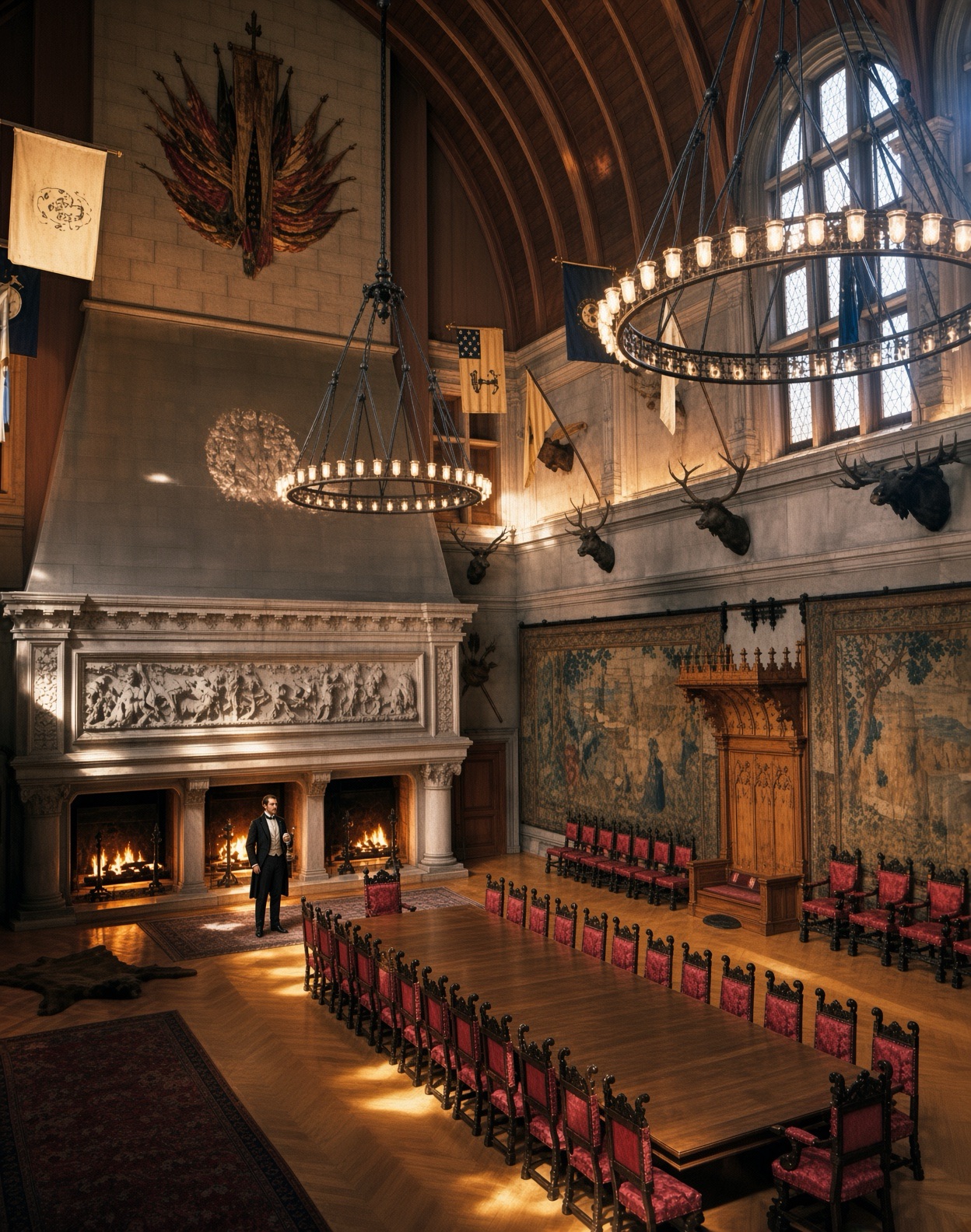
    Illustrated Gilded Age gentleman standing alone by a roaring fireplace in Biltmore's vast empty banquet hall

    George and Edith’s only child, Cornelia Vanderbilt, married John Francis Amherst Cecil in 1924, and the couple had two sons at Biltmore: George Henry Vanderbilt Cecil in 1925, and William Amherst Vanderbilt Cecil in 1928. In 1930, at the urging of the city of Asheville and hoping to generate desperately needed revenue during the Great Depression, the family opened Biltmore House to public tours for the first time.

    It didn’t work, at least not for a long time. By 1960, the house was losing roughly $250,000 a year, a shortfall the family covered by subsidizing it with income from the estate’s dairy farm. Three decades after opening to tourists, America’s largest private home was still, financially, a losing proposition, a banquet hall built for fifty, and often, quiet as the one pictured above.

    The Grandson Who Came Back

    William A.V. Cecil, George Vanderbilt’s grandson, had built his own career far from Asheville, graduating Harvard in 1952 and working in finance at Chase Manhattan Bank in New York. In 1960, he left that career and returned to try to save his family’s home.

    What he brought back with him was a banker’s instinct for marketing, not just nostalgia. In one notable campaign, he ran an eight-page advertisement in local newspapers and offered a free turn-of-the-century recipe from the Biltmore kitchens. It became popular enough that he started charging a quarter for it, with self-addressed envelopes flooding in. It was a small, almost quaint idea, and it was part of a broader, sustained effort to turn a crumbling mansion into something people would actually pay to experience.

    It took eight years. In 1968, Biltmore recorded its first-ever profit: $16.24. Not a typo, and not a large number, but a genuine turning point after decades in the red.

    From Barely Breaking Even to a Diversified Business

    In the late 1970s, William and his brother George H.V. Cecil divided their inheritance along interest lines. William kept the house, gardens, and forests, the historic heart of the estate. George took the dairy farm and surrounding land, at the time the more profitable half, and built it into Biltmore Farms, a real estate development company that continues to shape the Asheville area today.

    William kept building on his half. He added a vineyard and winery in 1985, expanded into restaurants, and eventually added hotel properties that now generate the bulk of the estate’s income. What began as a single, wildly expensive house had become a genuinely diversified hospitality business.

    Where It Stands Today

    Illustrated Biltmore House full of visitors with vineyard hills in the background, thriving and alive

    In 1995, on the estate’s 100th anniversary, William handed control to his son, Bill Cecil Jr., who remains president and CEO today, a fourth-generation descendant of George Vanderbilt running the family business his great-grandfather nearly lost. Biltmore now draws an estimated 1.4 million visitors a year, employs more than 2,400 people, and generates roughly $50 million in annual revenue, the majority of which is reinvested directly into maintaining the property. Buncombe County tax records place the estate’s market value at approximately $374 million. Fourth and fifth generation members of the Vanderbilt family remain involved in day-to-day operations to this day.

    What This Story Actually Shows

    It would be easy to tell this story as a cautionary tale about extravagance, and the first half of it certainly is one. But the second half is something more interesting: real redemption, built not through a lucky break but through one family member’s decades of unglamorous, disciplined work, marketing ingenuity, and patience, the same qualities that built the original Vanderbilt fortune three generations earlier. Proverbs 24:3-4 says by wisdom a house is built, and through understanding it is established, through knowledge its rooms are filled with rare and beautiful treasures. George Vanderbilt supplied the house. It took his grandson’s wisdom, decades later, to actually establish it.

    Frequently Asked Questions About the Biltmore Estate

    Do the Vanderbilts still own the Biltmore?

    Yes. Biltmore is still owned by George Vanderbilt’s descendants through The Biltmore Company, which is family owned and operated.

    Who runs the Biltmore Estate now?

    Bill Cecil Jr., George Vanderbilt’s great-grandson, is president and CEO of The Biltmore Company. He took over in 1995. His father, William A.V. Cecil, chaired the company’s board until his death in 2017 at age 89.

    Who originally owned the Biltmore Estate?

    George Washington Vanderbilt II, the grandson of Commodore Cornelius Vanderbilt. He built Biltmore House near Asheville, North Carolina, between 1889 and 1895.

    How did the Vanderbilts make their money?

    Through Cornelius “Commodore” Vanderbilt, who built his fortune in steamboats and then railroads. George inherited his share of it. Read the full story in Commodore Vanderbilt: From Ferry Boy to Railroad Titan.

    When did Biltmore open to the public?

    In March 1930. George’s daughter, Cornelia, and her husband, John Cecil, opened it at the request of the City of Asheville, which hoped tourism would help the area during the Great Depression.

    How big is the Biltmore Estate?

    The house has 250 rooms and about 179,000 square feet of floor space, including 35 bedrooms and 43 bathrooms. The estate covers about 8,000 acres today. See how the rest of the family fortune fared in How the Vanderbilt Fortune Actually Disappeared.

    📖 Want the full story? Get The Vanderbilts: Empire, Excess, Loss, and Redemption — the complete ebook.

    The Full Vanderbilt Series

    This content is for educational purposes only and is not personalized financial, legal, or tax advice. All facts in this article are drawn from publicly available sources cited below; no claims are made beyond what those sources document.

    References and Further Reading

  • 7 Incredible Stories of Dolly Parton’s Generosity

    7 Incredible Stories of Dolly Parton’s Generosity

    In the fall of 2016, wildfires tore through the Great Smoky Mountains, destroying more than 2,400 homes and businesses in and around Gatlinburg, Tennessee. Families who had lived there for generations stood in the ash of everything they owned. Within days, one woman had a plan: $1,000 a month, for six months, to every family who lost their main home — no paperwork maze, no means test, just help.

    That woman was Dolly Parton, and the fund she created became just one chapter in a lifetime of giving. Dolly Parton died on August 25, 2026, at age 80. In her memory, here are seven verified stories of her generosity — the kind rooted not in publicity but in a simple, oft-repeated philosophy: “I just see a need and if I can fill it, then I will.”

    1. The Imagination Library: Over 304 Million Free Kids Books

    Dolly’s father, Robert Lee Parton, never learned to read. In 1995, inspired by that fact, she started a simple program in her home county: every enrolled child, from birth to age five, would receive one free, age-appropriate hardcover book in the mail every single month — regardless of the family’s income. There’s no test, no application fee, and no cost ever passed to parents. The first book every child receives is The Little Engine That Could; the last, sent right before kindergarten, is Look Out, Kindergarten, Here I Come.

    The math behind it is part of what makes it remarkable: a child enrolled at birth receives 60 books by the time they start school — a personal home library built one mailbox delivery at a time, before they’ve ever set foot in a classroom. The program runs on a shared-funding model. The Dollywood Foundation covers overhead and negotiates bulk pricing on the books themselves, while local partners — libraries, nonprofits, churches, and state governments — fundraise to cover mailing costs in their own communities. That structure is what allowed a local Sevier County idea to scale into a program now mailing more than 3 million books every month across five countries: the United States, Canada, the United Kingdom, Australia, and the Republic of Ireland. By the end of 2025, the total stood at 304,539,509 books gifted since the program began.

    The impact isn’t just anecdotal. The largest shared book-reading study ever conducted — tracking more than 86,000 families across all five countries — found that children in the program were nine times more likely to show real interest in books and fifteen times more likely to actively join in during reading time, compared to children not enrolled. Caregivers in the program became six times more likely to count images with their child and seven times more likely to describe what’s happening in a picture together. Kindergarten-readiness studies in states like Colorado and Washington found enrolled children outperforming their peers on early literacy assessments before they ever reached a classroom. In practical terms: for every single child enrolled, the program isn’t just handing over a stack of books — it’s building a reading habit, a parent-child ritual, and a measurable head start, one month at a time, for five years straight.

    2. The Buddy Program: Paying Kids to Stay in School

    In 1988, Dolly founded the Dollywood Foundation with a specific, local problem in mind: too many students in Sevier County, Tennessee were dropping out of high school before graduation. Her solution was as personal as it was practical. Every 7th and 8th grader was paired with a “buddy” — a fellow student — and the two of them made a mutual promise to help each other stay in school all the way through to a diploma. If both students graduated, Dolly gave each of them $500.

    It wasn’t just a bribe to finish school — it was designed around relationship and mutual accountability, built into a community that Dolly knew from the inside. The results were dramatic: the dropout rate among Sevier County students fell from roughly 35 percent to just 6 percent. Just as importantly, the program’s early success catalyzed the wider community to keep investing in local education long after the initial Buddy Program cohorts graduated, turning a one-time incentive into a lasting shift in local expectations around finishing school.

    3. $75,000 a Year in College Scholarships

    Beyond the Buddy Program, the Dollywood Foundation awards five $15,000 Dolly Parton Scholarships every single year — $75,000 annually, without fail, to graduating seniors from Sevier County high schools. The scholarships aren’t handed out on GPA alone; students have to articulate an actual dream and a real plan for pursuing it, then defend that plan to be selected. It’s a small but telling detail: Dolly’s giving, even at the institutional level, tended to ask something of the recipient in return — not gratitude, but a real vision for what the money would be used to build.

    4. The My People Fund: Over $12 Million for Wildfire Survivors

    On November 28, 2016, wildfires swept through Sevier County — Dolly’s home county — destroying the homes of more than 1,000 families. Dolly asked the Dollywood Foundation to lead the relief effort, and in just two weeks, the Foundation designed and launched the My People Fund from scratch: $1,000 a month, for six months, to every family whose primary residence was completely destroyed. No committees, no drawn-out applications — cash in hand, fast, for people who had just lost everything.

    By the time the Foundation closed out distribution in May 2017, the My People Fund had delivered more than $12 million to displaced families. Dolly didn’t stop at short-term relief, either — she also established a Wildfire Scholarship Fund, offering $4,500 scholarships to high school juniors and seniors whose homes had burned, specifically so that a disaster that had already cost these families everything wouldn’t also cost them their future plans for college.

    5. $1 Million to Vanderbilt Children’s Hospital — A Personal Cause

    Dolly gave $1 million to Monroe Carell Jr. Children’s Hospital at Vanderbilt, one of the region’s leading pediatric care centers. Unlike some of her larger, more headline-grabbing gifts, this one had a direct, personal thread running through it: Dolly’s own niece had been treated at Vanderbilt for leukemia. Rather than treat that experience as a private family matter, Dolly turned it into an institutional gift — a reminder that some of her most significant giving came from places of direct, lived gratitude rather than distant charity.

    6. Turning a Benefit Concert Into a Hospital

    In 2007, Sevier County needed a full-service hospital closer to home, rather than families having to travel long distances for serious medical care. Dolly contributed $500,000 of her own money toward the project, then did something only someone with her level of fame could do: she headlined a benefit concert and raised another $500,000 on top of it — roughly $1 million combined. That funding helped open the LeConte Medical Center in 2010, which today also houses the Dolly Parton Center for Women’s Services. It’s one of the clearest examples in her giving history of treating her own celebrity as a fundraising instrument, not just her personal checkbook.

    7. $2 Million in Hurricane Helene Relief

    In late 2024, Hurricane Helene tore through East Tennessee and western North Carolina, flooding towns and displacing families across the region — including areas close to Dolly’s own home turf. She personally donated $1 million to the Mountain Ways Foundation, a fund established specifically to direct relief to the hardest-hit mountain communities. Her businesses, including Dollywood, matched that gift with another $1 million, bringing the total to $2 million — the same pattern she’d used with the wildfires eight years earlier: personal money, business money, and her platform, all pointed at the same need at the same time.

    And That’s Far From All of It

    Seven stories barely scratch the surface. Dolly also gave $1 million to Vanderbilt University Medical Center in 2020, funding early-stage COVID-19 research that helped support work related to the Moderna vaccine. She spent decades as a partner behind the Eagle Mountain Sanctuary at Dollywood, supporting bald eagle rehabilitation and conservation since 1990. And in 2021, when Tennessee lawmakers proposed a statue in her honor, she asked them not to build it — at least not yet.

    A Legacy Bigger Than the Dollar Amount

    Scripture says, “Each of you should give what you have decided in your heart to give, not reluctantly or under compulsion, for God loves a cheerful giver” (2 Corinthians 9:7, NIV). What stands out across all these stories isn’t just the size of the gifts — it’s that Dolly rarely gave once and walked away. She built systems: a scholarship fund, a foundation, a research fund, a book program that still runs today, in five countries, more than three million times a month. Give, build a system, scale it, and keep giving — a pattern that ran through sixty years of her life, echoing a much older American tradition of turning enormous personal wealth into lasting institutions, one Andrew Carnegie and John D. Rockefeller pioneered a century earlier in their own race to give it all away.

    Keep Her Work Going

    If any of these stories moved you, both organizations Dolly built are still active and accepting support:

    References

    • Dolly Parton’s Imagination Library, 2025 Year in Review; International Research summary, imaginationlibrary.com
    • Dollywood Foundation, official program pages (Buddy Program, Dolly Parton Scholarships, LeConte Medical Center)
    • Vanderbilt University Medical Center, “Dolly Parton Makes Generous Gift to Advance COVID-19 Research”
    • NBC News, “Dolly Parton Donates to Hurricane Helene Relief,” 2024
    • Mountain Ways Foundation, public disclosures
    • American Eagle Foundation, financial statements
    • Colorado Evaluation & Action Lab / Imagination Library of Washington, kindergarten readiness research, 2025

    Scripture quotations taken from The Holy Bible, New International Version® NIV® Copyright © 1973, 1978, 1984, 2011 by Biblica, Inc.® Used by permission. All rights reserved worldwide.


    Part of Our Dolly Parton Tribute Series

    See the full Dolly Parton Tribute Series.

  • Chuck Feeney: The Billionaire Who Secretly Gave Away $8 Billion

    Chuck Feeney: The Billionaire Who Secretly Gave Away $8 Billion

    When Chuck Feeney died in 2023 at age 92, Forbes reported his net worth at roughly $2 million. Decades earlier, he’d been worth well over a billion. The math isn’t a story of loss. It’s a story of a man who spent 40 years deliberately giving away more than $8 billion, almost entirely in secret, and considered the job successfully finished.

    An elderly man in simple clothing carrying a plastic bag walks through a busy airport terminal surrounded by travelers in suits with designer luggage

    Building the Fortune

    Born in 1931 to a modest, working-class family in New Jersey, Feeney co-founded Duty Free Shoppers with Robert Miller in 1960, opening duty-free retail locations for international travelers, first in Hong Kong and Honolulu. When Japan lifted travel restrictions on its citizens in 1966, Feeney, who had learned Japanese, built relationships with tour operators that turned the company into a global retail empire. By 1988, Forbes estimated his fortune at $1.3 billion, placing him among the 20 richest people in America.

    Forbes had no idea they’d made a significant error. By the time that estimate was published, Feeney had already quietly transferred the overwhelming majority of his wealth away.

    The Secret That Lasted 15 Years

    In 1982, Feeney established Atlantic Philanthropies. Two years later, he transferred his entire 38.75% stake in Duty Free Shoppers, along with the bulk of his other personal assets, into the foundation. His real net worth from that point on was a small fraction of what Forbes and the public believed.

    Almost nobody knew. Feeney required grant recipients to keep the source of their funding confidential, and he personally avoided publicity for over a decade. The arrangement only became public in 1997, when a legal dispute with his former business partner over the sale of Duty Free Shoppers to LVMH forced the details into the open. Feeney got ahead of it by contacting reporters directly rather than letting the story leak through the lawsuit. Forbes later nicknamed him “the James Bond of philanthropy.”

    “Giving While Living”

    An elderly man's hands signing a document at a plain wooden desk with a city skyline blurred in the window behind him

    Feeney’s core philosophy broke from how most major philanthropy has traditionally worked. Rather than leaving a fortune to a foundation that would distribute it gradually after his death, Feeney set out to give away essentially everything while he was still alive to see the results. “I did not want money to consume my life,” he said. “There’s just a limit to what you need.”

    Atlantic Philanthropies funded education, public health, human rights, and reconciliation efforts across the U.S., Ireland, Vietnam, South Africa, Australia, and Bermuda, more than $8 billion in total grants. Feeney set a hard deadline for the foundation to spend down completely and close its doors, which it did in 2020, four decades after it began and three years before his death.

    A Life That Didn’t Match the Fortune

    Feeney was known for wearing a $15 watch, carrying papers in a plastic bag instead of a briefcase, flying economy class, and living in a modest rented apartment in San Francisco in his final years. His frugality wasn’t a performance for a media narrative, it was consistent with how he lived decades before anyone knew what he’d given away.

    His example directly inspired two of the most famous names in modern philanthropy. Warren Buffett called Feeney “the model for us all,” and both Buffett and Bill Gates have credited him as a direct influence in creating The Giving Pledge in 2010, the commitment through which many of the world’s wealthiest individuals have pledged to give away the majority of their fortunes. Feeney’s radical generosity followed in a much older tradition, one that traces back to Andrew Carnegie and John D. Rockefeller’s own race to give it all away a century earlier.

    What This Story Actually Teaches

    Feeney’s story pushes against two common instincts at once: the instinct to give publicly, for recognition, and the instinct to give later, once there’s more, once retirement comes, once the estate is being settled. Proverbs 19:17 says, “Whoever is generous to the poor lends to the Lord, and he will repay him for his deed.” (NIV) Feeney’s version of that generosity wasn’t a single grand gesture. It was four decades of consistent, deliberate, often invisible decisions to give rather than accumulate, right up until the accumulation itself had nothing left to show for it, by design. It’s the same quiet consistency behind a Mississippi washerwoman’s gift of $150,000, built one load of laundry at a time.

    Chuck Feeney: Common Questions

    How much did Chuck Feeney give away?

    More than $8 billion, through his foundation, Atlantic Philanthropies, over about 40 years.

    What was Chuck Feeney’s net worth when he died?

    About $2 million, according to Forbes. He had once been worth well over a billion, and he gave nearly all of it away on purpose.

    What does “giving while living” mean?

    It means giving your wealth away during your lifetime so you can see the good it does, instead of leaving it all to be handed out after you die.

    Did Chuck Feeney inspire the Giving Pledge?

    Yes. Warren Buffett and Bill Gates both credited him as an influence when they started the Giving Pledge in 2010. His story also shows that wealth itself isn’t the problem, what matters is what we do with it. For more on that, see Is It a Sin to Be Rich? What the Bible Actually Says.

    This content is for educational purposes only and is not personalized financial or tax advice. Scripture quotations taken from The Holy Bible, New International Version® NIV® Copyright © 1973, 1978, 1984, 2011 by Biblica, Inc.® Used by permission. All rights reserved worldwide.

    References and Further Reading

  • Is the 10% Tithe a Biblical Command or a Guideline?

    Is the 10% Tithe a Biblical Command or a Guideline?

    Few questions in Christian finance generate as much genuine, good-faith disagreement as this one. Some Christians treat 10% as a fixed, non-negotiable floor. Others believe it was a Mosaic Law requirement that never carried forward as binding on the church. Many evangelical and Baptist traditions still teach the fixed tithe as a standard practice today, so this remains a live question, not a settled one. Here’s the strongest version of each case, what the original languages actually say, and why the percentage debate might matter less than the question underneath it.

    What the Original Words Actually Mean

    Illustration of an ancient scroll showing the Hebrew word ma'aser and Greek word dekate side by side, both meaning a tenth

    The Hebrew word behind every Old Testament tithe reference is ma’aser (מַעֲשֵׂר), and the Greek word behind the New Testament references is dekate (δεκάτη). Both words mean exactly the same thing: a tenth. The debate was never about what the word tithe means. It’s about whether the practice it describes still applies the same way today.

    The Case for Command

    The strongest argument for treating the tithe as a standing command starts before the Law of Moses even existed. Abraham gave a tenth of the spoils of battle to Melchizedek in Genesis 14, and Jacob independently vowed a tenth of everything God gave him in Genesis 28, both centuries before Sinai. If the tithe were purely a Mosaic Law requirement, the argument goes, it wouldn’t have shown up as a voluntary act of worship before that Law existed at all.

    Malachi 3:10 is the passage most often cited: “Bring the whole tithe into the storehouse, that there may be food in my house. Test me in this,” says the Lord Almighty, “and see if I will not throw open the floodgates of heaven and pour out so much blessing that there will not be room enough to store it.” (NIV) Pastor and author Tony Evans, drawing on the Genesis 14 precedent, teaches tithing as an act of worship that predates the Law entirely, a tangible way of recognizing God as the source of everything a person has.

    The Case for Guideline

    The strongest argument on the other side starts with what the New Testament doesn’t say. Nowhere does Jesus, Paul, or any New Testament writer explicitly command a 10% tithe for Christians. Pastor John MacArthur has made this case directly and repeatedly over decades of teaching: “New Testament believers are never commanded to tithe.” His reading of 2 Corinthians 8-9, the New Testament’s longest sustained passage on giving, finds no percentage requirement anywhere in it, only the instruction to give “not reluctantly or under compulsion” (2 Corinthians 9:7, NIV).

    Pastor Francis Chan holds the same position and has taken it further in practice than most, reportedly giving away roughly 90% of his own income without ever framing it as a required percentage. His point isn’t that giving matters less without a fixed floor. It’s that generosity shouldn’t need a legal minimum to be taken seriously, a conviction two centuries of thought have echoed. John Wesley’s own instruction to his followers never mentioned a percentage at all: “Earn all you can, save all you can, give all you can.” And Charles Spurgeon, pushed on the question directly by his own congregation, put it plainly: “There are no rules laid down in the Word of God” for exactly what a Christian owes.

    Why the Percentage Debate Is a Distraction

    Illustration contrasting a calculator showing a percentage sign with an open hand releasing coins into warm golden light

    Here’s what we’d actually encourage you to take from all of this: spend less energy on the technical questions, gross or net income, before or after taxes, exactly which percentage, and more on the question underneath all of them. Every voice above, regardless of which side of the debate they land on, agrees on one thing: the goal was never a specific number. It was a posture of trust and sacrifice.

    A precisely calculated 10% given without any real sacrifice attached to it can miss the point just as easily as skipping giving altogether. Someone giving 6% because that’s genuinely stretching them may be living out the actual heart behind these passages more fully than someone technically hitting the number without feeling it at all. The debate matters for understanding Scripture accurately. It shouldn’t become the thing that determines whether or how generously someone actually gives.

    Where This Leaves Us

    We won’t tell you which side of this is correct. Faithful, Bible-believing Christians across real traditions, some teaching the fixed tithe as a continuing standard, others teaching Spirit-led proportional giving, land in genuinely different places on this question, and both positions deserve to be taken seriously rather than dismissed.

    1 Chronicles 29:14 captures something both sides actually agree on regardless of the percentage debate. King David, reflecting on the offerings gathered for the temple, prayed, “Everything comes from you, and we have given you only what comes from your hand.” (NIV) Whether you land on a strict 10%, a growing percentage, or Paul’s “as you have prospered” principle, that’s the actual foundation underneath all of it. The real question was never the percentage. It’s what your giving actually costs you.

    This content is for educational purposes only and is not personalized financial or tax advice. Scripture quotations taken from The Holy Bible, New International Version® NIV® Copyright © 1973, 1978, 1984, 2011 by Biblica, Inc.® Used by permission. All rights reserved worldwide.

    References and Further Reading

  • Oseola McCarty: The Washerwoman Who Gave Her Life Savings to Students

    Oseola McCarty: The Washerwoman Who Gave Her Life Savings to Students

    In 1995, a university in Mississippi received a gift of $150,000 to fund scholarships for students who couldn’t otherwise afford to attend. That kind of gift usually comes from a corporation, a wealthy alumnus, or a family foundation. This one came from an 87-year-old woman who had spent her entire life washing other people’s clothes by hand.

    Painting-style portrait of an elderly Black woman doing laundry by hand at a washboard outside a modest wood-frame home

    A Life of Quiet, Steady Work

    Oseola McCarty was born in 1908 in rural Mississippi. She left school in the sixth grade to care for a sick aunt and never went back. For the next 75 years, she made her living as a washerwoman in Hattiesburg, scrubbing other families’ laundry by hand with a washboard, day after day, for a few dollars a load.

    She never married. She never owned a car, walking or riding with friends everywhere she needed to go, including nearly a mile pushing a shopping cart for cheaper groceries. She lived simply, in the same modest home for most of her adult life, and she saved. Not aggressively, not with any investment strategy beyond consistency, just steadily setting money aside from decades of physically demanding work that most people would consider barely enough to live on, let alone save from.

    A Faith Practiced Long Before the Headlines

    Her generosity in 1995 wasn’t a sudden decision. It was the visible tip of something she had practiced quietly for over 70 years. McCarty was a lifelong member of Friendship Baptist Church in Hattiesburg, riding with friends to services since she never owned a car. She read her Bible every morning and prayed on her knees every evening, a discipline reporters who visited her small home in the 1990s noted as simply part of her daily routine, not something performed for their benefit.

    She tithed from her laundry earnings for decades before anyone outside Hattiesburg knew her name. In her own words, recalling her decades of saving: every coin she earned went into the bank, except for what she dropped in the collection plate at Friendship Baptist. Nobody had instructed her to do it. It simply felt right to return part of what she’d been given. When asked by national reporters why she gave away almost everything instead of spending it on herself, her answer was the same verse Christians have leaned on for 2,000 years: it is more blessed to give than to receive.

    Even in the formality of settling her estate, her church came first. According to the bank trust officer who helped her allocate her savings using a literal handful of dimes to represent percentages, the first dime she placed, before any relative’s share, went on the card marked for Friendship Baptist Church.

    The Gift Nobody Saw Coming

    By 1995, arthritis had forced McCarty to retire. She had quietly accumulated $280,000. She set aside enough to live on, gave a portion to her church, and made small gifts to three relatives. Then she donated $150,000, the bulk of what remained, to the University of Southern Mississippi to establish a scholarship fund for Black students who needed financial help to attend.

    It’s worth sitting with the irony here: the University of Southern Mississippi hadn’t even admitted Black students until the 1960s. When asked why she chose that school specifically rather than a historically Black college, McCarty’s answer was characteristically plain: “Because it’s here. It’s close.” Years later, reflecting on the gift, she put it even more simply: “I don’t regret one penny I gave.”

    The Ripple Effect

    A university student moved to tears while reading a letter at her desk, dorm room with family photos and BSU laptop visible

    Her gift didn’t stay a single, isolated act. News of an elderly washerwoman giving away her life savings spread nationally, and it moved people. Local business leaders matched her gift almost immediately, and within four years, more than 600 additional donors had given, growing the fund to nearly $250,000. Harvard awarded her an honorary doctorate. President Bill Clinton presented her with the Presidential Citizens Medal. She died in 1999, four years after making the gift.

    The giving never stopped. By 2014, the endowment had topped $700,000. In March 2025, the USM Foundation announced it had officially reached a full $1 million corpus, funded by roughly 1,400 donors in total across 30 years, timed deliberately to mark what would have been McCarty’s 117th birthday. That $1 million now generates $2,000 scholarships for 20 students every single year, and 133 students total have been helped by the fund across its history. In 2018, USM built on her legacy further, creating the Oseola McCarty Scholars Program, a structured leadership and financial-wellness program for recipients, not simply a check, explicitly built around her work ethic and servant attitude. In 2026, her actual home in Hattiesburg opened to the public as a museum preserving her story for future generations.

    What Made This Different

    McCarty’s gift wasn’t remarkable because of its size. Plenty of wealthy donors have given more without anyone remembering their names a year later. What made it remarkable was the ratio: a woman who never earned more than a modest wage in her life gave away the overwhelming majority of everything she had, built dollar by dollar over 75 years of physical labor most people never see and rarely think about, faith practiced quietly the entire way through.

    Matthew 25:21 records Jesus commending a servant with the words, “Well done, good and faithful servant! You have been faithful with a few things; I will put you in charge of many things.” (NIV) The parable is about stewardship of what’s entrusted to us, not about the size of the starting amount. McCarty’s whole life reads like a real-world illustration of exactly that principle. She was faithful with a washboard, a collection plate, and a few dollars a load for most of a century, and what she built from that faithfulness ended up outlasting her by decades and reshaping the lives of students she never met.

    The Actual Lesson

    It would be easy to read this story and conclude the lesson is simply “save more.” That undersells it. The real lesson is that consistency, in saving and in giving alike, compounds in ways that feel invisible in the moment and undeniable in hindsight. Nobody watching Oseola McCarty do laundry in 1960, or 1975, or 1990, dropping a portion into the collection plate every week without being asked, would have guessed her savings would eventually outgrow itself into a seven-figure scholarship fund still changing lives 30 years later, and counting. Faithfulness in something small, sustained over a lifetime, produced something genuinely large. That’s not a coincidence. It’s usually how it actually works. It’s a pattern that shows up again and again in stories of radical generosity, from a duty-free retail billionaire who quietly gave away $8 billion to a country music icon whose generosity reshaped entire communities.

    Oseola McCarty: Common Questions

    How much did Oseola McCarty give?

    $150,000, most of her life savings, to fund scholarships at the University of Southern Mississippi.

    Why did she choose the University of Southern Mississippi?

    Her answer was simple: it was close to home in Hattiesburg.

    What church did Oseola McCarty attend?

    Friendship Baptist Church in Hattiesburg. She gave to her church from her laundry earnings for decades. If you’re wondering how giving like hers fits with what the Bible teaches, see Is the 10% Tithe a Biblical Command or a Guideline?

    How big is her scholarship fund today?

    It reached $1 million in 2025, funded by about 1,400 donors, and it helps 20 students every year. Like the widow Jesus praised for her two small coins, her gift was never about the size. It was about how much of herself she gave.

    This content is for educational purposes only and is not personalized financial or tax advice. Scripture quotations taken from The Holy Bible, New International Version® NIV® Copyright © 1973, 1978, 1984, 2011 by Biblica, Inc.® Used by permission. All rights reserved worldwide.

    References and Further Reading

  • 8 Practical Ways to Build an Emergency Fund (No Matter Your Income)

    8 Practical Ways to Build an Emergency Fund (No Matter Your Income)

    An emergency fund doesn’t need to start large to matter. It just needs to start. Here are eight practical, low-barrier ways to actually build one, whatever your income looks like right now.

    Illustration split between a dark storm dropping tools and a glowing piggy bank labeled emergency fund protected by a warm umbrella

    1. Start With a Tiny, Specific Number

    Don’t start with “3-6 months of expenses,” that number is genuinely intimidating and can stop people before they start. Start with something small and concrete, like $500 or even $100. A small, fully funded goal builds real momentum in a way a distant, massive one doesn’t.

    2. Automate a Small, Fixed Amount

    Even $10-20 a week moved automatically into a separate savings account adds up faster than it feels like it will, and automation removes the need to make the decision to save every single time.

    3. Keep It in a Separate, Slightly Inconvenient Account

    Emergency savings sitting in the same account as everyday spending money tends to get spent. A separate savings account, ideally at a different bank than your everyday checking, adds just enough friction to protect the fund from casual dipping without making it inaccessible in a real emergency.

    4. Save Windfalls Before You Get Used to Them

    A tax refund, a bonus, a rebate, money you weren’t counting on in your regular budget is much easier to save than money you’ve already mentally spent. Redirecting even half of an unexpected windfall into the emergency fund can jumpstart it significantly.

    5. Find One Recurring Expense to Pause Temporarily

    Not permanently, just while the fund is being built. A subscription, a streaming service, a recurring delivery, redirecting that specific amount for a few months can build real savings without touching anything essential.

    6. Sell Something You’re Not Using

    Most households have at least a few hundred dollars of unused items sitting around. Selling them isn’t a long-term savings strategy, but it’s a legitimate, fast way to seed the first chunk of an emergency fund from money that was otherwise doing nothing.

    7. Treat It Like a Bill, Not a Leftover

    Savings that only happen with whatever’s left at the end of the month often don’t happen at all. Budgeting the emergency fund contribution as a fixed line item, paid the same way rent or a utility bill gets paid, dramatically increases the odds it actually happens consistently.

    8. Increase It Gradually as Income Grows

    A raise, a new job, extra hours, these are natural moments to increase the automatic savings amount before the higher income gets absorbed into a higher lifestyle. Building the emergency fund alongside income growth, rather than after lifestyle catches up to it, is far easier than trying to carve out savings from an already-stretched budget later.

    Illustration of coins building step by step into a protective shield labeled step by step

    Why This Matters More Than the Math Suggests

    An emergency fund isn’t really about the dollar amount sitting in the account. It’s about what that account represents: the difference between a car repair being a stressful inconvenience and it being a full-blown financial crisis. Proverbs 21:20 puts it plainly: “The wise store up choice food and olive oil, but fools gulp theirs down.” (NIV) None of these eight steps require a high income to start. They just require starting.

    This content is for educational purposes only and is not personalized financial advice. Scripture quotations taken from The Holy Bible, New International Version® NIV® Copyright © 1973, 1978, 1984, 2011 by Biblica, Inc.® Used by permission. All rights reserved worldwide.

  • How the Vanderbilt Fortune Actually Disappeared

    How the Vanderbilt Fortune Actually Disappeared

    When William Henry Vanderbilt died in 1885, he left behind roughly $200 million, a fortune he’d nearly doubled from what his father built. He also left behind eight children who had grown up watching that fortune double, in a family that had just built its first mansion on Fifth Avenue. This is the third piece in our Vanderbilt series, and it’s the one where the story turns.

    A House for Every Heir

    Unlike his father’s concentrated inheritance strategy, William split his fortune more evenly among his children. What followed wasn’t reckless all at once, at first it looked like ambition. His son Cornelius Vanderbilt II took over much of the railroad business alongside his brother William Kissam Vanderbilt and, for a time, kept the empire genuinely thriving. But the family’s real energy in this generation went somewhere else: building. Along Fifth Avenue, Vanderbilt mansion after Vanderbilt mansion went up, a stretch of the street so dense with the family’s palaces it became known as “Vanderbilt Row.”

    The Party That Announced a New Standard

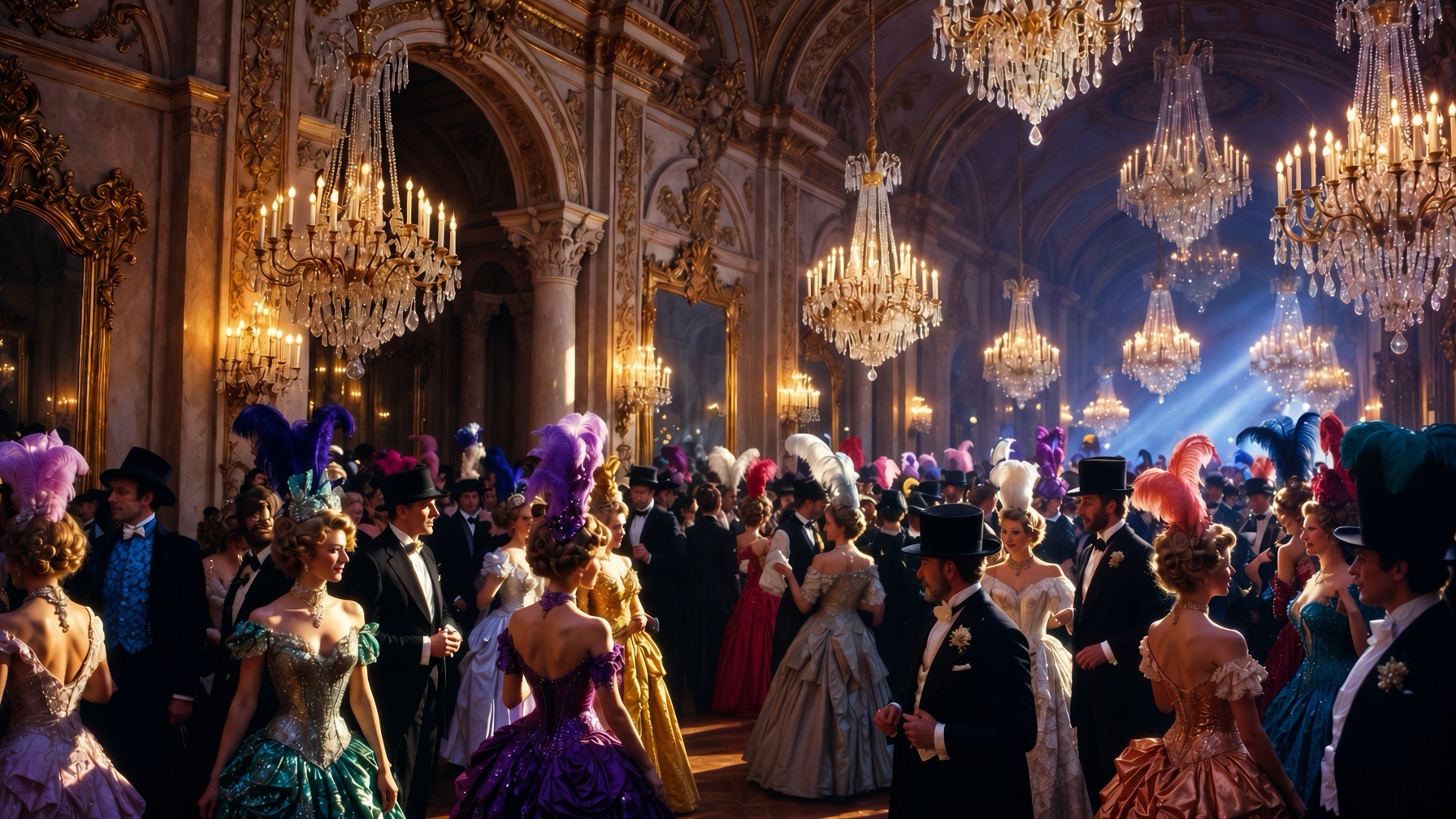
    Illustrated lavish Gilded Age costume ball with elaborately dressed guests and crystal chandeliers

    On March 26, 1883, Alva Vanderbilt, wife of William Kissam Vanderbilt, hosted a costume ball at their newly built Fifth Avenue mansion for 1,200 guests. The New York World called it an event never equalled in the social history of the city. Police held back crowds just to watch the carriages arrive. It was, by design, a public announcement that the Vanderbilts had arrived at the very top of American society, and it set a tone the next generation would spend enormous sums trying to match or exceed.

    Newport’s “Cottages”

    Illustrated grand Newport Gilded Age summer cottage mansion overlooking the Atlantic coastline at sunset

    The competition didn’t stay in Manhattan. In Newport, Rhode Island, the family built a series of summer homes so large they were called “cottages” only ironically. Cornelius Vanderbilt II built The Breakers. William Kissam and Alva Vanderbilt built Marble House, reportedly costing around $11 million, a staggering sum for a seasonal residence used only a few weeks a year. Each new house seemed to exist partly to outdo the last one.

    The youngest of William’s sons, George Washington Vanderbilt II, would eventually take this instinct further than anyone. In the mountains of North Carolina, he built the largest private home ever constructed in America, a story significant enough that it deserves, and gets, its own telling in the final piece of this series.

    The Money Stops Growing

    Houses don’t generate income, they consume it, in staff, upkeep, and property taxes, year after year. Meanwhile, the family kept growing. Each generation split the fortune into more pieces than the one before, spread across more heirs, most of whom had been raised to spend at a Vanderbilt standard without necessarily being raised to run a railroad. According to family historian Arthur T. Vanderbilt II’s account in Fortune’s Children, Cornelius II’s descendants in particular proved far better at spending than earning, and several died relatively young, cutting short whatever chance there was to rebuild.

    The End of the Railroad Empire

    Illustrated faded Gilded Age mansion interior with furniture under dust sheets and a single shaft of light

    The business that had generated the fortune in the first place didn’t survive it either. New York Central, once one of the largest railroads in the country, declared bankruptcy in 1970. By 1947, every Vanderbilt mansion on Fifth Avenue had been demolished, their contents auctioned off to help cover debts.

    The Reunion That Said It All

    In 1973, roughly 120 descendants of Cornelius Vanderbilt gathered at Vanderbilt University, the school the Commodore himself had endowed exactly a century earlier. According to Arthur T. Vanderbilt II’s research, not one person in that room was a millionaire. A fortune that had once been larger than the entire U.S. Treasury had, across four generations, simply run out.

    What Actually Happened Here

    It wasn’t one bad decision. It was a pattern: a fortune divided more ways with each generation, poured increasingly into assets that consumed money rather than generated it, spent by heirs raised to display wealth more than to build it. Proverbs 21:20 says the wise store up choice food and oil, but fools gulp theirs down. Three generations of Vanderbilts gulped. One house, though, built by the youngest of them and seemingly headed for exactly the same fate, would eventually take a very different path. That’s where we’re headed next.

    📖 Want the full story? Get The Vanderbilts: Empire, Excess, Loss, and Redemption — the complete ebook.

    The Full Vanderbilt Series

    Or see the full series hub page for the complete story, including practical lessons drawn from it.

    This content is for educational purposes only and is not personalized financial, legal, or tax advice. All facts in this article are drawn from publicly available sources cited below; no claims are made beyond what those sources document.

    References and Further Reading

  • 7 Reasons Churches Need to Preach More on Tithing

    7 Reasons Churches Need to Preach More on Tithing

    There’s a strange gap sitting in the data on American church giving. Most churchgoers still believe tithing matters. Very few actually practice it. That gap is worth taking seriously, and it points less to a generosity problem than a teaching one.

    Illustration of a pastor preaching to an attentive congregation in a warmly lit church

    The Belief-Practice Gap, in Numbers

    According to research compiled by Fellowship Development, 77% of American Protestant churchgoers affirm that tithing is a biblical command that still applies today, down slightly from 83% in 2017. And yet only about 27% of churchgoers actually tithe at or above the traditional 10% mark. Average giving across all churchgoers sits at roughly 2.5% of net income, according to Christianity Today, actually lower than the 3.3% Christians gave during the Great Depression, a season with far less financial margin than most churchgoers have today.

    Illustration of a crowd split by a widening crack, labeled believe it and practice it, showing the gap between belief and action

    That’s not a small gap. Most people in the pews believe the teaching. Most aren’t living it out. Here are seven reasons that gap is worth churches addressing directly, not avoiding.

    1. Belief Without Practice Isn’t Discipleship

    A congregation that intellectually agrees tithing matters but doesn’t practice it hasn’t actually been discipled on the subject, it’s been informed about it. Those are different outcomes, and only one of them is the actual goal.

    2. Money Is One of the Most-Discussed Topics in Scripture

    Jesus talked about money and possessions more than almost any other single topic, more than heaven, more than prayer. A church that teaches deeply on prayer and heaven but avoids money isn’t giving a full picture of what Jesus actually emphasized.

    3. Silence Gets Filled By Something Else

    When churches don’t teach clearly on money, culture fills the gap instead, consumerism, financial anxiety, or vague guilt untethered from any actual biblical framework. Clear teaching is the alternative to that vacuum, not an intrusion into it.

    4. Generosity Is Linked to Real Wellbeing

    Research on giving and happiness, including studies published in the journal Science, has found that people who give measurably report greater happiness than those who don’t, a finding that holds across income levels. Teaching people to give isn’t just a church funding strategy, it’s pointing them toward something that appears to genuinely benefit them.

    5. Many Churchgoers Genuinely Don’t Know Where to Start

    Gross or net income, tithing while carrying debt, whether giving has to go to a local church specifically, these are common, sincere questions, and silence from the pulpit leaves people guessing rather than confidently obeying something they already believe in.

    6. Avoiding the Topic Often Comes From Fear, Not Wisdom

    Many pastors avoid teaching on money specifically to not be seen as chasing donations, an understandable instinct given how the topic has been abused elsewhere. But avoiding a true, important subject to dodge a false accusation isn’t wisdom, it’s letting fear set the curriculum.

    7. The Ministry Impact Is Real

    One estimate from Health Research Funding suggests that if every American Christian tithed at 10%, churches and ministries would have an additional $139 billion available annually. Whatever a congregation believes about the specific percentage, undertaught generosity has a real, measurable cost to the ministries and people that consistent giving could otherwise support.

    What This Isn’t Saying

    This isn’t an argument for guilt-driven fundraising appeals or manipulative giving campaigns, and it isn’t taking a side on the specific tithing debates covered elsewhere on this site. It’s simply naming what the data already shows: a wide gap between what churchgoers believe about money and what they actually do with it, and that gap closes through clear, consistent, honest teaching, not through avoidance.

    This content is for educational purposes only and is not personalized financial or tax advice.

    References and Further Reading

  • What Is a Mutual Fund? A Beginner’s Guide

    What Is a Mutual Fund? A Beginner’s Guide

    This is the second piece in our Investing Fundamentals series. If an index fund is a basket of investments that just tracks the market, a mutual fund is that same basic idea with one key difference: a person is actively steering it.

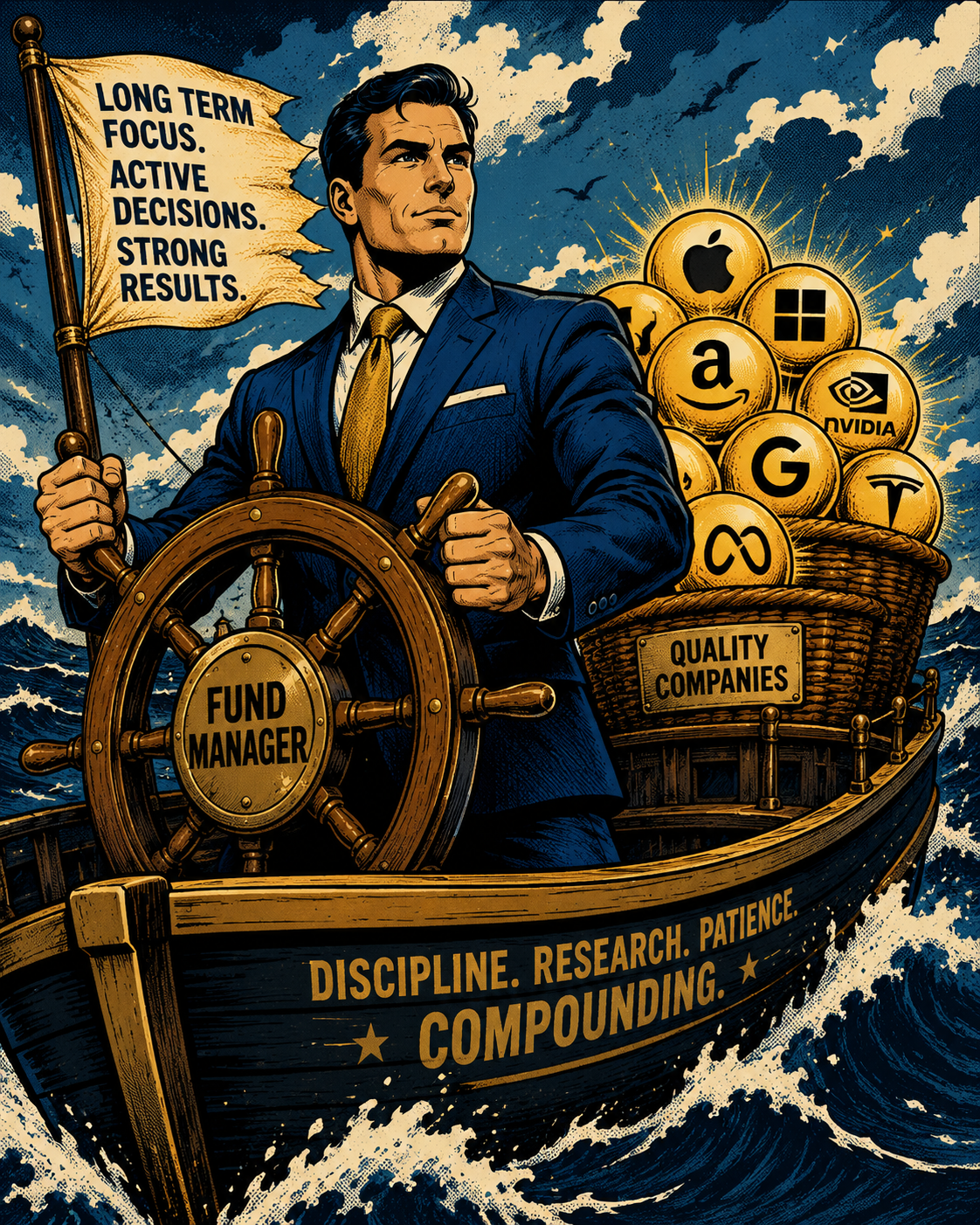
    Comic book style illustration of a fund manager steering a ship loaded with a basket of company stocks through rough seas

    What a Mutual Fund Actually Is

    A mutual fund pools money from many investors, just like an index fund does, and uses it to buy a collection of stocks, bonds, or other assets. The difference is who’s making the decisions. A mutual fund is run by a professional fund manager, or a team of them, who actively research companies, pick which ones to buy, and decide when to sell, all with the goal of beating the market rather than simply matching it.

    That active decision-making is the entire sales pitch behind a mutual fund: pay for expertise, and that expertise should, in theory, outperform a fund that’s just passively tracking an index.

    The Real Cost of That Expertise

    Illustration of a toll road showing fees being taken from a cart along the way, compared to a fee-free road arriving with more treasure

    Here’s where the comparison to index funds gets concrete. According to Investment Company Institute data, the asset-weighted average expense ratio for actively managed mutual funds sits around 0.59% a year. Index equity mutual funds, by contrast, average around 0.05%, more than ten times cheaper.

    On a $100,000 investment, that’s the difference between paying about $590 a year and paying about $50. Over decades, and compounded, that gap doesn’t stay small. A Motley Fool illustration puts real numbers to it: $100,000 invested for 20 years at 8% annual growth with a 2% expense ratio grows to roughly $320,000. That same $100,000 at a slightly lower 7% return but a 0.40% expense ratio grows to roughly $360,000, a higher ending balance despite the lower raw return, purely because of the fee difference.

    Does the Extra Cost Pay Off?

    This is the real question, and it’s a genuinely debated one in the investing world, not a settled fact. The honest answer is that the majority of actively managed funds underperform their benchmark index over long time periods, a pattern well-documented across decades of industry research, though certainly not every fund, and not every year. Some active managers do beat the market, sometimes for years at a stretch. The difficulty is knowing in advance which ones will, and paying the higher fee the entire time you’re trying to find out.

    Why Someone Might Still Choose One

    Mutual funds aren’t without a real case for themselves. A skilled manager can make judgment calls an index simply can’t, avoiding a struggling company before a downturn, or moving into a sector before it takes off. Some specialized markets, less efficiently priced than a broad index like the S&P 500, may genuinely reward active management more than others. And some investors are simply more comfortable with a professional making the calls rather than a fund that has no ability to react to changing conditions at all.

    The Practical Takeaway

    Mutual funds and index funds aren’t opposites so much as two different bets. An index fund bets that low costs and broad diversification will win out over time. A mutual fund bets that expert judgment is worth paying more for. Neither bet is inherently wrong, but the fee difference is real, it’s measurable, and it compounds right alongside your returns, which makes it one of the most important numbers to actually look at before choosing between the two.

    The Investing Fundamentals Series

    This content is for educational purposes only and is not personalized financial or investment advice. Consider talking with a licensed financial professional before making investment decisions.

    References and Further Reading